Original sin: definition
Original sin is the fault of our first parents, Adam and Eve, who disobeyed God, and the wounded state every human being receives at birth. It is not a personal fault that one commits, but a deprivation of original holiness, washed away by baptism.
The account in Genesis
The Book of Genesis tells how God created man and woman in his friendship, but they wanted to "be like gods," without him. They ate the forbidden fruit and lost this harmony: shame, fear, suffering and death entered human history.
The Catechism explains that this account uses figurative language, but that it affirms a real event that took place at the beginning of human history. What it teaches is that evil is not willed by God: it comes from a wrong use of freedom.
A state rather than a deed
Original sin is not a sin the newborn has committed. The Catechism calls it a sin "contracted" and not "committed," "a state and not an act." Every person is born deprived of the holiness God wanted to give, with a wounded nature: an intellect that errs, a weak will, an inclination to evil called concupiscence.
Saint Augustine, who reflected deeply on this question, gave this doctrine its Latin name. The Council of Trent defined it more precisely in the 16th century.
God's answer
From Genesis on, God promises that evil will be overcome. Saint Paul compares Christ to a new Adam: "For just as in Adam all die, so too in Christ shall all be brought to life." Baptism washes away original sin and gives grace; only the inclination to evil remains, as a battle to be fought.
Only one creature was preserved from it from the moment of her conception: the Virgin Mary. This is the meaning of the dogma of the Immaculate Conception, celebrated on December 8.
Saints to know
-
 August 28
Saint Augustine of Hippo
bishop of Hippo, Father and Doctor of the Church, author of the Confessions
He gave the Church the expression and the doctrine of original sin.
-
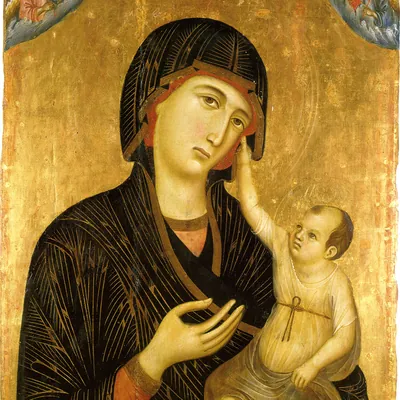 August 15
The Blessed Virgin Mary
mother of Jesus and Mother of God, honored by the Church as the first of the saints
The only creature preserved from original sin, according to the dogma of the Immaculate Conception.
Frequently asked questions
Is a baby guilty of original sin?
No: the baby did not commit it personally. He or she is simply born deprived of original holiness, which baptism comes to restore.
What remains after baptism?
Original sin is washed away, but concupiscence, that is, the inclination to evil, remains. It is not a sin in itself, but a ground of spiritual combat.
Was the forbidden fruit an apple?
The Bible speaks only of the fruit of the tree of the knowledge of good and evil. The image of the apple probably comes from the Latin malum, which means both evil and apple.