Saint Augustine, bishop of Hippo in North Africa, is one of the most influential thinkers in the history of the West. A brilliant teacher of rhetoric who long kept his distance from his mother's faith, he was converted in Milan at thirty-two, became a priest and then a bishop, and left an immense body of work, including the Confessions and The City of God. He died on August 28, 430, and is celebrated on that day, the day after his mother, Saint Monica. He is a Father and Doctor of the Church.
Who was Saint Augustine?
Aurelius Augustinus was born on November 13, 354, in Thagaste, today Souk Ahras in Algeria, in a Roman province of Africa. His father, Patricius, was a small pagan landowner who was baptized only at the end of his life; his mother, Monica, was a fervent Christian. A gifted child, he was sent to study at Madauros and then in Carthage.
In the Confessions, he tells the story of his youth, his ambitions and his disordered life himself, with a sincerity that gives the book its power.
The long road to faith
For years, Augustine looked for the truth outside the Church. Manichaeism at first seemed to offer an explanation of evil, then disappointed him. In Milan, he went out of curiosity to hear the sermons of Bishop Ambrose, whose eloquence attracted him before their content touched him. Reading the Platonist philosophers, and then the letters of Saint Paul, completed his preparation. One obstacle remained: he felt unable to change his life.
In the summer of 386, in the garden of the house where he was staying, he heard a child's voice repeating, "Take and read." He opened the letters of Saint Paul at random and came upon a passage of the Letter to the Romans (13:13-14) urging him to leave excess behind and to "put on the Lord Jesus Christ." Peace flooded his heart. He gave up his career and prepared for baptism, which he received from Ambrose at the Easter Vigil of 387.

Bishop of Hippo
Back in Africa, Augustine wanted to live in community, in prayer and study. But during a visit to Hippo in 391, the faithful chose him to be a priest. A few years later he became bishop of the city, a charge he held for thirty-five years. He preached several times a week, judged disputes, visited the poor, ransomed captives and shared a common life with his clergy, for whom he wrote a rule. In the Middle Ages, the Rule of Saint Augustine was adopted by many religious orders, including the Augustinians, the Canons Regular and the Dominicans.
Augustine was also at the heart of the debates of his time: against the Manichaeans, against the Donatist schism that divided Christian Africa, and against Pelagius, whose idea that human beings could save themselves by their own strength he opposed. His reflection on grace shaped all of Western theology.
The Confessions and The City of God
The Confessions, written soon after he became bishop, are not just an autobiography: they are a long prayer addressed to God, in which Augustine rereads his life as the story of a search. Their famous opening sums up his journey: "You have made us for yourself, and our heart is restless until it rests in you."
The City of God, written after the sack of Rome by the Visigoths in 410, answers the pagans who blamed Christians for the ruin of the Empire, and offers a vast meditation on the meaning of history.

Augustine's death and the fate of his relics
In the spring of 430, the Vandals laid siege to Hippo. Augustine, then seventy-five, fell ill. He had the penitential psalms posted on the wall of his room and died on August 28, 430. His remains were later taken to Sardinia, then bought back in the eighth century by the Lombard king Liutprand, who had them placed in Pavia, in the Basilica of San Pietro in Ciel d'Oro, where they still rest.
Why is Saint Augustine the patron saint of theologians?
No Latin Father has shaped Christian thought as deeply as Augustine: on grace, the Trinity, the Church, the sacraments and the meaning of history, theologians in the West have drawn on him for sixteen centuries, Saint Thomas Aquinas first among them. Printers and brewers also count him among their patrons. More broadly, he is invoked by students and by all who are searching for the truth, and he is often prayed to together with Saint Monica for loved ones who have drifted away from the faith.
Symbols and how to recognize Saint Augustine in art
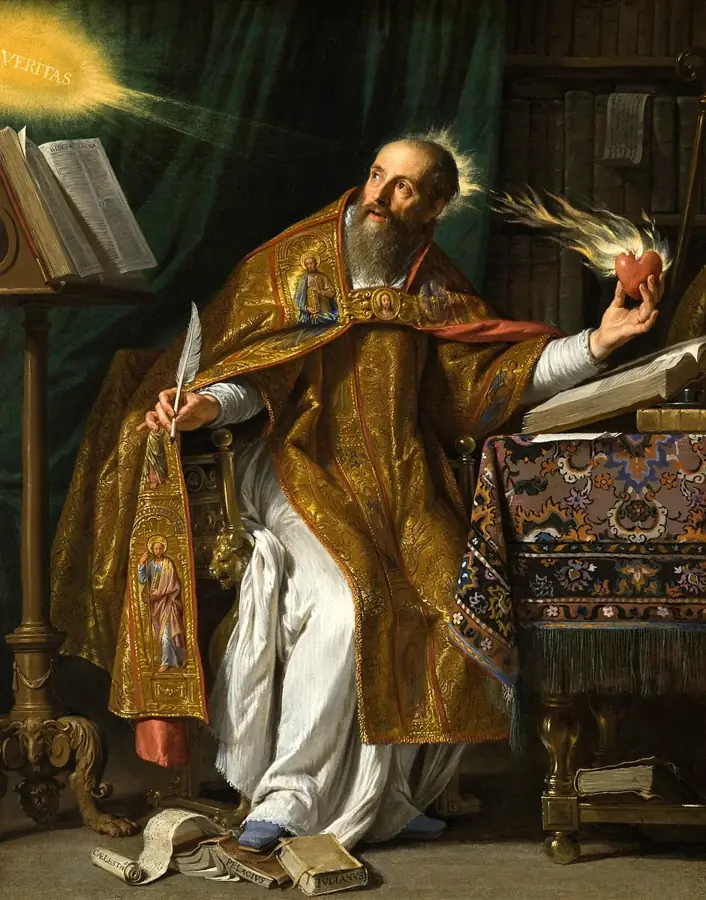
- A flaming heart, sometimes pierced by an arrow, for his burning love of God.
- A pen and a book, for his immense written work.
- The miter and crozier of a bishop, often with a black habit for the Augustinian tradition.
- A child by the sea with a shell, from a late legend about Augustine meditating on the mystery of the Trinity.
- Saint Monica at his side, especially in scenes at Ostia.
Where to pray to Saint Augustine
- Pavia, Italy: the Basilica of San Pietro in Ciel d'Oro, which holds his tomb.
- Annaba, Algeria: the Basilica of Saint Augustine, built at the end of the nineteenth century on the hill overlooking the ruins of Hippo.
- Milan: the Basilica of Sant'Ambrogio, which keeps the memory of his baptism.
- Rome: the Basilica of Sant'Agostino, where Saint Monica is buried.

To pray with him, use the prayer "Late have I loved you," taken from the Confessions, or follow the novena to Saint Augustine, from August 19 to 27.
Discover also
- Saint Monica, his mother, whose tears and prayers accompanied his conversion.
- Saint Ambrose of Milan, the bishop who baptized him.
- Saint Jerome, his contemporary and translator of the Bible, with whom he corresponded.
- Saint Thomas Aquinas, who constantly drew on his thought.
- Saint Paul, whose Letter to the Romans sparked his conversion.