Our Father (The Lord's Prayer)
The Our Father, also called the Lord's Prayer, is the prayer Jesus himself taught his disciples. All Christians, Catholic, Orthodox and Protestant, pray it, and it is often the first prayer a child learns.
It fits in a few lines, yet it holds everything: the praise of God, the longing for his kingdom to come, and then the needs of every day: bread, forgiveness and protection from evil.
The text of the prayer
Our Father, who art in heaven,
hallowed be thy name;
thy kingdom come,
thy will be done on earth as it is in heaven.
Give us this day our daily bread,
and forgive us our trespasses,
as we forgive those who trespass against us;
and lead us not into temptation,
but deliver us from evil.
Amen.
In Latin
Pater noster, qui es in caelis,
sanctificetur nomen tuum.
Adveniat regnum tuum.
Fiat voluntas tua, sicut in caelo et in terra.
Panem nostrum quotidianum da nobis hodie,
et dimitte nobis debita nostra,
sicut et nos dimittimus debitoribus nostris.
Et ne nos inducas in tentationem,
sed libera nos a malo.
Amen.
Origin and history
The text comes from the Gospels. Saint Matthew places it at the heart of the Sermon on the Mount (Matthew 6:9-13), and Saint Luke records it when a disciple asks Jesus, "Lord, teach us to pray" (Luke 11:1-4).
The words "lead us not into temptation" do not mean that God pushes anyone toward evil. They ask God not to let us give in to temptation. To make this clearer, the French translation was changed in 2017 to "do not let us enter into temptation," and the Italian one in 2019. The traditional English wording is unchanged.
When and how to say it
It is said at Mass before Communion, in every decade of the rosary, and in morning and evening prayer. You can also say it slowly, pausing on each petition: it is a simple way to meditate.
Saints related to this prayer
-
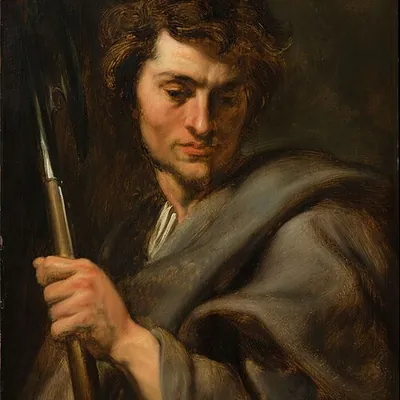 September 21
Saint Matthew, Apostle and Evangelist
tax collector from Capernaum called by Jesus, one of the twelve apostles, to whom tradition attributes the first Gospel
-
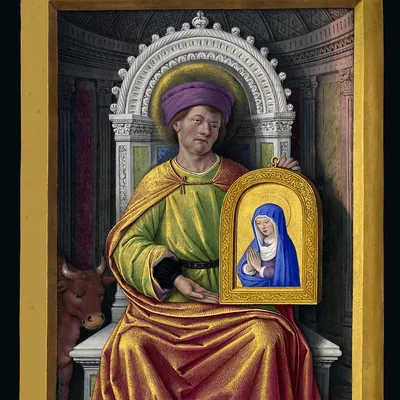 October 18
Saint Luke the Evangelist
physician and companion of Saint Paul, author of the third Gospel and of the Acts of the Apostles, patron saint of physicians and artists
-
 October 15
Saint Teresa of Avila
Spanish Carmelite nun, reformer of Carmel, mystic and first woman proclaimed a Doctor of the Church
Frequently asked questions
Why does the Our Father say "lead us not into temptation"?
The phrase does not mean that God tempts us. It asks him to keep us from falling into temptation and giving in to evil. Some languages, like French in 2017 and Italian in 2019, have reworded it to say this more clearly; the English text used at Mass has kept the traditional wording.
Why does the Our Father use "thy" and "art"?
The English text Catholics use comes from the old translations of the sixteenth century and keeps their traditional language. It is the version said at Mass and learned by heart by generations of English speakers.
Why do Protestants add a line at the end?
The line "For thine is the kingdom, and the power, and the glory" is an ancient doxology, a prayer of praise. Catholics say it too at Mass, but separately from the Our Father, after a short prayer by the priest.
Other classic prayers
- Hail Mary
- Glory Be
- Apostles' Creed
- The Angelus
- The Memorare
- Hail, Holy Queen (Salve Regina)
- Regina Caeli
- Act of Contrition
- Guardian Angel Prayer
- Come, Holy Spirit
- We Fly to Thy Patronage (Sub Tuum Praesidium)
- Magnificat
- Grace Before Meals
- How to Pray the Rosary
- Litany of the Blessed Virgin Mary (Litany of Loreto)
- Veni Creator Spiritus (Come, Creator Spirit)
- Anima Christi (Soul of Christ)
- Te Deum
- Prayer of Abandonment of Charles de Foucauld
- Peace Prayer (attributed to Saint Francis)
- Chaplet of Divine Mercy
- Act of Faith
- Act of Hope
- Act of Love (Act of Charity)
- Prayer to Saint Michael the Archangel
- Prayer to Saint Joseph by Pope Leo XIII
- Eternal Rest (Prayer for the Dead)
- O Mary, Conceived Without Sin (Miraculous Medal)
- Let Nothing Disturb You (Saint Teresa of Avila)
- Take, Lord, Receive (Suscipe of Saint Ignatius)
- Act of Spiritual Communion (Saint Alphonsus Liguori)
- O My Queen, O My Mother (Consecration to Mary)
- Tantum Ergo
- Prayer of Saint Nicholas of Flüe
- Morning Offering
- De Profundis (Psalm 130)
- Stations of the Cross (Way of the Cross)
- Stabat Mater
- Litany of the Saints