The Angelus
The Angelus is a prayer that recalls the Annunciation, the moment when the angel Gabriel tells Mary that she will be the mother of Jesus. It alternates short verses with three Hail Marys.
For centuries, church bells rang three times a day for the Angelus, and farmers stopped work to pray it, as in Millet's famous painting.
The text of the prayer
V. The Angel of the Lord declared unto Mary,
R. And she conceived of the Holy Spirit.
Hail Mary... (see the full prayer)
V. Behold the handmaid of the Lord,
R. Be it done unto me according to thy word.
Hail Mary... (see the full prayer)
V. And the Word was made flesh,
R. And dwelt among us.
Hail Mary... (see the full prayer)
V. Pray for us, O holy Mother of God,
R. That we may be made worthy of the promises of Christ.
Let us pray: Pour forth, we beseech thee, O Lord, thy grace into our hearts,
that we, to whom the Incarnation of Christ, thy Son, was made known by the message of an angel,
may by his Passion and Cross
be brought to the glory of his Resurrection.
Through the same Christ our Lord. Amen.
Origin and history
The custom began in the Middle Ages, when the Franciscans encouraged the faithful to greet Mary at the sound of the evening bell. The morning prayer, and then the noon prayer, were added in the fifteenth and sixteenth centuries.
The popes have kept the tradition: every Sunday at noon, the pope prays the Angelus from his window over Saint Peter's Square. During the Easter season, it is replaced by the Regina Caeli.
When and how to say it
Traditionally at 6 am, noon and 6 pm (7 am and 7 pm in some places, such as France). If you cannot pray it at those times, saying it once a day, at noon for example, keeps the spirit of the prayer: to stop and remember that God became man.
Saints related to this prayer
-
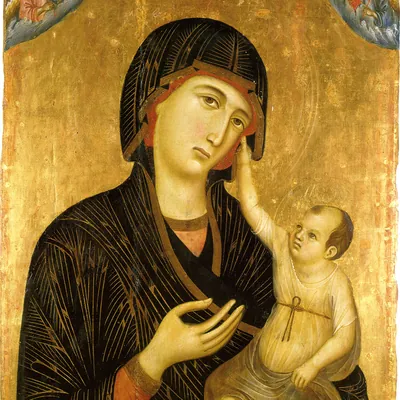 August 15
The Blessed Virgin Mary
mother of Jesus and Mother of God, honored by the Church as the first of the saints
-
 October 4
Saint Francis of Assisi
founder of the Friars Minor, poet of the Canticle of the Creatures, patron saint of Italy and of ecology
-
 October 22
Saint John Paul II
Karol Wojtyła, pope from 1978 to 2005, the first Polish pope in history
Frequently asked questions
What time is the Angelus prayed?
Traditionally at 6 am, noon and 6 pm, at the sound of the bells; in some countries, such as France, at 7 am and 7 pm. Many people pray it only at noon.
What is prayed during the Easter season?
From Easter to Pentecost, the Angelus is replaced by the Regina Caeli, a joyful prayer for the Resurrection.
What do V. and R. mean?
V. is the verse, said by the person leading the prayer, and R. is the response, said by everyone. When praying alone, you say both.
Other classic prayers
- Our Father (The Lord's Prayer)
- Hail Mary
- Glory Be
- Apostles' Creed
- The Memorare
- Hail, Holy Queen (Salve Regina)
- Regina Caeli
- Act of Contrition
- Guardian Angel Prayer
- Come, Holy Spirit
- We Fly to Thy Patronage (Sub Tuum Praesidium)
- Magnificat
- Grace Before Meals
- How to Pray the Rosary
- Litany of the Blessed Virgin Mary (Litany of Loreto)
- Veni Creator Spiritus (Come, Creator Spirit)
- Anima Christi (Soul of Christ)
- Te Deum
- Prayer of Abandonment of Charles de Foucauld
- Peace Prayer (attributed to Saint Francis)
- Chaplet of Divine Mercy
- Act of Faith
- Act of Hope
- Act of Love (Act of Charity)
- Prayer to Saint Michael the Archangel
- Prayer to Saint Joseph by Pope Leo XIII
- Eternal Rest (Prayer for the Dead)
- O Mary, Conceived Without Sin (Miraculous Medal)
- Let Nothing Disturb You (Saint Teresa of Avila)
- Take, Lord, Receive (Suscipe of Saint Ignatius)
- Act of Spiritual Communion (Saint Alphonsus Liguori)
- O My Queen, O My Mother (Consecration to Mary)
- Tantum Ergo
- Prayer of Saint Nicholas of Flüe
- Morning Offering
- De Profundis (Psalm 130)
- Stations of the Cross (Way of the Cross)
- Stabat Mater
- Litany of the Saints