Hail Mary
The Hail Mary is the great prayer addressed to the Virgin Mary. It is said fifty times in a rosary, and millions of Catholics pray it every day.
It has two parts. The first repeats, word for word, lines from the Gospel: those of the angel Gabriel and then of Elizabeth. The second is a request: that Mary pray for us now and at the hour of our death.
The text of the prayer
Hail Mary, full of grace,
the Lord is with thee.
Blessed art thou among women,
and blessed is the fruit of thy womb, Jesus.
Holy Mary, Mother of God,
pray for us sinners,
now and at the hour of our death.
Amen.
In Latin
Ave Maria, gratia plena,
Dominus tecum.
Benedicta tu in mulieribus,
et benedictus fructus ventris tui, Iesus.
Sancta Maria, Mater Dei,
ora pro nobis peccatoribus,
nunc et in hora mortis nostrae.
Amen.
Origin and history
"Hail, full of grace, the Lord is with thee" are the words of the angel Gabriel at the Annunciation (Luke 1:28). "Blessed art thou among women, and blessed is the fruit of thy womb" are those of Elizabeth at the Visitation (Luke 1:42).
Christians joined these two greetings from the early centuries. The name of Jesus was added in the Middle Ages, and the second part, "Holy Mary, Mother of God," took its final form in the sixteenth century. Pope Saint Pius V included it in the breviary in 1568.
When and how to say it
It is said on its own, in moments of worry, or in the rosary, where it comes ten times in each decade. Saying it slowly while thinking of a scene from the life of Jesus is the heart of praying the rosary.
Saints related to this prayer
-
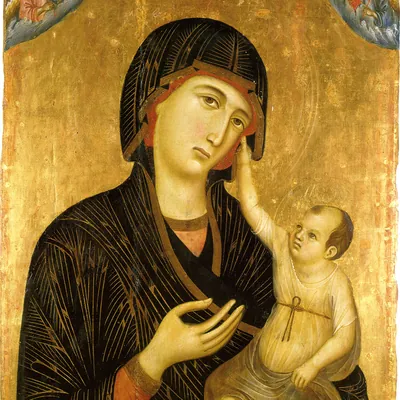 August 15
The Blessed Virgin Mary
mother of Jesus and Mother of God, honored by the Church as the first of the saints
-
 September 23
Saint Elizabeth, Mother of John the Baptist
wife of the priest Zechariah, relative of the Virgin Mary and mother of Saint John the Baptist
-
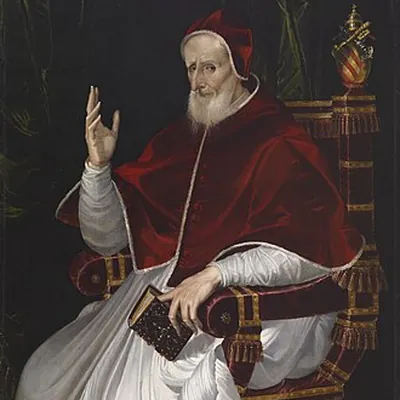 April 30
Saint Pius V
Dominican pope from 1566 to 1572, who put the Council of Trent into practice
-
 April 16
Saint Bernadette Soubirous
visionary of the Lourdes apparitions in 1858, later a Sister of Charity of Nevers
Frequently asked questions
Where does the Hail Mary come from?
Its first part comes from the Gospel of Luke: the greeting of the angel Gabriel and that of Elizabeth. The second part, a request for Mary's intercession, was added over the centuries and fixed in 1568.
Why does the Hail Mary say "thee" and "thou"?
The traditional English text keeps the old forms of address, as the Our Father does. Some modern versions say "the Lord is with you" and "blessed are you," and both forms are correct.
How many Hail Marys are in a rosary?
Fifty-three in all: three at the beginning, then five decades of ten.
Other classic prayers
- Our Father (The Lord's Prayer)
- Glory Be
- Apostles' Creed
- The Angelus
- The Memorare
- Hail, Holy Queen (Salve Regina)
- Regina Caeli
- Act of Contrition
- Guardian Angel Prayer
- Come, Holy Spirit
- We Fly to Thy Patronage (Sub Tuum Praesidium)
- Magnificat
- Grace Before Meals
- How to Pray the Rosary
- Litany of the Blessed Virgin Mary (Litany of Loreto)
- Veni Creator Spiritus (Come, Creator Spirit)
- Anima Christi (Soul of Christ)
- Te Deum
- Prayer of Abandonment of Charles de Foucauld
- Peace Prayer (attributed to Saint Francis)
- Chaplet of Divine Mercy
- Act of Faith
- Act of Hope
- Act of Love (Act of Charity)
- Prayer to Saint Michael the Archangel
- Prayer to Saint Joseph by Pope Leo XIII
- Eternal Rest (Prayer for the Dead)
- O Mary, Conceived Without Sin (Miraculous Medal)
- Let Nothing Disturb You (Saint Teresa of Avila)
- Take, Lord, Receive (Suscipe of Saint Ignatius)
- Act of Spiritual Communion (Saint Alphonsus Liguori)
- O My Queen, O My Mother (Consecration to Mary)
- Tantum Ergo
- Prayer of Saint Nicholas of Flüe
- Morning Offering
- De Profundis (Psalm 130)
- Stations of the Cross (Way of the Cross)
- Stabat Mater
- Litany of the Saints