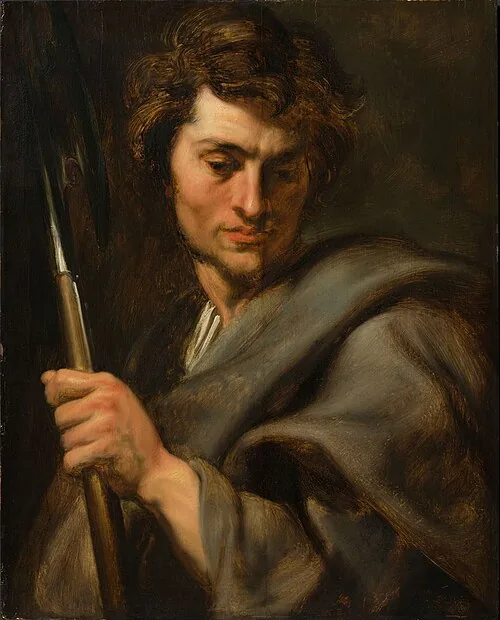
Saint Matthew is one of the twelve apostles of Jesus. A tax collector in Capernaum, despised as a collaborator and a public sinner, he left everything the day Jesus said to him, "Follow me." Since the second century, Christian tradition has attributed to him the first of the four Gospels, the one that gives us the Sermon on the Mount and the Beatitudes. His relics are venerated in Salerno, Italy. His feast day is September 21 in the Latin Church and November 16 in the Eastern Churches.
Who was Saint Matthew?
The Gospels tell us little about Matthew, but they tell us what matters. The Gospel of Matthew calls him Matthew; the Gospels of Mark and Luke tell the same scene and name the tax collector Levi, son of Alphaeus. Most commentators see one and the same person with two names, like Simon Peter.
He worked in Capernaum, on the shore of the Sea of Galilee, along a busy trade route, collecting taxes on behalf of the government of Herod Antipas. Tax collectors, often suspected of growing rich at the expense of ordinary people, were counted among public sinners. This is the man Jesus chose to be one of the Twelve.
"Follow me": the call of a sinner
The Gospel account is remarkably brief: "As Jesus passed by, he saw a man named Matthew sitting at the tax booth, and he said to him, 'Follow me.' And the man got up and followed him" (Matthew 9:9). No speech, no conditions. Right afterward, Matthew hosted a meal at his house, where many tax collectors and sinners gathered. The Pharisees were scandalized. Jesus answered with a sentence that sums up his mission: "It is not the healthy who need a doctor, but the sick." Quoting the prophet Hosea, he added: "I desire mercy, not sacrifice."
In the list of the Twelve, the Gospel of Matthew is the only one to say "Matthew the tax collector" (Matthew 10:3), as if the apostle did not want anyone to forget where he came from. In 1599-1600, Caravaggio gave this scene a striking image: in a dark room, a ray of light follows the outstretched hand of Christ toward a man counting his money.

The Gospel according to Matthew
In the second century, Papias, bishop of Hierapolis, reported that Matthew had put the sayings of the Lord into writing in the Hebrew language; his testimony is quoted by the historian Eusebius of Caesarea. Saint Irenaeus of Lyon also attributes a Gospel to Matthew. The Gospel that has come down to us is written in Greek and draws heavily on the Gospel of Mark. Most scholars therefore think it was written around the years 80-90, in a Christian community of Jewish origin that looked to the apostle as its authority. The Church receives it as the Word of God under the name of Matthew.
A Gospel of fulfillment
This Gospel is especially concerned to show that Jesus fulfills the Scriptures of Israel. It opens with the genealogy of Jesus and the announcement of Emmanuel, "God with us," and closes with the promise of the risen Lord: "I am with you always, to the end of the age." In it we find the Sermon on the Mount, with the Beatitudes and the Our Father, the great parables of the Kingdom, and the scene of the Last Judgment in which Christ identifies himself with "the least of these my brothers."

Missions and martyrdom: what tradition says
After Pentecost, the New Testament says nothing more about Matthew. According to ancient traditions, he first preached the Gospel to the Jews of Palestine and then traveled to distant lands. The sources disagree about where: Ethiopia, a name that in antiquity referred to faraway regions to the south, or Persia. The best-known account, retold in the Middle Ages in the Golden Legend, says that he was killed while celebrating at the altar, on the orders of a king whose plans for marriage he had opposed. These stories belong more to legend than to history.
In 954, relics attributed to the apostle were brought to Salerno, in the Campania region of southern Italy. The Norman prince Robert Guiscard built a great cathedral there, consecrated in 1084 by Pope Gregory VII, who died in exile in Salerno the following year.
Why is Saint Matthew the patron saint of accountants and bankers?
Because Matthew spent his working life handling money and keeping accounts at his tax booth, he is the patron saint of tax collectors, accountants and bankers. He is also the patron of the city of Salerno, which has kept his relics for more than a thousand years.
Above all, Matthew bears witness to a simple truth: no one is too far away to be called. Jesus did not ask him to become better before following him; he looked at him with mercy and chose him. Matthew answered at once, and his joy turned into a feast open to everyone. Catholics pray to him for those who work with money, for those who feel unworthy of God, and for the grace to answer the Lord's call. Pope Francis took his motto, miserando atque eligendo ("by having mercy and by choosing"), from a homily of Saint Bede on Matthew's calling.
Symbols and how to recognize Saint Matthew in art
- A winged man or an angel: his symbol among the four evangelists, because his Gospel begins with the human genealogy of Jesus.
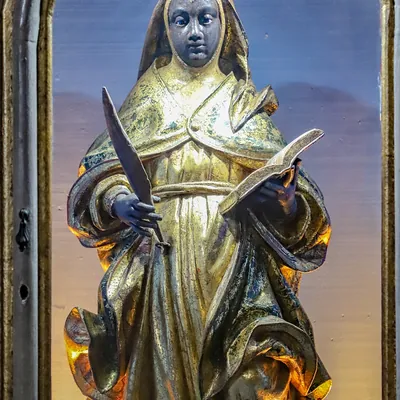
- A book or a quill: he is shown writing his Gospel, sometimes guided by an angel.
- A money bag, coins or a ledger: reminders of his former work as a tax collector.
- A sword or a halberd: in some traditions, the instrument of his martyrdom.
Where to pray to Saint Matthew
- Salerno, Italy: the Cathedral of Saint Matthew, where his relics are venerated in the crypt. The city also celebrates the arrival of his relics on May 6.
- Rome: the Church of San Luigi dei Francesi and its Contarelli Chapel, with Caravaggio's three paintings of the apostle.
- Capernaum, Galilee: the site of the town where he was called, on the shore of the Sea of Galilee.
To pray with him, you can pray the prayer to Saint Matthew based on the Gospel account of his calling, or follow the novena to Saint Matthew from September 12 to 20, ending on the eve of his feast.
Discover also
- Saint Mark, the evangelist whose account served as a basis for Matthew's.
- Saint Luke, the evangelist who also tells of the calling of Levi.
- Saint John, apostle and evangelist.
- Saint James the Less, another apostle whose father is called Alphaeus.
- Saint Gregory VII, the pope who consecrated Salerno Cathedral and is buried there.