Glory Be
The Glory Be is a very short prayer of praise addressed to the Trinity: the Father, the Son and the Holy Spirit. It is also called the minor doxology.
It asks for nothing: it gives glory to God. That is why it so often closes other prayers, such as each decade of the rosary or each psalm in the Liturgy of the Hours.
The text of the prayer
Glory be to the Father, and to the Son, and to the Holy Spirit,
as it was in the beginning,
is now, and ever shall be,
world without end.
Amen.
In Latin
Gloria Patri, et Filio, et Spiritui Sancto.
Sicut erat in principio, et nunc et semper,
et in saecula saeculorum.
Amen.
Origin and history
The formula goes back to the first centuries. It became widespread in the fourth century, at the time of the great debates about the Trinity, to affirm that the Son and the Spirit are God, equal with the Father.
Saint Benedict, in the Rule he wrote around 530, asks that every psalm sung by the monks end with the Glory Be. The custom spread to the whole Church.
When and how to say it
After each decade of the rosary, at the end of the psalms, or on its own, as a short word of praise in the middle of the day. Many believers bow their heads slightly as they say it.
Saints related to this prayer
-
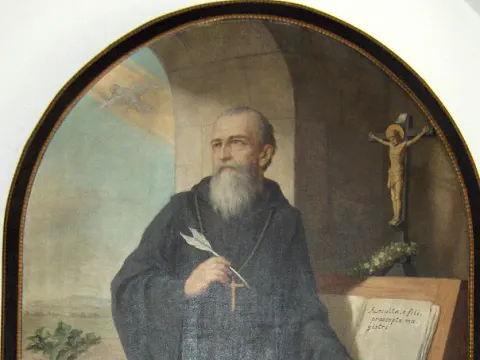 July 11
Saint Benedict of Nursia
father of Western monasticism, author of the Benedictine Rule and patron saint of Europe
-
 August 28
Saint Augustine of Hippo
bishop of Hippo, Father and Doctor of the Church, author of the Confessions
Frequently asked questions
What is the difference between the Glory Be and the Gloria?
The Glory Be is a short prayer of praise in two sentences. The Gloria, "Glory to God in the highest," is a long hymn sung at the beginning of Sunday Mass.
Why is the Glory Be said in the rosary?
Each decade ends with praise of the Trinity: after meditating on a mystery of the life of Christ, we give glory to God.
Other classic prayers
- Our Father (The Lord's Prayer)
- Hail Mary
- Apostles' Creed
- The Angelus
- The Memorare
- Hail, Holy Queen (Salve Regina)
- Regina Caeli
- Act of Contrition
- Guardian Angel Prayer
- Come, Holy Spirit
- We Fly to Thy Patronage (Sub Tuum Praesidium)
- Magnificat
- Grace Before Meals
- How to Pray the Rosary
- Litany of the Blessed Virgin Mary (Litany of Loreto)
- Veni Creator Spiritus (Come, Creator Spirit)
- Anima Christi (Soul of Christ)
- Te Deum
- Prayer of Abandonment of Charles de Foucauld
- Peace Prayer (attributed to Saint Francis)
- Chaplet of Divine Mercy
- Act of Faith
- Act of Hope
- Act of Love (Act of Charity)
- Prayer to Saint Michael the Archangel
- Prayer to Saint Joseph by Pope Leo XIII
- Eternal Rest (Prayer for the Dead)
- O Mary, Conceived Without Sin (Miraculous Medal)
- Let Nothing Disturb You (Saint Teresa of Avila)
- Take, Lord, Receive (Suscipe of Saint Ignatius)
- Act of Spiritual Communion (Saint Alphonsus Liguori)
- O My Queen, O My Mother (Consecration to Mary)
- Tantum Ergo
- Prayer of Saint Nicholas of Flüe
- Morning Offering
- De Profundis (Psalm 130)
- Stations of the Cross (Way of the Cross)
- Stabat Mater
- Litany of the Saints