Saint Luke is the author of the third Gospel and of the Acts of the Apostles, nearly a quarter of the New Testament. A physician of Greek culture, he did not know Jesus during his earthly life, but he accompanied Saint Paul on several of his journeys and carefully gathered the accounts of the first witnesses. We owe him the stories of Christ's childhood, the great parables of mercy and the encounter on the road to Emmaus. His feast day is October 18, and he is the patron saint of physicians and artists.
Who was Saint Luke?
The New Testament names Luke three times, always in the letters of Paul. In the Letter to the Colossians, the apostle sends greetings from "Luke, the beloved physician" (Colossians 4:14); in the Letter to Philemon, he counts him among his "co-workers" (Philemon 24); and in the Second Letter to Timothy, written in a time of trial, he confides: "Luke is the only one with me" (2 Timothy 4:11). These few words sketch a portrait: an educated, faithful man who stayed with Paul when others had left him.
An ancient tradition, reported in particular by Eusebius of Caesarea in the 4th century, makes him a Syrian from Antioch. Commentators deduce from the way Paul distinguishes him from "those of the circumcision" in the Letter to the Colossians that he was probably of pagan, that is Gentile, origin. His elegant Greek, the most polished of the Gospels, confirms that he had received a solid education.

The evangelist of mercy
Luke opens his Gospel with a short preface, something unique among the Gospels: he explains to a certain Theophilus that he has "investigated everything accurately anew" in order to write an orderly account (Luke 1:1-4). He presents himself as a careful historian who has collected the testimony of eyewitnesses. He takes up much of the Gospel of Mark, but adds many passages found only in his work.
These are often the pages Christians love most: the Annunciation, the Visitation, the birth of Jesus in Bethlehem and the visit of the shepherds, the Presentation in the Temple, the finding of Jesus among the teachers. Only Luke reports the parables of the Good Samaritan, the Prodigal Son and the lost coin, the meeting with Zacchaeus, the forgiveness granted to the good thief, and the appearance of the risen Lord to the disciples on the road to Emmaus. Dante called him "the scribe of the gentleness of Christ." Luke also shows constant attention to the poor, the sick, foreigners and the women who followed Jesus.
His Gospel is, finally, the Gospel of prayer: Jesus prays before every great moment of his life. Luke passed on to us the three canticles the Church sings every day in the Liturgy of the Hours: the Benedictus of Zechariah, the Magnificat of Mary and the Nunc dimittis of the old man Simeon.
The Acts of the Apostles
Luke's second book, also dedicated to Theophilus, tells the birth of the Church: the Ascension, Pentecost, the life of the first community in Jerusalem, the martyrdom of Stephen, the conversion of Paul and the spread of the Gospel as far as Rome. Several passages are written in the first person plural. Tradition sees in them the direct testimony of Luke, present at Paul's side during these journeys, especially during the shipwreck off Malta, told with a sailor's precision.
Why is Saint Luke the patron saint of physicians and artists?
Paul calls him "the beloved physician," and his Gospel shows a doctor's eye: it describes illnesses and healings with care, and tells the parable of the Good Samaritan with the words of a caregiver, oil, wine and bandages. This is why physicians, surgeons and all who care for the sick take him as their patron, and why many hospitals in the English-speaking world bear his name.
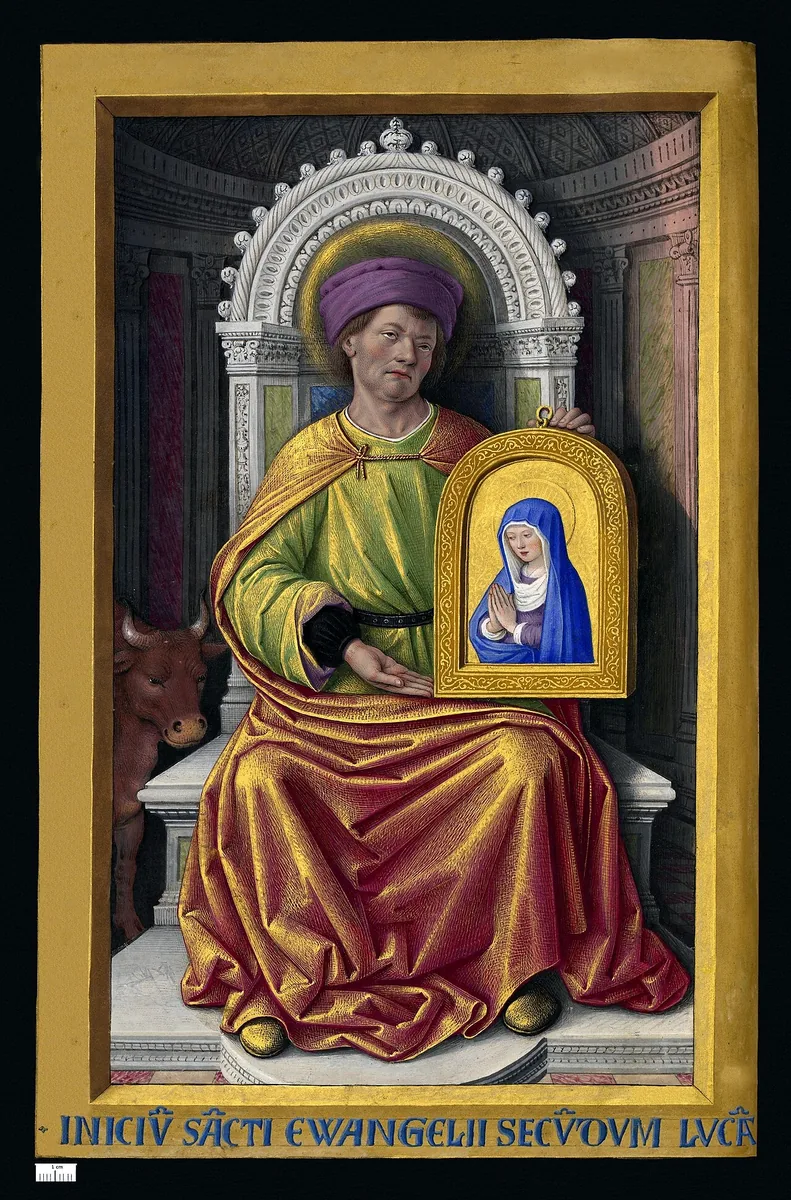
From around the 6th century, an Eastern tradition claimed that Luke had painted a portrait of the Virgin Mary. Several venerable icons were attributed to him, such as the Salus Populi Romani in the Basilica of Saint Mary Major in Rome. Art historians date these works to much later periods, but the legend says something true: it is to Luke that we owe the stories that have nourished Christian art around Mary. For this reason he became the patron of painters, and the artists' guilds of the late Middle Ages bore his name.
Saint Luke was not an eyewitness, and perhaps that is what makes him so close to us: like us, he received the faith from others, and he took the time to search, to listen and to pass it on faithfully. His holiness is that of the loyal companion, of the physician attentive to bodies and souls, and of the writer who puts his talent at the service of the Gospel.
To pray with him, you can take up the Magnificat, the canticle of Mary handed down by Saint Luke, or follow the novena to Saint Luke from October 9 to 17, finishing on the eve of his feast.
Symbols and how to recognize Saint Luke in art
- An ox or bull, often winged: this symbol, drawn from the visions of Ezekiel and the Book of Revelation, is linked to his Gospel, which begins in the Temple of Jerusalem, the place of sacrifice, with the priest Zechariah.
- A book or a pen: he is shown writing his Gospel, like the other evangelists.
- A painter's easel or an icon of the Virgin: in many paintings he is shown drawing or painting Mary and the Child.

Where to pray to Saint Luke
- Padua (Italy): the Basilica of Santa Giustina, which keeps the tomb attributed to the evangelist.
- Thebes (Greece): the ancient tomb where tradition placed his burial; a relic was brought there from Padua in 2000.
- Rome: the Basilica of Saint Mary Major, where the icon Salus Populi Romani, attributed by tradition to Saint Luke, is venerated.
- Bologna: the Sanctuary of the Madonna of San Luca, on the Colle della Guardia, which houses an icon of the Virgin also linked to this tradition.
Discover also
- Saint Paul, the apostle whose traveling companion and faithful co-worker Luke was.
- Saint Mark, the evangelist whose account Luke took up and enriched.
- Saint Matthew, apostle and evangelist, whose Gospel shares with Luke's the stories of Jesus' childhood.
- The Virgin Mary, whose Magnificat and memories of Jesus' childhood Luke handed down.
- Saint Barnabas, Paul's companion in Antioch, whose mission is told in Acts.