Stabat Mater
The Stabat Mater contemplates the Virgin Mary standing at the foot of the cross where her Son is dying. Its name comes from its first Latin words: Stabat Mater dolorosa, "The sorrowful Mother stood."
It is one of the most beautiful prayers of the Middle Ages. It is sung during the Stations of the Cross, in Lent, and on September 15, the feast of Our Lady of Sorrows.
The text of the prayer
The sorrowful Mother stood
weeping beside the cross
where her Son was hanging.
Her grieving soul,
crushed and suffering,
was pierced by a sword.
How sad and afflicted
was that blessed Mother
of the only Son!
She mourned and grieved,
the loving Mother, as she saw
the torments of her glorious Son.
Who would not weep
on seeing the Mother of Christ
in such agony?
Who would not be saddened
to behold the Mother of Christ
suffering with her Son?
For the sins of his people
she saw Jesus in torment
and subjected to the scourge.
She saw her sweet Child
dying, forsaken,
as he gave up his spirit.
O Mother, fountain of love,
make me feel the power of your sorrow,
that I may grieve with you.
Make my heart burn
with love for Christ my God,
that I may please him.
Holy Mother, do this for me:
fix the wounds of the Crucified
deep within my heart.
Of your wounded Son,
who deigned to suffer so much for me,
share the pains with me.
Let me weep with you in love,
and suffer with the Crucified
as long as I live.
To stand with you beside the cross
and join you
in your weeping is my desire.
Virgin, most glorious of virgins,
do not be harsh with me,
let me mourn with you.
Let me bear the death of Christ,
share in his Passion
and keep his wounds in mind.
Let me be wounded by his wounds,
let the cross and the blood of your Son
fill me with love.
Lest I burn in the flames,
may I be defended by you, O Virgin,
on the day of judgment.
O Christ, when I must leave this world,
grant that through your Mother
I may come to the palm of victory.
When my body dies,
grant that my soul be given
the glory of paradise.
Amen.
In Latin
Stabat Mater dolorosa
iuxta crucem lacrimosa,
dum pendebat Filius.
Cuius animam gementem,
contristatam et dolentem
pertransivit gladius.
O quam tristis et afflicta
fuit illa benedicta
Mater Unigeniti!
Quae maerebat et dolebat,
pia Mater, dum videbat
Nati poenas incliti.
Quis est homo qui non fleret,
Matrem Christi si videret
in tanto supplicio?
Quis non posset contristari,
Christi Matrem contemplari
dolentem cum Filio?
Pro peccatis suae gentis
vidit Iesum in tormentis
et flagellis subditum.
Vidit suum dulcem Natum
moriendo desolatum,
dum emisit spiritum.
Eia, Mater, fons amoris,
me sentire vim doloris
fac, ut tecum lugeam.
Fac ut ardeat cor meum
in amando Christum Deum,
ut sibi complaceam.
Sancta Mater, istud agas,
crucifixi fige plagas
cordi meo valide.
Tui Nati vulnerati,
tam dignati pro me pati,
poenas mecum divide.
Fac me tecum pie flere,
crucifixo condolere,
donec ego vixero.
Iuxta crucem tecum stare,
et me tibi sociare
in planctu desidero.
Virgo virginum praeclara,
mihi iam non sis amara,
fac me tecum plangere.
Fac ut portem Christi mortem,
passionis fac consortem,
et plagas recolere.
Fac me plagis vulnerari,
fac me cruce inebriari,
et cruore Filii.
Flammis ne urar succensus,
per te, Virgo, sim defensus
in die iudicii.
Christe, cum sit hinc exire,
da per Matrem me venire
ad palmam victoriae.
Quando corpus morietur,
fac ut animae donetur
paradisi gloria.
Amen.
Origin and history
The poem dates from the 13th century. It is often attributed to the Franciscan Jacopone da Todi, an Italian poet, though without certainty; others have suggested Pope Innocent III or Saint Bonaventure.
It entered the liturgy as the sequence of the Mass of Our Lady of Sorrows in 1727. Pergolesi, Vivaldi, Haydn, Rossini, Dvořák and Poulenc set it to music. The translation given here follows the Latin verse by verse.
When and how to say it
During the Stations of the Cross, one verse between each station, on Good Friday, in Lent and on September 15. You can also read it slowly beside someone who is suffering.
Saints related to this prayer
-
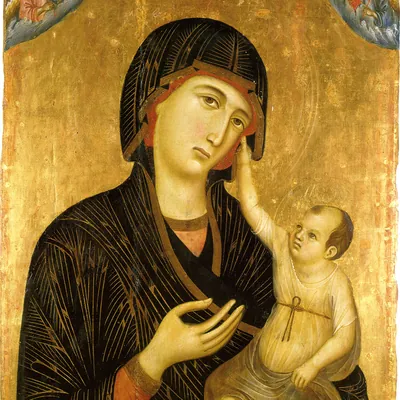 August 15
The Blessed Virgin Mary
mother of Jesus and Mother of God, honored by the Church as the first of the saints
-
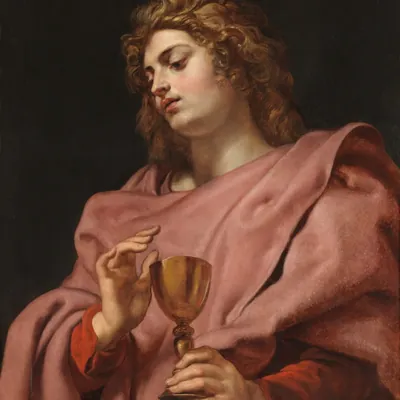 December 27
Saint John, Apostle and Evangelist
apostle of Jesus, son of Zebedee, evangelist, recognized by tradition as the beloved disciple
-
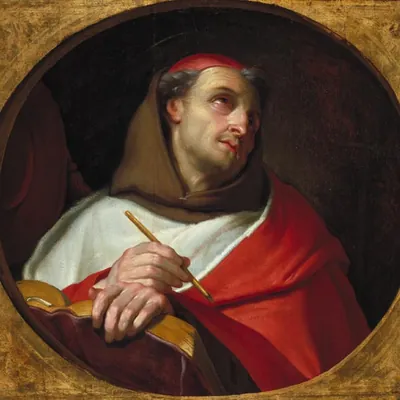 July 15
Saint Bonaventure
Franciscan theologian, minister general of his order and Doctor of the Church, known as the Seraphic Doctor
Frequently asked questions
Who wrote the Stabat Mater?
The author is not known for certain. It is most often attributed to the Franciscan Jacopone da Todi, in the 13th century.
When is the Stabat Mater sung?
During the Stations of the Cross, on Good Friday, and on September 15, the feast of Our Lady of Sorrows, when it is the sequence of the Mass.
What are the best-known musical settings?
Pergolesi's (1736) is the most famous. Vivaldi, Haydn, Rossini, Dvořák and Poulenc also composed settings.
Other classic prayers
- Our Father (The Lord's Prayer)
- Hail Mary
- Glory Be
- Apostles' Creed
- The Angelus
- The Memorare
- Hail, Holy Queen (Salve Regina)
- Regina Caeli
- Act of Contrition
- Guardian Angel Prayer
- Come, Holy Spirit
- We Fly to Thy Patronage (Sub Tuum Praesidium)
- Magnificat
- Grace Before Meals
- How to Pray the Rosary
- Litany of the Blessed Virgin Mary (Litany of Loreto)
- Veni Creator Spiritus (Come, Creator Spirit)
- Anima Christi (Soul of Christ)
- Te Deum
- Prayer of Abandonment of Charles de Foucauld
- Peace Prayer (attributed to Saint Francis)
- Chaplet of Divine Mercy
- Act of Faith
- Act of Hope
- Act of Love (Act of Charity)
- Prayer to Saint Michael the Archangel
- Prayer to Saint Joseph by Pope Leo XIII
- Eternal Rest (Prayer for the Dead)
- O Mary, Conceived Without Sin (Miraculous Medal)
- Let Nothing Disturb You (Saint Teresa of Avila)
- Take, Lord, Receive (Suscipe of Saint Ignatius)
- Act of Spiritual Communion (Saint Alphonsus Liguori)
- O My Queen, O My Mother (Consecration to Mary)
- Tantum Ergo
- Prayer of Saint Nicholas of Flüe
- Morning Offering
- De Profundis (Psalm 130)
- Stations of the Cross (Way of the Cross)
- Litany of the Saints