Magnificat
The Magnificat is Mary's song of joy when she visits her cousin Elizabeth. It begins "My soul proclaims the greatness of the Lord," in Latin Magnificat anima mea Dominum.
It is a song of thanksgiving and a song of justice: God lifts up the lowly, fills the hungry and sends the rich away empty.
The text of the prayer
My soul proclaims the greatness of the Lord,
my spirit rejoices in God my Savior,
for he has looked with favor on his lowly servant.
From this day all generations will call me blessed:
the Almighty has done great things for me,
and holy is his Name.
He has mercy on those who fear him
in every generation.
He has shown the strength of his arm,
he has scattered the proud in their conceit.
He has cast down the mighty from their thrones,
and has lifted up the lowly.
He has filled the hungry with good things,
and the rich he has sent away empty.
He has come to the help of his servant Israel,
for he has remembered his promise of mercy,
the promise he made to our fathers,
to Abraham and his children for ever.
Origin and history
The text is found in the Gospel of Saint Luke (Luke 1:46-55). It echoes the song of Hannah in the Old Testament, the mother of the prophet Samuel, and many of the psalms.
Since the early centuries, the Church has sung it every evening at Vespers. It ends with the Glory Be.
When and how to say it
In the evening, at Vespers, and in moments of gratitude: after a birth, a healing or good news. Singing it is a way of saying thank you.
Saints related to this prayer
-
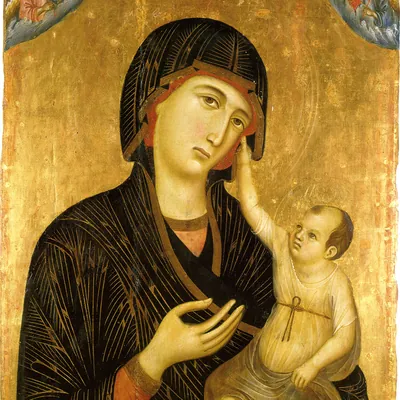 August 15
The Blessed Virgin Mary
mother of Jesus and Mother of God, honored by the Church as the first of the saints
-
 September 23
Saint Elizabeth, Mother of John the Baptist
wife of the priest Zechariah, relative of the Virgin Mary and mother of Saint John the Baptist
-
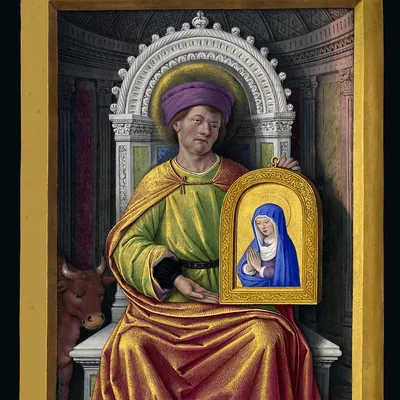 October 18
Saint Luke the Evangelist
physician and companion of Saint Paul, author of the third Gospel and of the Acts of the Apostles, patron saint of physicians and artists
Frequently asked questions
Where is the Magnificat in the Bible?
In the Gospel according to Saint Luke, chapter 1, verses 46 to 55, at the Visitation.
When is the Magnificat sung?
Every evening, at Vespers (Evening Prayer). It is one of the high points of the Church's evening prayer.
Other classic prayers
- Our Father (The Lord's Prayer)
- Hail Mary
- Glory Be
- Apostles' Creed
- The Angelus
- The Memorare
- Hail, Holy Queen (Salve Regina)
- Regina Caeli
- Act of Contrition
- Guardian Angel Prayer
- Come, Holy Spirit
- We Fly to Thy Patronage (Sub Tuum Praesidium)
- Grace Before Meals
- How to Pray the Rosary
- Litany of the Blessed Virgin Mary (Litany of Loreto)
- Veni Creator Spiritus (Come, Creator Spirit)
- Anima Christi (Soul of Christ)
- Te Deum
- Prayer of Abandonment of Charles de Foucauld
- Peace Prayer (attributed to Saint Francis)
- Chaplet of Divine Mercy
- Act of Faith
- Act of Hope
- Act of Love (Act of Charity)
- Prayer to Saint Michael the Archangel
- Prayer to Saint Joseph by Pope Leo XIII
- Eternal Rest (Prayer for the Dead)
- O Mary, Conceived Without Sin (Miraculous Medal)
- Let Nothing Disturb You (Saint Teresa of Avila)
- Take, Lord, Receive (Suscipe of Saint Ignatius)
- Act of Spiritual Communion (Saint Alphonsus Liguori)
- O My Queen, O My Mother (Consecration to Mary)
- Tantum Ergo
- Prayer of Saint Nicholas of Flüe
- Morning Offering
- De Profundis (Psalm 130)
- Stations of the Cross (Way of the Cross)
- Stabat Mater
- Litany of the Saints