Saint Joseph is the husband of the Virgin Mary and the foster father of Jesus, the man who raised him in Nazareth and taught him his trade. The Gospels record not a single word spoken by him, yet they show a just man, attentive to God even in his dreams, who protected his family at the cost of exile. Patron of the universal Church since 1870, he is honored on March 19 and, as Saint Joseph the Worker, on May 1. He is one of the most widely invoked saints in the world, especially by fathers, workers and those who ask for a happy death.
Who was Saint Joseph?
Everything we know for certain about Joseph comes from the first two chapters of the Gospels of Matthew and Luke,. A devout Jew descended from King David, he lived in Nazareth, in Galilee, and worked with his hands. He was betrothed to a young woman of the village, Mary. The Gospels give neither his birth date, his age nor the date of his death.
Apocryphal writings such as the Protoevangelium of James, from the 2nd century, imagined Joseph as a very old widower chosen by a miraculous sign. These texts shaped Christian art, which often shows him as an old man, but the Church does not regard them as historical.
Joseph in the Gospels
Matthew calls Joseph "a righteous man" (Matthew 1:19). Learning that Mary is expecting a child who is not his, he decides to divorce her quietly, to spare her public shame. An angel then appears to him in a dream and tells him to take Mary into his home, because the child is from the Holy Spirit. When he wakes, he obeys. It is Joseph who gives the child the name Jesus, meaning "God saves," and by naming him he places him in the line of David.
Three more dreams mark Matthew's account: the command to flee into Egypt to escape the massacre ordered by Herod, the announcement that the family may return, and the instruction to settle in Galilee, at Nazareth. Each time, Joseph rises and goes. Luke, for his part, shows him in Bethlehem at the birth, in the Temple at the presentation of Jesus, and in Jerusalem when the twelve-year-old boy stays behind among the teachers of the Law. Mary then says to Jesus: "Your father and I have been searching for you in great anxiety."

The carpenter of Nazareth
The people of Nazareth call Jesus "the carpenter's son" (Matthew 13:55). The Greek word tekton refers to a craftsman who worked with wood and probably with stone as well. Joseph earned a modest living for his family and passed his skills on to Jesus, whom Mark himself calls "the carpenter" (Mark 6:3). For some thirty years, the Son of God grew up in an ordinary home, shaped by work and Jewish prayer.
This is why the Church sees Joseph as the model and patron of workers. In 1955, Pope Pius XII wanted to give Labor Day a Christian meaning and instituted the feast of Saint Joseph the Worker on May 1. Joseph reminds us that the humblest work has dignity and that holiness is lived out in everyday faithfulness.
A devotion that grew over the centuries
The early centuries say little about Joseph. Devotion to him developed in the Middle Ages, promoted by writers such as Jean Gerson and by the Franciscans, including Saint Bernardine of Siena. In the 16th century, Saint Teresa of Avila credited him with her healing and wrote in her Life (chapter 6) that she could not remember ever asking him for anything without receiving it. She dedicated many Carmelite convents to him and spread his devotion across Europe.
In the 19th century, at a time of heavy trials for the Church, Blessed Pius IX proclaimed him patron of the universal Church: the one who had protected the Holy Family was asked to protect the Church. In 1889, Leo XIII devoted an encyclical to him and asked that the prayer "To you, O blessed Joseph" be said in October. More recently, Saint John XXIII, Saint John Paul II and Pope Francis wrote major texts about him, and his name was added to the Eucharistic Prayers in 2013. The month of March is traditionally dedicated to him, as is Wednesday of each week.
In the English-speaking world, his feast is celebrated with particular warmth by Italian-American communities, who prepare Saint Joseph's Day tables, or altars, laden with bread and food to share with the poor.

Why is Saint Joseph the patron saint of a happy death and of families?
According to tradition, Joseph died in Nazareth before the public ministry of Jesus. He no longer appears at Cana or at the Passion, where Jesus entrusts his mother to Saint John. Christians picture him dying in the arms of Jesus and Mary, which made him the patron of a happy death, invoked for the dying. Because he protected and provided for the Holy Family, he is also the patron of fathers, husbands, carpenters and craftsmen, and of several countries, including Canada.
What his holiness teaches
His holiness lies in his actions: welcoming, protecting, working, getting up in the night to set out. He shows that one can be a father without possessing, and that obeying God often means accepting what we do not understand right away. In Patris corde, Pope Francis describes him as a beloved, tender, obedient, accepting and courageous father, who remains in the shadows.
To pray with him, read the prayer to Saint Joseph by Leo XIII, or follow the novena to Saint Joseph, from March 10 to 18 so that it ends on the eve of his feast, or from April 22 to 30 before May 1.
Symbols and how to recognize Saint Joseph in art
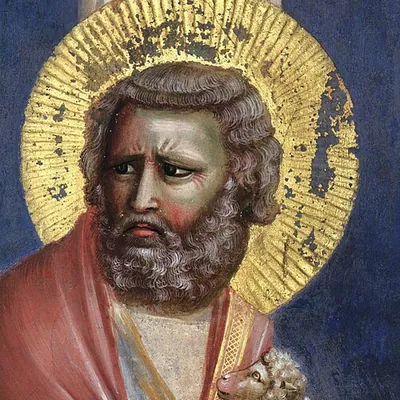
Saint Joseph is usually shown holding the Child Jesus in his arms. His most common attribute is a flowering staff, often topped with lilies, a sign of purity drawn from the apocryphal story of his betrothal. Carpenter's tools, such as a saw, a plane or a square, recall his trade.

Where to pray to Saint Joseph
- Montreal (Canada): Saint Joseph's Oratory of Mount Royal, founded by Saint André Bessette, one of the largest shrines in the world dedicated to Saint Joseph.
- Nazareth (Israel): the Church of Saint Joseph, next to the Basilica of the Annunciation, built over remains that tradition links to the home of the Holy Family.
- Cotignac (Provence, France): the shrine of Saint Joseph at Bessillon, site of an apparition reported in 1660, with its spring.
- Espaly-Saint-Marcel (France): the shrine of Saint Joseph de Bon-Espoir, near Le Puy-en-Velay, crowned by a large statue of the saint.
- Avila (Spain): the Monastery of Saint Joseph, the first Carmel founded by Saint Teresa in 1562.
Discover also
- The Virgin Mary, his wife and the mother of Jesus.
- Saint John the Baptist, relative of Jesus and the last of the prophets.
- Saint Teresa of Avila, great apostle of devotion to Saint Joseph.
- Saint John XXIII, who added his name to the Canon of the Mass.
- Saint Joseph of Cupertino, one of the many saints who bear his name.