Saint Stephen was one of the seven men chosen by the apostles to serve the first Christian community in Jerusalem, in whom the Church sees the first deacons. A fervent preacher, accused of speaking against the Temple and the Law, he was stoned outside the city a few years after the death of Jesus, praying for those who killed him. The Acts of the Apostles recount his death in detail: he is the first disciple to have given his life for Christ, the "protomartyr." His feast is on December 26, the day after Christmas.
Who was Saint Stephen?
Everything we know about Stephen comes from chapters 6 to 8 of the Acts of the Apostles, written by Saint Luke. His name is Greek, Stephanos, meaning "crown." He probably belonged to the group Luke calls the "Hellenists": Greek-speaking Jews, often born outside the land of Israel, who had come back to live in Jerusalem and become disciples of Jesus. Luke describes him as "a man full of faith and of the Holy Spirit," full "of grace and power." Nothing is known of his birth, his family or his life before he became a disciple.
Serving at table
The first community in Jerusalem shared its goods and cared for the poorest. Yet tension arose: the Hellenists complained that their widows were being overlooked in the daily distribution. The Twelve, who wanted to remain free for prayer and preaching, proposed choosing seven men "of good repute" for this service. The community chose Stephen, Philip, Prochorus, Nicanor, Timon, Parmenas and Nicolaus, a convert from Antioch. The apostles prayed and laid their hands on them.
Acts does not yet call them deacons, but tradition has seen in this account the origin of that ministry, whose Greek name, diakonia, means "service." Stephen did not simply hand out meals: he preached, debated and worked "great wonders and signs" among the people. In him, service of the poor and proclamation of the Word go together.
The speech before the Sanhedrin
His opponents, members of synagogues of Jews from Cyrene, Alexandria, Cilicia and Asia, could not hold their own against him in debate. They brought forward witnesses who accused him of saying that Jesus would destroy the Temple and change the customs handed down by Moses. Brought before the Sanhedrin, Stephen appeared, Luke writes, with a face "like the face of an angel."
His defense, the longest speech in Acts, retells the whole history of Israel, from Abraham to Solomon. He shows that God revealed himself outside the Holy Land, to Abraham in Mesopotamia, to Joseph in Egypt, to Moses in the desert, and that "the Most High does not dwell in houses made by human hands." He also recalls that the people often rejected those whom God sent to them. Tempers rose. Then Stephen, looking up, cried out: "Behold, I see the heavens opened, and the Son of Man standing at the right hand of God."
The stoning and the forgiveness
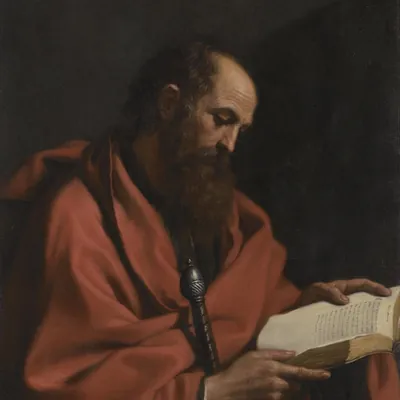
They dragged him out of the city and stoned him. The witnesses laid their cloaks at the feet of a young man named Saul, the future Saint Paul, who "approved of his killing." Stephen prayed: "Lord Jesus, receive my spirit." Then, kneeling down, he cried out in a loud voice: "Lord, do not hold this sin against them." And Luke concludes: "When he had said this, he fell asleep." His last words echo those of Jesus on the cross: self-surrender to the Father and forgiveness for those who put him to death.
Devout men buried him and mourned him greatly. His death opened a persecution that scattered the disciples through Judea and Samaria, and so the Gospel began to go out from Jerusalem. A saying traditionally attributed to Saint Augustine sums up the link between this martyrdom and Saul's conversion: if Stephen had not prayed, the Church would not have had Paul.

A devotion spread throughout the Church
Stephen's feast is one of the oldest in the Christian calendar. By the end of the fourth century it was celebrated in the East on the day after Christmas, alongside the feasts of Saint John the Evangelist and the Holy Innocents: tradition calls these saints the "companions of Christ." In 415 the discovery of relics at Caphargamala, following a dream of the priest Lucian, sparked an immense wave of devotion. Fragments reached North Africa, where Saint Augustine built a chapel at Hippo and recorded in The City of God (Book XXII, chapter 8) the healings attributed to them. In Gaul, a great many cathedrals took his name, among them Bourges, Metz, Sens, Toulouse, Auxerre, Limoges and Châlons.
In Ireland, December 26 is still known as Saint Stephen's Day and is a public holiday, and in Britain the same day, Boxing Day, has long been linked with giving to the poor. The English carol "Good King Wenceslas" is set "on the feast of Stephen."
Why is Saint Stephen the patron saint of deacons?
Stephen is the first named among the Seven on whom the apostles laid hands for the service of the poor, so the Church has always seen him as the model of deacons, uniting the service of charity and the proclamation of the Word. He is also invoked by stonemasons, a patronage that comes from the stones of his martyrdom. More deeply, he shows that Christian martyrdom is not a fight against enemies but a love that goes as far as forgiveness. He is prayed to for deacons, for persecuted Christians and for the strength to forgive.
To pray with him, you can repeat his last words, "Lord Jesus, receive my spirit," or follow the novena to Saint Stephen from December 17 to 25, which also accompanies the last days of Advent.
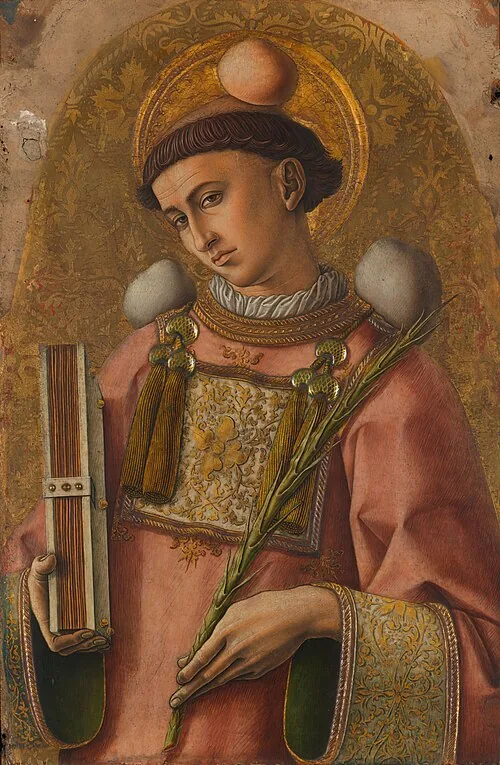
Symbols and how to recognize Saint Stephen in art
- The deacon's dalmatic: he is usually shown as a young man in the vestment of a deacon.
- Stones: held in his hand, placed on his head or lying at his feet, recalling his stoning.
- The martyr's palm: the sign of victory through death.
- A book or a censer: the Gospel he proclaimed and the liturgical service of the deacon.
Where to pray to Saint Stephen
- Jerusalem: the Basilica of Saint Stephen, north of the Damascus Gate, rebuilt by the Dominicans on the Byzantine church of Empress Eudocia.
- Rome: the Basilica of Saint Lawrence Outside the Walls, where tradition places part of his relics beside those of Saint Lawrence, and the round church of Santo Stefano Rotondo on the Caelian Hill.
- Bourges (France): the Cathedral of Saint Stephen, a Gothic masterpiece on the World Heritage list.
- Metz (France): the Cathedral of Saint Stephen and its immense stained glass windows.
- Paris: the church of Saint-Étienne-du-Mont, on the hill of Sainte-Geneviève.
Discover also
- Saint Paul, witness of his stoning before becoming the apostle to the nations.
- Saint Luke, author of the Acts of the Apostles, which tell of his life and death.
- Saint John the Evangelist, celebrated on December 27, the day after Stephen.
- Saint Vincent of Saragossa, another deacon martyr, much venerated in Spain and France.
- Saint Stephen of Hungary, first Christian king of Hungary, who bears his name.