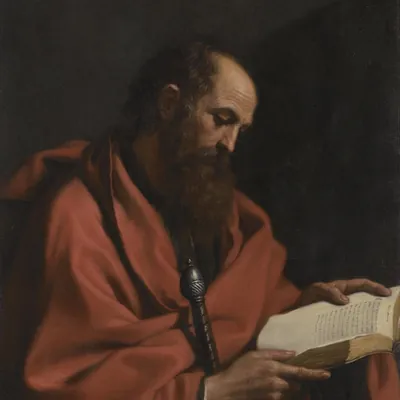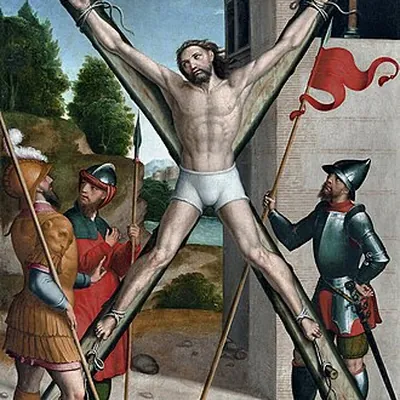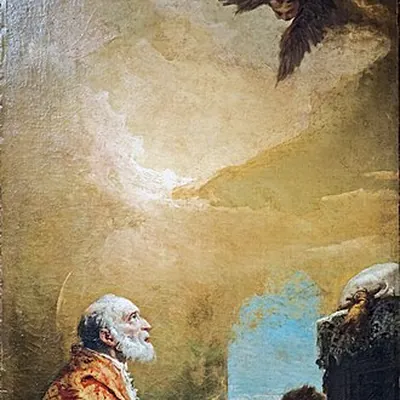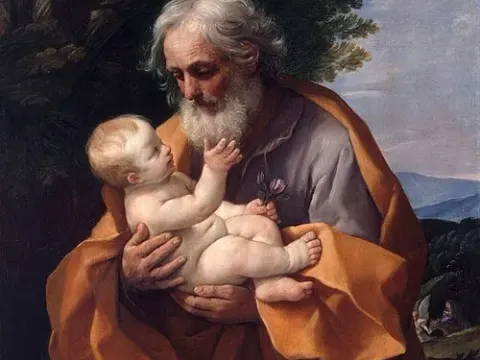
Saint Peter is the first of the twelve apostles of Jesus. A simple fisherman from the Sea of Galilee, impulsive and generous, he received from Jesus a new name, Peter, and the mission to strengthen his brothers. He denied his master on the night of the Passion, wept, then became a bold witness to the Resurrection. The first bishop of Rome, he died a martyr there under Nero, and the Catholic Church sees in him the first pope. He is celebrated on June 29 together with Saint Paul.
Who was Saint Peter?
His first name was Simon, son of Jonah. Born in Bethsaida, he lived in Capernaum, on the shore of the Sea of Galilee, where he worked as a fisherman with his brother Andrew. He was married: the Gospel tells how Jesus healed his mother-in-law. Nothing marked him out to become the leader of a Church that would spread across the world.
Jesus gave him the Aramaic nickname Kepha, "rock," translated into Greek as Petros, Peter. The name speaks both of his mission and of the trust Jesus placed in a man who was, in many ways, fragile.

"You are Peter": the calling of a fisherman
One morning, after a night of catching nothing, Jesus asked Simon to put out into deep water and let down his nets again. The nets filled until they were close to breaking. Simon fell to his knees: "Depart from me, Lord, for I am a sinful man." Jesus answered: "Do not be afraid; from now on you will be catching men" (Luke 5).
With James and John, Peter was one of the three disciples closest to Jesus. He was present at the Transfiguration, at the raising of Jairus's daughter and at the agony in Gethsemane. He often spoke first, on behalf of the others. When many walked away from Jesus, it was Peter who said: "Lord, to whom shall we go? You have the words of eternal life."
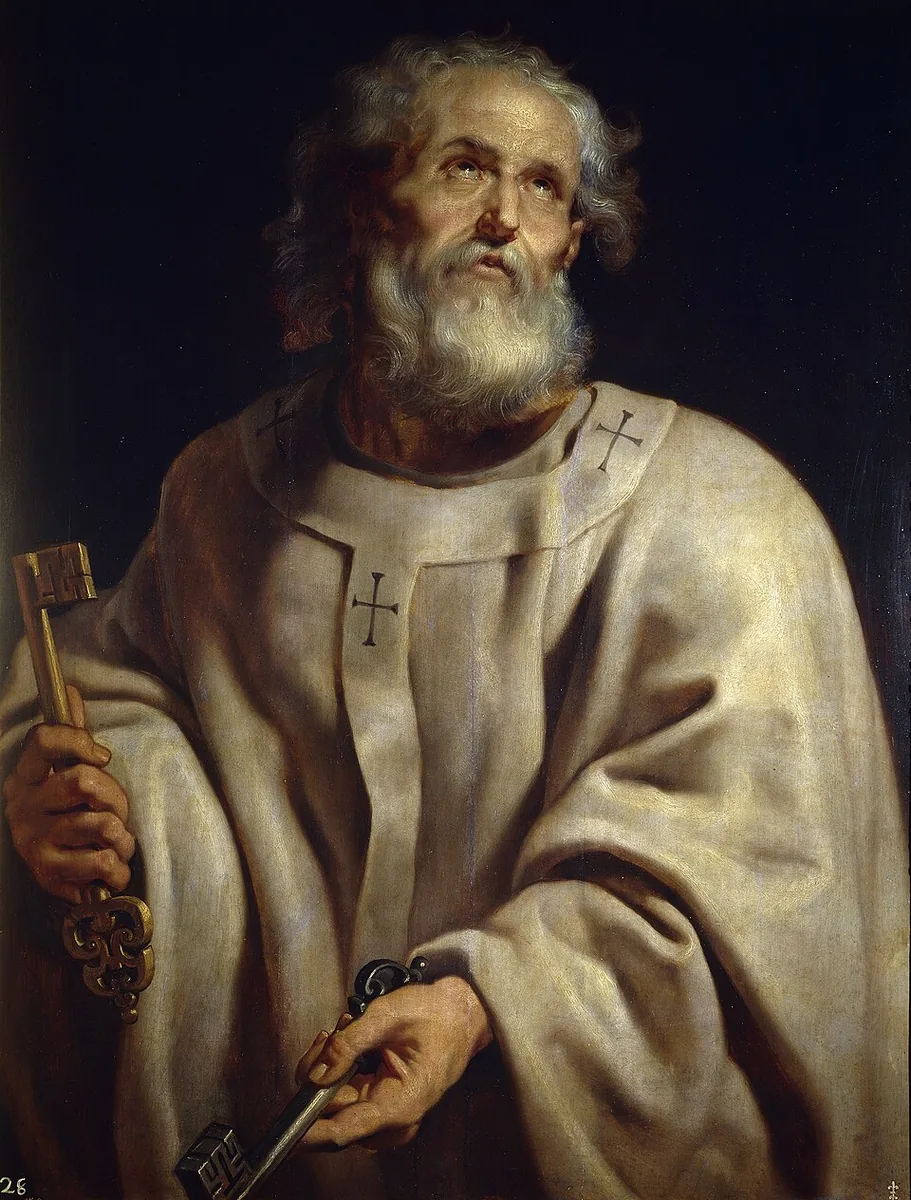
At Caesarea Philippi, Jesus asked: "But who do you say that I am?" Peter answered: "You are the Christ, the Son of the living God." Jesus then said to him: "You are Peter, and on this rock I will build my Church. I will give you the keys of the kingdom of heaven." This is why Saint Peter is always shown holding two keys.
The fall and the forgiveness
Peter was no flawless hero. He wanted to walk on the water toward Jesus, then grew afraid and began to sink. He promised to follow his master to death, then, on the night of the arrest, in the high priest's courtyard, he swore three times that he did not know him. The cock crowed, Jesus turned and looked at him, and Peter went out and wept bitterly.
After the Resurrection, by the same lake, Jesus asked him three times: "Simon, son of John, do you love me?" With each answer, he gave him a mission: "Feed my sheep" (John 21). Three denials, three declarations of love. This dialogue is one of the most beautiful stories of forgiveness in the Gospel, and for twenty centuries it has comforted those who have fallen.

Leader of the early Church
The Acts of the Apostles show Peter transformed by the Holy Spirit. On the day of Pentecost, he spoke to the crowd in Jerusalem. He healed a lame man at the gate of the Temple, faced the council that forbade him to speak about Jesus, and replied: "We must obey God rather than men."
He also opened the Church to non-Jews: in Caesarea he baptized the Roman centurion Cornelius and his household. Thrown into prison by King Herod Agrippa, he was freed during the night by an angel (Acts 12). He then left Jerusalem, passed through Antioch and, according to a very ancient tradition, reached Rome. Two letters of the New Testament bear his name.
Martyrdom in Rome
Peter died in Rome during Nero's persecution, between 64 and 67, probably in the circus on the Vatican Hill. According to a tradition reported by Origen, he asked to be crucified upside down, not considering himself worthy to die as his master had. An ancient story, the source of the novel Quo Vadis, tells that as he was fleeing Rome he met Jesus on the Appian Way and turned back.
Christians buried him nearby, on the Vatican Hill. Excavations beneath the basilica between 1939 and 1950 uncovered a necropolis and a small second-century monument, the "trophy of Gaius," that already marked his tomb.
Why is Saint Peter the patron saint of popes, fishermen and locksmiths?
Peter is the patron of popes because the Catholic Church regards each bishop of Rome as his successor, entrusted like him with strengthening his brothers in the faith. He is the patron of fishermen because that was his trade on the Sea of Galilee before Jesus called him. Locksmiths claim him because of the keys of the kingdom of heaven entrusted to him. He is also the patron of the city of Rome, where he died and is buried.
Symbols and how to recognize Saint Peter in art
- Two keys, often one gold and one silver, the keys of the kingdom of heaven.
- An upside-down cross, recalling the tradition of his crucifixion.
- A rooster, a reminder of his denial and his tears.
- A boat, nets or fish, for his first trade and the miraculous catch.
- A book or scroll, for the two New Testament letters that bear his name.
- He is usually shown as an older man with short, curly gray hair and a short beard.
Where to pray to Saint Peter
The great place of pilgrimage is Saint Peter's Basilica in Rome, built over his tomb. In Rome, you can also visit San Pietro in Vincoli (Saint Peter in Chains), where the chains of his captivity are venerated. In the Holy Land, pilgrims visit the remains of his house at Capernaum and, at Tabgha, the Church of the Primacy of Saint Peter, on the shore of the lake.
People pray to Saint Peter for a solid faith, for the courage to get up again after a sin, and for faithfulness to the Church. They also pray to him for the pope, his successor. His feasts are June 29, the Solemnity of Saints Peter and Paul, and February 22, the Chair of Saint Peter. The novena to Saint Peter begins on June 20.
Discover also
- Saint Andrew, his brother, who first brought him to Jesus.
- Saint John the Apostle, the beloved disciple, his companion at the empty tomb.
- Saint James the Greater, who with Peter and John witnessed the Transfiguration.
- Saint Paul, with whom he shares his feast on June 29.