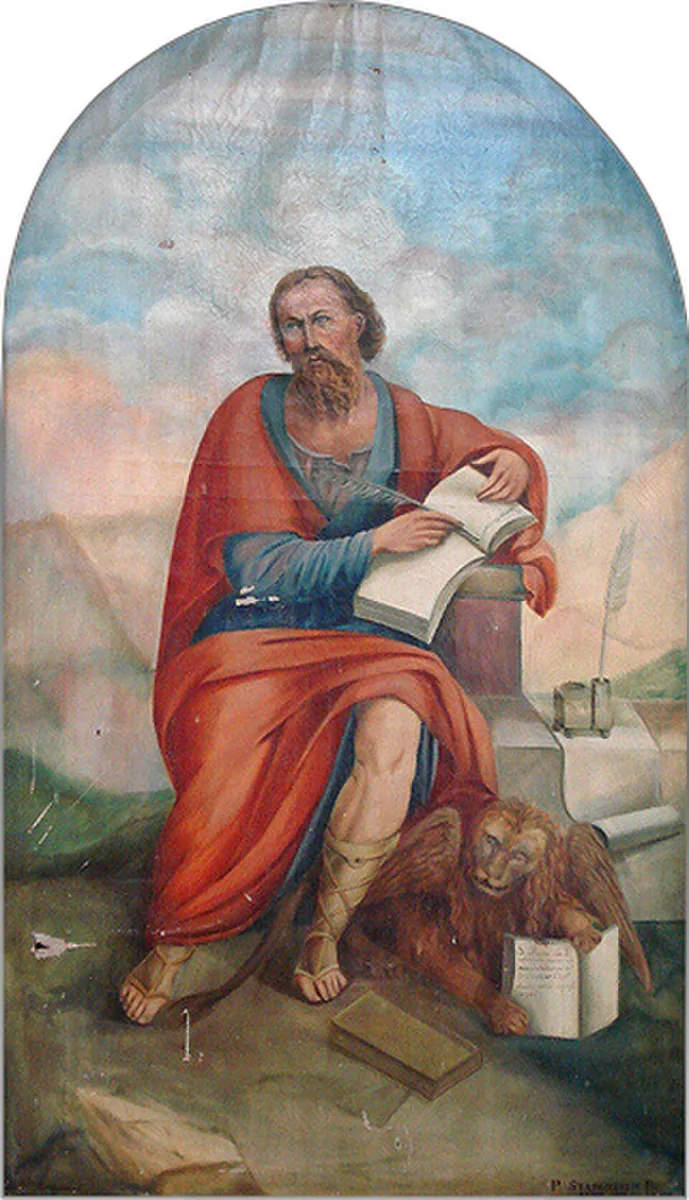
Saint Mark is, according to a tradition going back to the second century, the author of the second Gospel, the shortest of the four and, for most scholars, the oldest. The New Testament knows him as John Mark: companion of Saint Paul and Saint Barnabas, then close to Saint Peter in Rome. Tradition makes him the founder of the Church of Alexandria, where he is said to have died a martyr. His symbol is the lion, his relics have rested in Venice since 828, and his feast is on April 25.
Who was Saint Mark?
Mark had two names: a Jewish name, John (Yohanan), and a Latin surname, Marcus, common in the Roman Empire. The Acts of the Apostles mention the house of his mother, Mary, in Jerusalem: it was there that the community was gathered in prayer when Peter, miraculously freed from prison, came knocking at the door (Acts 12:12). Mark therefore came from a Jewish family in Jerusalem, well-off enough to host meetings, and the Letter to the Colossians tells us he was the cousin of Barnabas.
Some commentators have suggested that Mark is the young man, mentioned only in his Gospel, who ran away naked when Jesus was arrested, leaving behind the linen cloth he was wearing (Mark 14:51-52). It is an old and appealing hypothesis, but it cannot be verified.
A disciple who knew failure
Mark's life, as Acts tells it, was anything but a straight line. He set out full of enthusiasm with Paul and Barnabas on the first great mission, to Cyprus. But on reaching Perga, on the coast of present-day Turkey, he left them and went home to Jerusalem. Luke does not say why. A few years later, when Barnabas suggested taking him along again, Paul flatly refused: the disagreement was so sharp that the two missionaries parted ways. Barnabas left with Mark, and Paul with Silas.
The story does not end there. About ten years later, Mark was at the side of Paul in prison, and Paul recommended him to the communities. In the Second Letter to Timothy, Paul even asks: "Get Mark and bring him with you, for he is very useful to me for ministry" (2 Timothy 4:11). The young man who had given up had become a valued co-worker. Mark is the saint of second chances and reconciliation.

The Gospel according to Saint Mark
Around 130, Papias, Bishop of Hierapolis in Phrygia, quoted by Eusebius of Caesarea, reports a tradition he received from an elder: Mark, having become Peter's interpreter, wrote down accurately, though not in order, what he remembered of the Lord's words and deeds. This is the oldest testimony on the origin of a Gospel. Modern scholarship debates the exact nature of this link with Peter, but most scholars regard Mark's Gospel as the first to be written, and as a source used by Matthew and Luke.
It is a fast-moving, vivid account that opens without an infancy narrative: "The beginning of the gospel of Jesus Christ, the Son of God." The word "immediately" comes back again and again. Mark stresses how hard it was for the disciples to understand who Jesus was, the silence Jesus imposed on those he healed, and the cross: it is a Roman centurion, at the foot of the Crucified, who is the first to proclaim, "Truly this man was the Son of God." The original account ends with the women's fear before the empty tomb, as if inviting the reader to take up the witness.
Alexandria, Venice and the lion
Eusebius of Caesarea reports in the fourth century that Mark was the first to preach the Gospel in Egypt and to found churches in Alexandria. Later accounts tell of his martyrdom: dragged through the streets of the city by pagans, he is said to have died around 68. The Coptic Church, whose patriarch presents himself as his successor, venerates him as its founder.
In 828, two Venetian merchants, Buono of Malamocco and Rustico of Torcello, carried his body away from Alexandria, then under Muslim rule; legend has it that they hid it under pork to discourage inspection. Venice made Mark its patron and built him a church, which would become the Basilica of Saint Mark. The winged lion, the evangelist's symbol since Saint Jerome, became the emblem of the Republic of Venice. The symbol refers to the opening of his Gospel, where the voice of John the Baptist rings out in the desert like a roar.

Why is Saint Mark the patron saint of Venice?
Venice adopted Mark as its patron when his relics arrived in 828, replacing its earlier patron, and from then on the city identified itself with him: his basilica, his lion and his name became the symbols of the Republic for a thousand years. He is also the patron of notaries, a patronage usually explained by his role as the one who faithfully set Peter's preaching down in writing. More deeply, Mark reminds us that a first failure disqualifies no one. He left the mission, he was turned down, then he came back and made himself useful. He also knew how to put himself at the service of someone else's word, Peter's, to hand on what matters most: the Good News of Jesus Christ, the Son of God.
To pray with him, you can read the opening words of his Gospel, or follow the novena to Saint Mark from April 16 to 24, so that it ends on the eve of his feast. In the older Roman liturgy, April 25 was also the day of the "Greater Litanies," a procession of prayer for the harvest.
Symbols and how to recognize Saint Mark in art
- The winged lion: his symbol among the four evangelists, often shown beside him or alone with an open book.
- The book or scroll: his Gospel, sometimes being written at a desk.
- The pen: the evangelist at work, faithful scribe of Peter's preaching.
- Venice in the background: in Venetian painting, scenes of his relics and miracles.

Where to pray to Saint Mark
- Venice: Saint Mark's Basilica, where his relics rest beneath the high altar.
- Cairo: the Coptic Orthodox Cathedral of Saint Mark, which keeps the relic given by Paul VI in 1968.
- Alexandria: the Coptic church of Saint Mark, historic seat of the patriarchate, on the traditional site of his martyrdom.
- Rome: the Basilica of San Marco near Piazza Venezia, founded in the fourth century.
Discover also
- Saint Barnabas, his cousin, who gave him a second chance.
- Saint Paul, who refused him before calling him "very useful for ministry."
- Saint Luke, another evangelist, who drew heavily on his account.
- Saint Matthew, apostle and evangelist, who also took up Mark's Gospel.
- Saint John the Evangelist, author of the fourth Gospel.