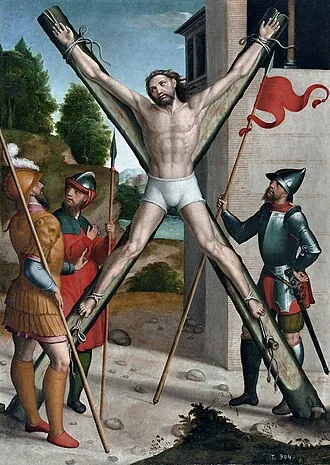
Saint Andrew is one of the twelve apostles of Jesus. A fisherman on the Sea of Galilee and the brother of Simon Peter, he was, according to the Gospel of John, the first to follow Jesus, which earned him among the Greeks the beautiful title of Protokletos, "the First-Called." Tradition says he was crucified at Patras, in Greece, on a cross that art depicts in the shape of an X. Patron saint of Scotland, Greece and the Patriarchate of Constantinople, he is celebrated on November 30, in East and West alike.
Who was Saint Andrew?
Andrew came from Bethsaida, a fishing village on the north shore of the Sea of Galilee; he later lived in Capernaum with his brother Simon. His name is Greek, Andreas, meaning "manly" or "courageous," a sign of Galilee's openness to Greek culture. Before meeting Jesus, he was a disciple of John the Baptist, which shows him to be a seeker, attentive to the signs of God.

"We have found the Messiah"
The Gospel of John tells of the first meeting with the precision of an eyewitness. John the Baptist sees Jesus passing by and says: "Behold, the Lamb of God." Two of his disciples begin to follow Jesus, who turns and asks them: "What are you looking for?" They answer: "Rabbi, where are you staying?" "Come, and you will see." They stay with him that day, at about four in the afternoon, the evangelist notes. One of these two disciples is Andrew.
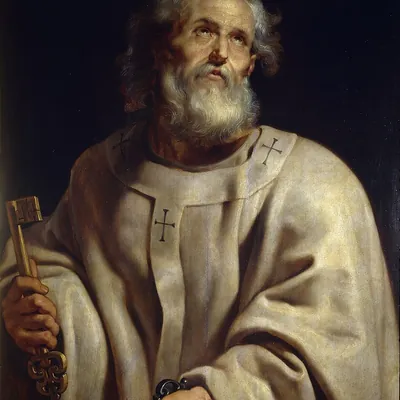
His first act is to go and find his brother: "We have found the Messiah." He brings him to Jesus, who gives Simon the name Cephas, Peter. Andrew's whole vocation lies in this movement: meeting Christ and not keeping that meeting to himself. Mark and Matthew then report the decisive call by the lake: the two brothers immediately leave their nets.
The one who brings others to Jesus
At the multiplication of the loaves, it is Andrew who points out a boy with five barley loaves and two fish, adding realistically: "But what good are these for so many?" (John 6:8-9). A few days before the Passion, some Greeks who had come up to Jerusalem for the feast approach Philip, who tells Andrew; together they go and tell Jesus (John 12:20-22).
After Pentecost, the New Testament says nothing more about him, and traditions take over. Origen, quoted by the historian Eusebius of Caesarea in the 4th century, says that Andrew received Scythia, the lands north of the Black Sea. Other accounts take him to Asia Minor and Greece, and a medieval Russian chronicle has him climb the hills where Kyiv would one day stand. These stories cannot be verified, but they explain the veneration the peoples of the East have for him.
The cross of Patras
The Acts of Andrew, an apocryphal writing probably composed in the 2nd or 3rd century, tell of his death at Patras, in the Peloponnese. The proconsul Aegeates, angered by his wife's conversion, had him tied to a cross rather than nailed, to prolong his agony. Andrew is said to have greeted the cross as a long-desired friend. These details belong to pious legend; only the apostle's death at Patras rests on an ancient and constant tradition.

Relics between East and West
In 357, Emperor Constantius II had Andrew's remains moved to Constantinople, giving the new capital an apostolic patron, as Rome had Peter. After the sack of the city by the Crusaders in 1204, Cardinal Pietro Capuano, a native of Amalfi, brought the body back to his hometown, where it was laid in the crypt of the Cathedral of Saint Andrew on May 8, 1208. The apostle's head, which had remained in Patras, was entrusted in 1462 to Pope Pius II by Thomas Palaiologos, who was fleeing the Ottoman advance.
In 1964, Pope Paul VI returned this relic to the Church of Patras, a strong gesture of rapprochement between Catholics and Orthodox. Since then, a delegation of the Holy See has gone every November 30 to the Phanar, in Istanbul, for the feast of the Ecumenical Patriarchate.
Why is Saint Andrew the patron saint of Scotland and of fishermen?
Andrew was a fisherman before Jesus called him to become a "fisher of men," so fishermen have always taken him as their patron. Scotland's devotion is linked to the medieval tradition that relics of the apostle were brought there by Saint Rule (Regulus), to the place that became St Andrews. The white saltire on a blue field, the flag of Scotland, is Saint Andrew's cross, and November 30, Saint Andrew's Day, is Scotland's national day.
Saint Andrew reminds us that faith begins with a question ("where are you staying?") and is passed on by simple witness: "we have found." He does not put himself forward; he brings others. He also teaches us to offer the little we have, like the boy's five loaves, and let Christ do more with it. He is invoked for the missions, for Christian unity and for fishermen.
To pray with him, read the prayer to Saint Andrew, with the "O good Cross" antiphon and the Saint Andrew Christmas Novena, or follow the novena to Saint Andrew from November 21 to 29. His feast is linked to Advent: the first Sunday of Advent is traditionally the Sunday nearest to November 30.
Symbols and how to recognize Saint Andrew in art
- An X-shaped cross, the "Saint Andrew's cross" or saltire, which became established in art only in the late Middle Ages. It then became an emblem: the flag of Scotland, the cross of Burgundy, the collar of the Order of the Golden Fleece, founded in 1430 by Philip the Good under the apostle's patronage.
- A fishing net or fish, recalling his trade on the Sea of Galilee.
- An older man with white hair and beard, often shown beside his brother Peter.
Where to pray to Saint Andrew
- Amalfi (Italy): the Cathedral of Saint Andrew, whose crypt has held his relics since 1208.
- Patras (Greece): the great Orthodox Basilica of Saint Andrew, which keeps his head and fragments of the cross.
- Rome: Saint Peter's Basilica, where the monumental statue of Saint Andrew by François Duquesnoy adorns one of the piers of the dome.
- St Andrews (Scotland): the ruins of the medieval cathedral, linked to the tradition of relics brought by Saint Rule.
Discover also
- Saint Peter, his brother, whom he brought to Jesus.
- Saint John the Baptist, his first teacher, who pointed out to him the Lamb of God.
- Saint James the Greater, another fisherman of the lake, called the same day according to Mark.
- Saint John the Apostle, companion of the first days and brother of James.
- Saint Philip, apostle from Bethsaida, with whom he brought the Greeks to Jesus.