The chains in Christian art
Prisoners set free by Saint Leonard, and the devil in chains. See the other attributes: objects and symbols
Chains have two opposite meanings in Christian art. Sometimes they are broken: the saint has set captives free. Sometimes they are pulled tight: the saint holds the defeated devil on a leash.
In both cases they speak of freedom, the freedom that Christ brings to prisoners, as he announced in the synagogue at Nazareth.
What this attribute means
Saint Leonard of Noblac, a hermit in the Limousin in the sixth century, had obtained from the Frankish king the right to free the prisoners he visited. Freed captives, it is said, came to leave their irons at his hermitage. So he holds manacles or chains, and his cult spread throughout Europe, from Bavaria to England.
The other image is that of the devil in chains: Saint Juliana of Nicomedia holds on a leash the devil who had tried to deceive her, and in some depictions Saint Bernard chains the devil. As for Saint Peter, his chains recall his miraculous deliverance by an angel (Acts 12): they are venerated in Rome at San Pietro in Vincoli, Saint Peter in Chains.
How not to get it wrong. A young deacon or a monk holding irons or manacles: Saint Leonard. A young woman pulling a small devil on the end of a chain: Saint Juliana. A priest taking the place of a chained convict: Saint Vincent de Paul, according to a popular legend.
The saints shown with this attribute
- Saint Leonard of Noblac
Patron of prisoners, he holds irons or chains, often in a deacon's vestments.
- Saint Juliana of Nicomedia
The martyr holds on the end of a chain the devil she unmasked in her prison.
- Saint Peter the Apostle
The chains of his captivity in Jerusalem, which fell from his hands when the angel arrived, are venerated in Rome.
- Saint Vincent de Paul
Chaplain to the galleys, he was shown in the nineteenth century taking on a galley slave's irons, after a legend.
Artworks to look at
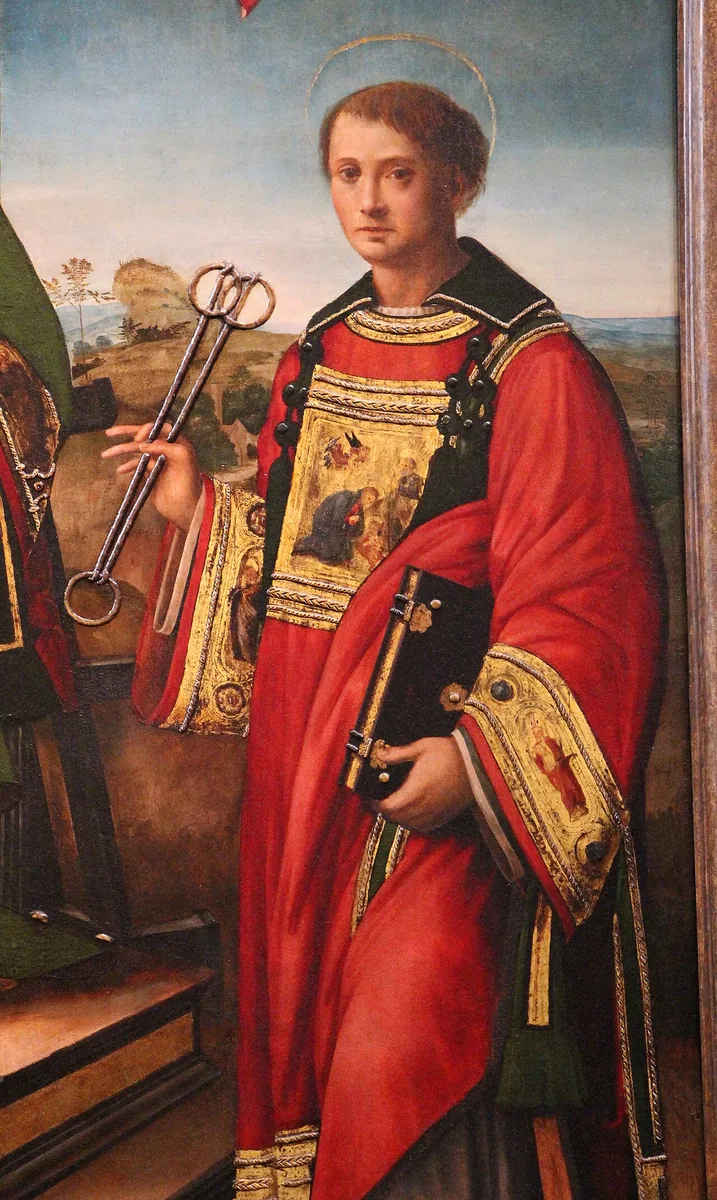
Raffaellino del Garbo (attributed to), Saint Leonard The saint, in a deacon's red dalmatic, holds out the prisoner's irons that are his attribute, along with a book.
Attributed to Raffaellino del Garbo, public domain, via Wikimedia Commons. Source · License
Domenico Fetti paints the saint raising her eyes to heaven, while the devil, defeated and chained, lies at her feet.
Saint Juliana of Nicomedia: life
Image: Attributed to Domenico Fetti, public domain, via Wikimedia Commons. Source · License
Léon Bonnat illustrates the legend that Vincent de Paul took the place of a convict so that the man could return to his family.
Image: Anonyme, photographe, CC0, via Wikimedia Commons. Source · License
Frequently asked questions
Why does Saint Leonard hold chains?
According to tradition, he had obtained from King Clovis the right to free prisoners. Freed captives came to leave their chains at his hermitage at Noblac, near Limoges. He is the patron saint of prisoners.
Which female saint holds the devil in chains?
Saint Juliana of Nicomedia, a fourth-century martyr. The devil appeared to her in her prison in the form of an angel; she unmasked him and chained him.
What are the chains of Saint Peter?
The chains of his captivity in Jerusalem, from which an angel freed him according to the Acts of the Apostles. A relic is venerated in Rome, in the Basilica of San Pietro in Vincoli (Saint Peter in Chains), which also houses Michelangelo's Moses.
Other attributes of the saints
- The keys
- The sword
- The arrows
- The martyr's palm
- The tower
- The lion
- The dragon
- The skull
- The scallop shell
- The X-shaped cross
- The lily
- Eyes on a dish
- The lamb
- The stag
- The raven
- The Child Jesus in their arms
- The stigmata
- The Veil of Veronica
- The dove
- The knife
- The stones
- The dog
- The shared cloak
- The heart
- The crown of thorns
- The royal crown
- The miter and crozier
- The monstrance and the chalice
- The roses
- The banner