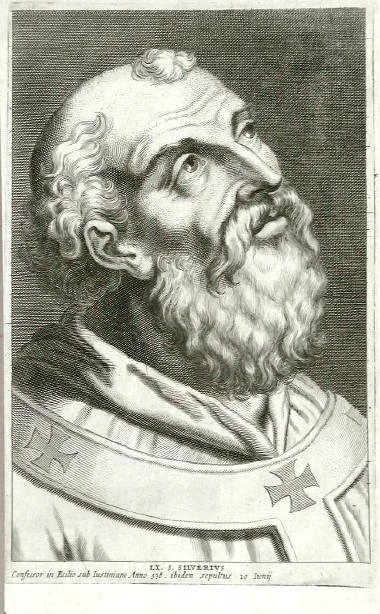
Saint Silverius was pope from 536 to 537, in one of the most troubled periods in the history of Rome, caught between the Ostrogoths and the Byzantine army. The son of a pope, elected under pressure from a Gothic king, he refused to give in to Empress Theodora on a question of faith. Deposed on the basis of a forged letter and exiled to a deserted island in the Tyrrhenian Sea, he died there of privation. Venerated as a martyr and patron of the island of Ponza, he is celebrated on June 20.
Who was Saint Silverius?
Silverius was born around 480, probably in Ceccano, in Lazio. His case is unique in the history of the papacy: he was the legitimate son of Pope Saint Hormisdas, who had married before entering the clergy and who governed the Church from 514 to 523. Silverius served the Church of Rome as a subdeacon. In 536, when Pope Agapetus I died in Constantinople, he was chosen to succeed him. It was the first time a mere subdeacon became pope.

A pope between the Goths and Byzantium
When Silverius was elected, Italy was ruled by the Ostrogoths, a people who followed Arian Christianity. The Byzantine emperor Justinian had decided to win back the old lands of the Empire and had sent his general Belisarius. The Gothic king Theodahad wanted a pope who would favor him, and it was under his pressure that the Roman clergy accepted Silverius. The Liber Pontificalis, the ancient book of the popes, even accuses Silverius of having bought his election from the king. Historians remain cautious about this hostile account.
Silverius nevertheless showed realism. He advised the Senate not to resist the Byzantines, and Belisarius entered Rome without a fight on December 9, 536. The city was immediately besieged by the Gothic king Vitiges and endured a year of famine.
Faithful before the empress
The real conflict was religious. Empress Theodora supported the Monophysites, who recognized only one nature in Christ. She wanted to restore to the see of Constantinople the patriarch Anthimus, whom Agapetus I had deposed for heresy. Silverius refused. Theodora then turned to the Roman deacon Vigilius, an ambitious man ready to serve her, and won the support of Belisarius and his wife Antonina.
A forged letter accused the pope of offering to open a city gate to the Goths. On March 11, 537, Silverius was summoned to the palace on the Pincian Hill, stripped of his insignia, dressed in a monk's habit and sent into exile at Patara, in Lycia, in what is now Turkey. Vigilius was consecrated in his place.
The bishop of Patara pleaded his case before Justinian, who ordered a fair trial. But when Silverius returned to Italy, he was handed over to Vigilius, who had him deported to the Pontine Islands. He died of hunger a few months later, in 537, most likely on the islet of Palmarola. According to the Liber Pontificalis, he was buried there and his remains never left the island.

The saint of the fishermen of Ponza
Silverius was never canonized through a formal procedure. He was recognized as a saint by popular veneration, and his name appears in lists of saints from the eleventh century onward. His tomb became a place of devotion, and the people of Ponza took him as their patron. According to a local legend, fishermen caught in a storm off Palmarola called on him; the saint appeared to them and guided them safely to shore.
Every June 20, Ponza celebrates its patron for three days. His statue is carried in procession on a float shaped like a fishing boat and covered with red carnations. Emigrants from the island carried this devotion all the way to New York. Silverius is also patron of Frosinone, together with his father Hormisdas.
Why is Saint Silverius the patron saint of Ponza?
Ponza and its neighboring islet of Palmarola are where Silverius spent his last months and where he died, alone and starving. The islanders, most of them fishermen and sailors, adopted the exiled pope as their own, and the legend of the storm off Palmarola made him their protector at sea. Beyond Ponza, he is invoked for exiles and people unjustly condemned, for those under pressure to act against their conscience, and for sailors and fishermen.
Symbols and how to recognize Saint Silverius in art
- Papal vestments and tiara, as a pope.
- A palm, sign of the martyrdom he is honored for, though he died of hunger rather than by violence.
- The sea, a boat or an island, recalling his exile and his protection of the fishermen of Ponza.
- A boat-shaped float covered in red carnations, at his feast in Ponza.
What his holiness teaches us
The election of Silverius was clouded by suspicion, and his pontificate lasted less than a year. But at the decisive moment he refused to sacrifice the faith to the demands of an empress, and he died for it, alone on a deserted island. His holiness was played out in a single refusal.
To pray with him, see the prayer to Saint Silverius and the novena to Saint Silverius, prayed from June 11 to 19.
Where to pray to Saint Silverius
- Ponza (Pontine Islands): the main church of the island and its statue of the saint, at the heart of the June 20 feast.
- Palmarola: the islet of his exile, where a small chapel keeps his memory.
- Frosinone (Lazio): the city of which he is patron with Saint Hormisdas.
Discover also
- Saint Hormisdas, his father, pope from 514 to 523.
- Saint Agapetus I, his predecessor, who had deposed the patriarch Anthimus.
- Saint Martin I, another pope arrested on the orders of Byzantium who died in exile.
- Saint Pontian, a pope deported to Sardinia and one of the first to give up his office.
- Saint Clement of Rome, who according to tradition also died in exile.