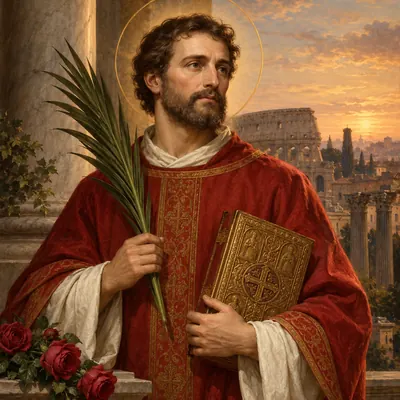
Saint Tarcisius was a Roman martyr of the 3rd century, killed by a hostile mob while he was carrying the Eucharist. He is known only through a few lines of verse carved a century later by Pope Damasus, but his act has crossed the centuries: he became the "martyr of the Eucharist," a model for children making their First Communion and the patron saint of altar servers. His feast day is August 15.
Who was Saint Tarcisius?
Tarcisius lived in Rome in the middle of the 3rd century, a time when Christians suffered violent persecutions, especially under Emperor Valerian (253-260). His name, derived from the city of Tarsus in Cilicia, the hometown of Saint Paul, was common in Rome.
Beyond that, honesty requires us to say it plainly: we know almost nothing about his life. His memory rests on a single historical source, a verse inscription composed by Pope Damasus, elected in 366, who did much to honor the martyrs of Rome.

What the inscription of Damasus says
In his Latin verses, Damasus compares Tarcisius to Saint Stephen, the first martyr. He recalls that Stephen was stoned, then speaks of Tarcisius: while he was carrying the sacraments of Christ, an ungodly crowd tried to seize them in order to profane them, and he chose to die under their blows rather than surrender "the heavenly members to raging dogs."
That is all the source says. It gives neither his age, nor his rank in the Church, nor the exact way he was killed. The comparison with Stephen, who was a deacon, has led several historians to think that Tarcisius was also a deacon, or at least a young adult charged with carrying the Eucharist to the sick or to prisoners. This was indeed a mission entrusted to the ministers of the Church.
The legend of the young acolyte
From these few lines, piety wove a more detailed story. According to the legend, Tarcisius was a young boy entrusted with bringing Communion to imprisoned Christians. On the Appian Way, companions and then passersby wanted to know what he was hiding under his cloak. He refused to show the Blessed Sacrament. Learning that he was a Christian, the crowd beat and stoned him. A Christian soldier, Quadratus, drove off the attackers and carried away his body, but the sacred species were no longer found on him.
Fabiola and the 19th-century revival
In the 19th century this story became very popular, especially through Fabiola, the novel by the English Cardinal Nicholas Wiseman, first Archbishop of Westminster, which made Tarcisius a boy of about ten. Closer to our time, the French writer Serge Dalens told his story in La Couronne de pierres (1980). These works did much for his popularity, but they should be read as edifying tales, not as history.

A cult that has crossed the centuries
Tarcisius was first buried in the Catacomb of Saint Callixtus, on the Appian Way. In 767, Pope Paul I had his relics transferred to the Church of San Silvestro in Capite, in the center of Rome, where they have rested under the high altar since 1596. On the Appian Way, the church of the Saint Tarcisius Institute, run by the Salesians, also keeps a sarcophagus that serves as its altar.
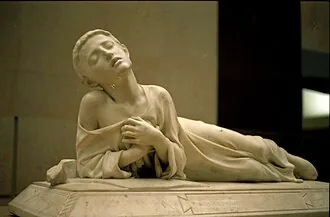
The 19th century made him a hero of Catholic youth. The marble statue by Alexandre Falguière, now in the Musée d'Orsay in Paris, was reproduced in countless churches and schools. His name was given to seminaries, parishes, and even a municipality in Quebec, Saint-Tharcisius. The young Mexican martyr Saint José Sánchez del Río was nicknamed "Tarcisius."
Why is Saint Tarcisius the patron saint of altar servers?
What history keeps of Tarcisius fits in one sentence: he preferred to die rather than let the Body of Christ be profaned. That act alone speaks of his love for the Eucharist and his courage. Because he served the Eucharist with his life, he became the patron saint of altar servers and a model for First Communicants.
Speaking in 2010 to thousands of altar servers gathered in Rome, Benedict XVI presented him as a model of fidelity and love for Christ present in the consecrated bread. He is invoked for children preparing for their First Communion, for altar servers, and for all who bring Communion to the sick, including extraordinary ministers of Holy Communion. To pray with him, see the prayer to Saint Tarcisius and the novena to Saint Tarcisius.
Symbols and how to recognize Saint Tarcisius in art
- A young boy, often lying on the ground, as in Falguière's famous statue.
- The Blessed Sacrament held to his chest, sometimes wrapped in a cloth or hidden under his cloak.
- Stones, recalling the manner of death told by the legend.
- The palm of martyrdom.

Where to pray to Saint Tarcisius
- Rome: the Church of San Silvestro in Capite, where his relics rest under the high altar. The church is today entrusted to the English-speaking Catholic community of Rome, making it a natural place of prayer for English-speaking pilgrims.
- Rome, Appian Way: the Catacombs of Saint Callixtus, his first burial place, and the church of the Saint Tarcisius Institute.
- Paris: the Musée d'Orsay, where Falguière's statue can be seen.
Discover also
- Saint Stephen, the first martyr, to whom Damasus compares him.
- Saint Damasus I, the pope who carved his praise.
- Saint Sixtus II, martyr pope of the same persecution of Valerian.
- Saint Lawrence, deacon and martyr of Rome in the same period.
- Saint Dominic Savio, another young saint and friend of the Eucharist.