Saint Lawrence was a deacon of the Church of Rome who died a martyr on August 10, 258, during the persecution of Emperor Valerian. Entrusted with the Church's goods and its care for the poor, he is said, according to a tradition recorded by Saint Ambrose, to have presented the poor to the prefect of Rome as the true treasures of the Church. Tradition holds that he was roasted on a gridiron. One of the most venerated martyrs of Rome, he is celebrated on August 10 and is the patron saint of deacons, the poor and cooks.
Who was Saint Lawrence?
Lawrence (Laurentius in Latin, Lorenzo in Italian, Lorenzo or Laurence elsewhere) was one of the seven deacons of the Church of Rome in the time of Pope Saint Sixtus II. Deacons were then responsible for serving the poor, widows and orphans, and for managing the goods of the community. Lawrence was the first among them, the archdeacon, the Pope's trusted assistant. A later tradition says he was born in Spain, at Huesca in Aragon, but this is not established.
What is certain is the date of his death and the place of his burial on the Via Tiburtina, recorded in the oldest calendars of the Church of Rome. His veneration spread very early, and his feast has always held a high rank in the Roman liturgy. He is one of the martyrs named in the Roman Canon, the First Eucharistic Prayer of the Mass.
The persecution of Valerian
In 258 Emperor Valerian ordered the immediate execution of bishops, priests and deacons. On August 6 Pope Sixtus II was arrested while celebrating the liturgy in an underground cemetery, the Catacomb of Callixtus, and was put to death together with several of his deacons. Lawrence was executed four days later, on August 10.
Saint Ambrose, Bishop of Milan in the 4th century, records a tradition that Lawrence, seeing the Pope led away to martyrdom, begged not to be left behind. Sixtus is said to have told him that he would follow three days later, in an even harder struggle.
The treasures of the Church
According to Ambrose's account, the prefect of Rome demanded that Lawrence hand over the treasures of the Church. Lawrence asked for a few days, gave everything he had to the poor, then gathered the sick, the blind, the lame, the widows and the orphans whom the community supported. He presented them to the prefect, saying that these were the treasures of the Church. The story has no doubt been embellished, but it says what matters: for Lawrence, the wealth of the Church is the poor.
Martyrdom on the gridiron
According to the tradition passed on by Saint Ambrose and the poet Prudentius, Lawrence was put to death slowly on an iron grill set over hot coals. In the middle of his torment, he is said to have told his executioners, with good humor, to turn him over because he was done on that side. This famous saying made him the patron saint of cooks and, with a smile, of comedians.
Many historians think, however, that he was more likely beheaded, like Pope Sixtus II, in keeping with Valerian's edict, and that the story of the gridiron developed later. Either way, his courage and serenity in the face of death made a deep impression on the Christians of Rome, and his tomb quickly became a place of pilgrimage.
Why is Saint Lawrence the patron saint of deacons, the poor and cooks?
As archdeacon of Rome, Lawrence is the model for deacons, who are called to the service of charity, liturgy and the Word. Because he gave the Church's goods to the poor and called them "treasures," he is the patron of the poor and of those who serve them. The story of the gridiron made him the patron of cooks, chefs and those who work near fire. As guardian of the Church's goods and records, he is also sometimes considered the patron of librarians and archivists.
The "tears of Saint Lawrence"
Every year, around August 10, the summer sky is crossed by the Perseid meteor shower. In Italy and elsewhere, these shooting stars are traditionally called the "tears of Saint Lawrence," as if the sky remembered the burning coals of his martyrdom.
Symbols and how to recognize Saint Lawrence in art
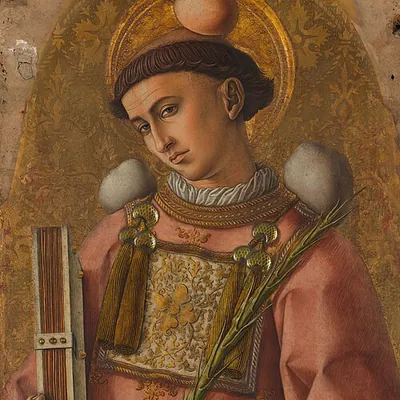
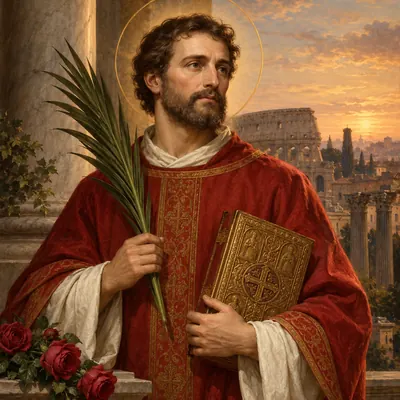
Saint Lawrence is shown as a young man wearing the dalmatic, the liturgical vestment of deacons. His main symbol is the gridiron. He often also holds the martyr's palm, a Book of the Gospels, or a purse or coins recalling his almsgiving. Fra Angelico painted his life in the Niccoline Chapel in the Vatican, and Titian painted his martyrdom in a dramatic night scene now in Venice.

Where to pray to Saint Lawrence
The great shrine of Saint Lawrence is the Basilica of Saint Lawrence Outside the Walls (San Lorenzo fuori le Mura) in Rome, built over his tomb and one of the seven pilgrim churches of Rome. In the same city, the church of San Lorenzo in Panisperna marks, according to tradition, the place of his martyrdom, and San Lorenzo in Lucina keeps a gridiron venerated as the one on which he died. In Spain, the royal monastery of El Escorial, built by King Philip II, is dedicated to him. Many parishes in the United States, Ireland, the Philippines and around the world bear his name.
How to pray to Saint Lawrence
Catholics pray to Saint Lawrence for deacons, for the poor and those who serve them, for courage in trials and for the grace to keep joy in difficult times. You can pray the prayer to Saint Lawrence or follow the novena to Saint Lawrence, from August 1 to 9, so that it ends on the eve of his feast.
Discover also
- Saint Sixtus II, the Pope he served, martyred four days before him.
- Saint Stephen, deacon and first martyr, whose relics tradition places beside his.
- Saint Vincent of Saragossa, another deacon martyr.
- Saint Ambrose of Milan, who told the story of his martyrdom.
- Saint Agnes, another great martyr of Rome named in the Roman Canon.