Saint Zosimus was bishop of Rome for barely twenty-one months, from March 417 to December 418. Coming from southern Italy, he succeeded Innocent I and was immediately plunged into the Pelagian controversy, in which he was at first persuaded by the accused before solemnly condemning them. His turbulent pontificate shows that a pope can be mistaken and then correct himself. His feast day is December 26.
Who was Saint Zosimus?
According to the Liber Pontificalis, Zosimus came from Magna Graecia, the Greek-speaking south of Italy; one tradition places his birth at Mesoraca, in Calabria. His Greek name fits this origin. His father was named Abramius. The historian Adolf von Harnack deduced from this a Jewish origin, a hypothesis rejected by Louis Duchesne. Nothing certain is known on this point, nor about his life before his election.
He was chosen unanimously on March 18, 417, a few days after the death of Pope Innocent I.
Historians describe him as a man of good intentions, attached to the authority of the See of Rome, but unfamiliar with Roman customs and often lacking in tact. His short pontificate was marked by hasty decisions, yet also by a real ability to listen and to change course.

The Pelagian affair: mistaken, then corrected
Pelagius and his disciple Caelestius taught that human beings can do good by their own strength alone, without needing God's grace. Condemned in Africa and then by Innocent I, they appealed to the new pope.
Zosimus gathered the Roman clergy in the Basilica of San Clemente to hear Caelestius, who declared that he accepted the teaching of Innocent. Soon afterward, the pope received a profession of faith from Pelagius. Convinced of their sincerity, he wrote to the African bishops to reproach them for a hasty judgment.
The African response
The African bishops, gathered around Aurelius of Carthage and Saint Augustine of Hippo, answered firmly that the pope had been deceived. Zosimus then assured them that he had not settled anything definitively.
The Council of Carthage of May 1, 418, together with the measures taken at the same time by Emperor Honorius, completed his understanding of the case. He then published the Tractoria, a letter addressed to all the Churches, which set out the doctrine of original sin and of the grace of Christ, and condemned Pelagius and Caelestius.
The Pelagian controversy was not a quarrel of specialists. At stake was the heart of the Gospel: whether salvation is a human achievement or a gift of God. By joining the African bishops, Zosimus confirmed the faith the Church still professes, that every good work begins with the grace of God.

Arles, Africa and the right of appeal
Right after his election, Zosimus gave Bishop Patroclus of Arles the authority of a metropolitan over the provinces of Vienne and Narbonne. The bishops of Vienne, Narbonne and Marseille protested, and the question was settled only under Leo the Great.
In Africa, he received the appeal of a priest, Apiarius of Sicca, who had been excommunicated by his bishop. Zosimus based his decision on a canon he attributed to the Council of Nicaea. In fact the text came from the Council of Serdica: in the Roman manuscripts, the two series of canons followed one another without separate titles. The mistake, made in good faith, poisoned relations with the African bishops for a long time.
Behind these disputes lay a real question: how far may the bishop of Rome intervene in the affairs of local Churches? The African bishops defended their own discipline, while Rome affirmed the right of clergy to appeal to the See of Peter. Zosimus's clumsiness sharpened the debate, but the question itself would occupy the Church for a long time after him.
What can we learn from Saint Zosimus?
Zosimus is not the patron saint of any particular cause, and he is far from a flawless saint. His memory reminds us rather that a shepherd can be misled by clever speakers, can listen to those who contradict him and can revise his first impression in order to defend the common faith.
He can be a companion for:
- those who have made a mistake and must have the humility to correct it;
- leaders who need to listen to advice and criticism;
- all who seek to understand the gift of God's grace.
To pray with him, see the prayer to Saint Zosimus and the novena to Saint Zosimus.
Symbols and how to recognize Saint Zosimus in art
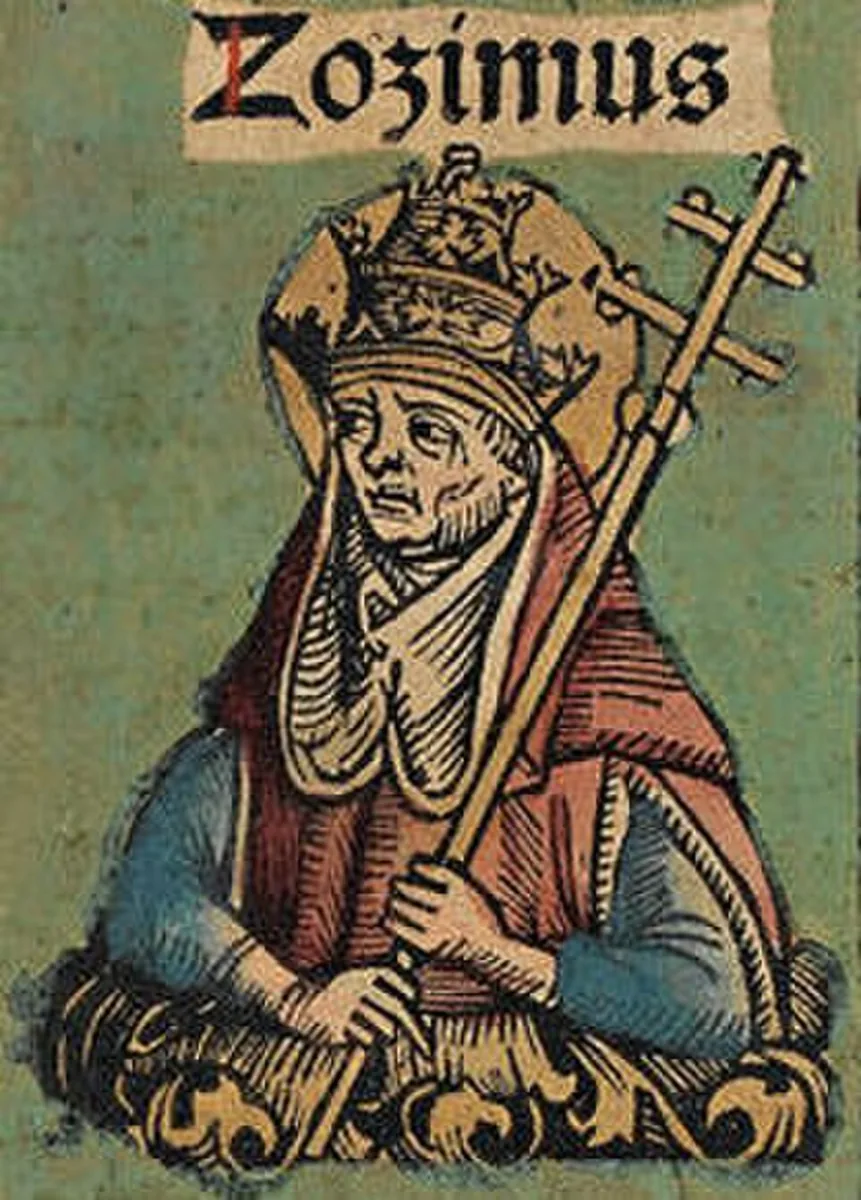
Zosimus has no personal attribute established by tradition. In the Nuremberg Chronicle of 1493, he appears as a pope wearing the tiara and holding a book, a reminder of his letters and teaching. Like other early popes, he also figures in the series of papal portraits, in papal vestments and identified by his name.

Where to pray to Saint Zosimus
- Rome: the Basilica of San Lorenzo Outside the Walls (Saint Lawrence), where he was buried.
- Rome: the Basilica of San Clemente, where he heard Caelestius in 417.
His name appears in the martyrologies only from the 9th century. He is celebrated today on December 26, the day after Christmas, which is also the feast of Saint Stephen, the first martyr.
Discover also
- Saint Innocent I, his predecessor, who had already condemned Caelestius.
- Saint Boniface I, his successor.
- Saint Augustine of Hippo, the great opponent of Pelagius.
- Saint Celestine I, who continued the fight against Pelagianism after him.
- Saint Leo the Great, who settled the dispute between Arles and Vienne.