Saint Phoebe was a Christian of Cenchreae, the eastern port of Corinth, in the first century. She appears in only two verses of the New Testament, at the beginning of the last chapter of Saint Paul's Letter to the Romans, where the apostle warmly recommends her. These few lines are enough to make her one of the rare women whom Paul names as holding a service in a local Church. The Roman Martyrology commemorates her on September 3.
Who was Saint Phoebe?
All that we know of her is contained in this passage, here in the Douay-Rheims translation:
"And I commend to you Phebe, our sister, who is in the ministry of the church, that is in Cenchrae: That you receive her in the Lord as becometh saints; and that you assist her in whatsoever business she shall have need of you. For she also hath assisted many, and myself also." (Romans 16:1-2)
Paul wrote this letter around the middle of the 50s, probably from Corinth, before leaving for Jerusalem. Cenchreae, a few miles from Corinth on the Saronic Gulf, was the harbor through which ships sailed toward Asia Minor and the East. The Acts of the Apostles mention that Paul stopped there (Acts 18:18). A Christian community had taken root in this busy port, and Phoebe was one of its members.
Her name, which means "the bright one" in Greek, is that of a figure from mythology, so she was most likely of pagan background before becoming a Christian. Nothing is known about her birth, her family or her death. The dates and places sometimes given for her are conjecture.

"Minister of the church": what does this title mean?
For Phoebe, Paul uses the Greek word diakonos, translated according to context as "servant," "minister" or "deaconess." It is the same word he uses elsewhere for himself and his co-workers. He adds that she had been a prostatis to many, and to himself: a word that means a protector, a benefactor, even a patron in the ancient sense. The French ecumenical translation of the Bible (TOB) concludes from this that she was probably a person of high standing who had intervened several times on behalf of Christians.
It is difficult to know exactly what function this title covered in such a young Church, at a time when ministries were not yet fixed. Biblical scholars debate it, and the question also comes up in current discussions about women and the diaconate. What is certain is that Phoebe exercised a recognized service in her community and that Paul trusted her fully.
Did Phoebe carry the Letter to the Romans?
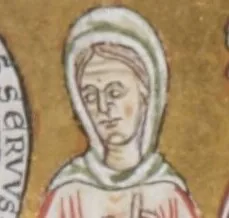
If Paul recommends her at the very start of his closing greetings, it is probably because she was traveling to Rome. Many commentators, since antiquity, have concluded that she was entrusted with carrying the letter itself to its readers. It is a likely hypothesis, taken up by medieval illustrations, but the text does not say so explicitly. The Benedictine biblical scholar Augustin Calmet also suggested that Paul may have stayed in her house when he passed through Corinth.
If she did carry it, Phoebe would have been the first to bring to Rome the letter that has shaped Christian thought on grace, faith and salvation more than almost any other. In the ancient world, such letters were entrusted only to people the sender trusted completely.

Why is Saint Phoebe honored today?
Phoebe is a saint of the very beginnings, whose memory rests on two sentences. But those two sentences say what matters most: a woman of faith, generous, who put her means and her time at the service of the young Church and of its apostles, so much so that Paul asks the Romans to welcome her as he would welcome them himself. She reminds us of the place of women in the first Christian communities and of the value of those who support, often behind the scenes, the proclamation of the Gospel.
She can be invoked by all who serve their parish in quiet ways: those who welcome newcomers, open their homes, give generously, carry messages or organize the life of a community. Her example also speaks to benefactors, who use their resources for the good of the Church, and to travelers on a mission.
To pray with her, see the prayer to Saint Phoebe and the novena to Saint Phoebe, prayed from August 26 to September 3.
Symbols and how to recognize Saint Phoebe in art
Representations of Phoebe are rare. Her main attribute is the letter scroll, recalling the tradition that she carried Paul's Letter to the Romans. An illumination of 1164 shows her receiving the letter from the hands of Saint Paul. In icons, she appears as a woman wrapped in a cloak, holding a scroll.

Where to pray to Saint Phoebe
No shrine or relic of Saint Phoebe is known with certainty. The best place to meet her is the Bible itself: read slowly the sixteenth chapter of the Letter to the Romans, with its long list of men and women who served the Gospel alongside Paul. Pilgrims to Greece can also visit the archaeological site of ancient Cenchreae (Kechries), near Corinth, where she lived.
Discover also
- Saint Paul, the apostle who recommended her to the Romans.
- Saint Tychicus, another co-worker of Paul who carried his letters.
- Saint Timothy, the faithful companion of the apostle, named in the same chapter of the Letter to the Romans.
- Saint Thecla, a woman in Paul's circle according to tradition.
- Saint Lydia, the purple-cloth merchant of Philippi baptized by Paul, who opened her home to the apostle.
- Saint Martha, another woman of the New Testament known for her service.