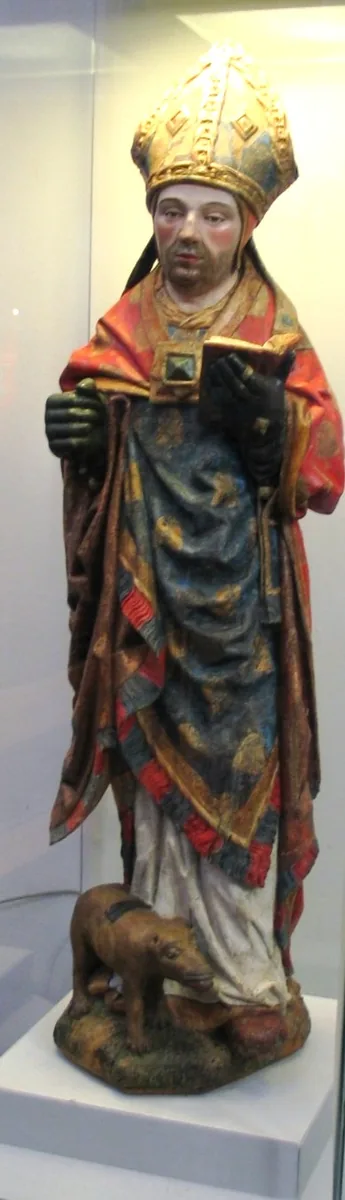
Saint Remaclus (Remacle in French) was a seventh-century monk and abbot, born in Aquitaine and trained at the great monastery of Luxeuil. He became the first abbot of Solignac, in the Limousin region of France, and then founded the twin abbeys of Stavelot and Malmedy in the Ardennes, in present-day Belgium. Part of the tradition also counts him among the bishops of Maastricht. He died at Stavelot around 673, is the patron saint of the town of Spa, and his feast day is September 3.
Who was Saint Remaclus?
Remaclus (Latin Remaclus) belongs to the great generation of monks who brought the Christian faith to northern Gaul in the seventh century. They worked in the wake of the Irish missionary Saint Columbanus, with the support of the Merovingian kings and the leading families of Austrasia, the eastern part of the Frankish kingdom.
What we know of his life comes from a biography written at Stavelot in the ninth century, together with the foundation charters of his monasteries, which allow historians to date several episodes. His name remains bound to the Ardennes: for more than a thousand years Stavelot was the great religious and political center of the region, and the abbey later became the seat of a small principality.
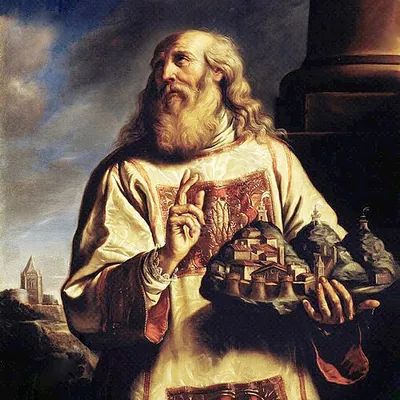
He is shown as an abbot or a bishop, accompanied by a wolf carrying stones, a memory of a legend from the founding of Stavelot.

From Aquitaine to Luxeuil
Born around 600 into an Aquitanian family, Remaclus received a solid Christian education. He entered the monastery of Luxeuil, in the Vosges mountains, founded by Saint Columbanus a few decades earlier.
At that time Luxeuil was a seedbed of monks, abbots and bishops who spread across the whole Frankish kingdom. Its communities combined the rule of Columbanus with the rule of Saint Benedict, a mixture that shaped many monasteries of the age.
First abbot of Solignac
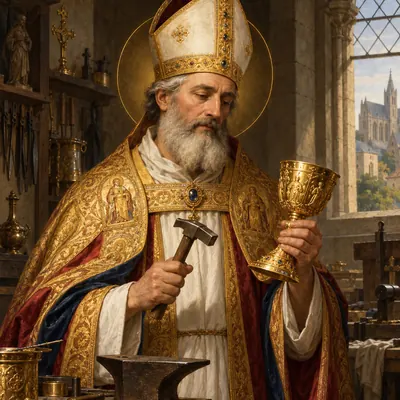
Around 632, Saint Eligius (Éloi), goldsmith and counselor of King Dagobert, founded the monastery of Solignac in the Limousin, on land the king had given him. He asked Luxeuil for an abbot able to lead it, and Remaclus was chosen.
The new abbot organized the community according to the customs of Luxeuil, uniting the rules of Columbanus and Benedict. Solignac quickly became a flourishing monastery.
Founder of Stavelot and Malmedy
A few years later Remaclus was called to Austrasia. He first led the monastery of Cugnon, on the Semois river, founded by King Sigebert III. Then, with the support of the king and of Grimoald, mayor of the palace, he received a vast stretch of the Ardennes forest to found a double monastery: Malmedy and Stavelot, on two neighboring rivers. The two abbeys remained united under a single abbot for more than a thousand years.
The legend of the wolf
Legend says that while Stavelot was being built, a wolf devoured the donkey that carried the stones. Remaclus ordered the wolf to take the donkey's place, and the animal obeyed meekly. This wolf loaded with stones still appears today in the coat of arms of Stavelot.

Was Saint Remaclus a bishop of Maastricht?
Part of the tradition makes Remaclus the successor of Saint Amand in the see of Tongeren-Maastricht around 650, before he withdrew to Stavelot and made way for Saint Theodard. Historians remain cautious. The title of bishop given to him might also reflect the role of an abbot-bishop, fairly common at the time in these missionary regions.
Remaclus died at Stavelot around 673 and was buried there.
Why is Saint Remaclus the patron saint of Spa?
Devotion to Saint Remaclus is very much alive in the Belgian Ardennes, in the Grand Duchy of Luxembourg, in the German Eifel and in the French Ardennes, where many churches are dedicated to him. He is the patron of the town of Spa, whose main church bears his name together with that of Our Lady.
Near Spa, a stone marked with a footprint and known as the "foot of Saint Remaclus" is linked to an old popular devotion. The Benedictine monastery of Saint-Remacle at Wavreumont, near Stavelot, carries his name into monastic life today. Because he gave the region its first great monastic centers, he is naturally invoked as the patron of Stavelot as well.
Symbols and how to recognize Saint Remaclus in art
- The wolf carrying stones: his most distinctive attribute, taken from the legend of the building of Stavelot.
- The crosier: the staff of an abbot, or of a bishop in images that follow the Maastricht tradition.
- Monastic habit or episcopal vestments: he is shown either as an abbot or as a bishop.
- The shrine of Stavelot: the great reliquary itself has become an image of his memory.
What can we learn from Saint Remaclus?
Remaclus was a builder of monasteries, a monk who accepted being sent from one end of the kingdom to the other to serve wherever the Church needed him. The legend of the wolf says something of his gentleness and his strength: even what is wild can be tamed and put at the service of good.
He can be invoked for monks and nuns, for rural and forest regions, for people who must change place or mission, and for the town of Spa. You can pray with him using the prayer to Saint Remaclus or the novena to Saint Remaclus.
Where to pray to Saint Remaclus
His relics rest in a great shrine of Mosan goldsmith work completed between 1263 and 1268, one of the masterpieces of that art. After the abbey was suppressed during the French Revolution, the shrine was moved to the parish church of Saint Sebastian in Stavelot, where it can be seen today.
- Stavelot (province of Liège, Belgium): the church of Saint Sebastian, which holds his shrine, and the site of the former abbey.
- Malmedy: the cathedral, once the abbey church of the other monastery he founded.
- Spa: the church of Our Lady and Saint Remaclus, dedicated to its patron.
- Wavreumont (Stavelot): the Benedictine monastery of Saint-Remacle.
- Solignac (Haute-Vienne, France): the Romanesque abbey church, on the site of the monastery where he was the first abbot.
Discover also
- Saint Eligius, founder of Solignac, who made him its first abbot.
- Saint Columbanus, founder of Luxeuil, where he was formed.
- Saint Sigebert III, the king who supported the founding of Stavelot and Malmedy.
- Saint Amand, another great missionary of the Maastricht region.
- Saint Lambert of Maastricht, bishop of the following generation.