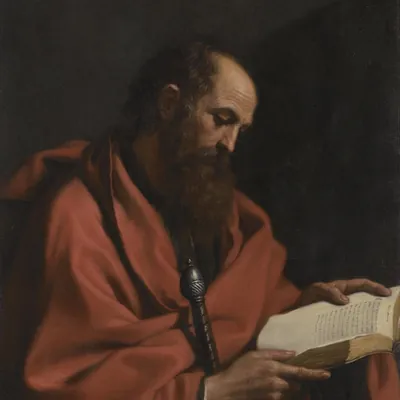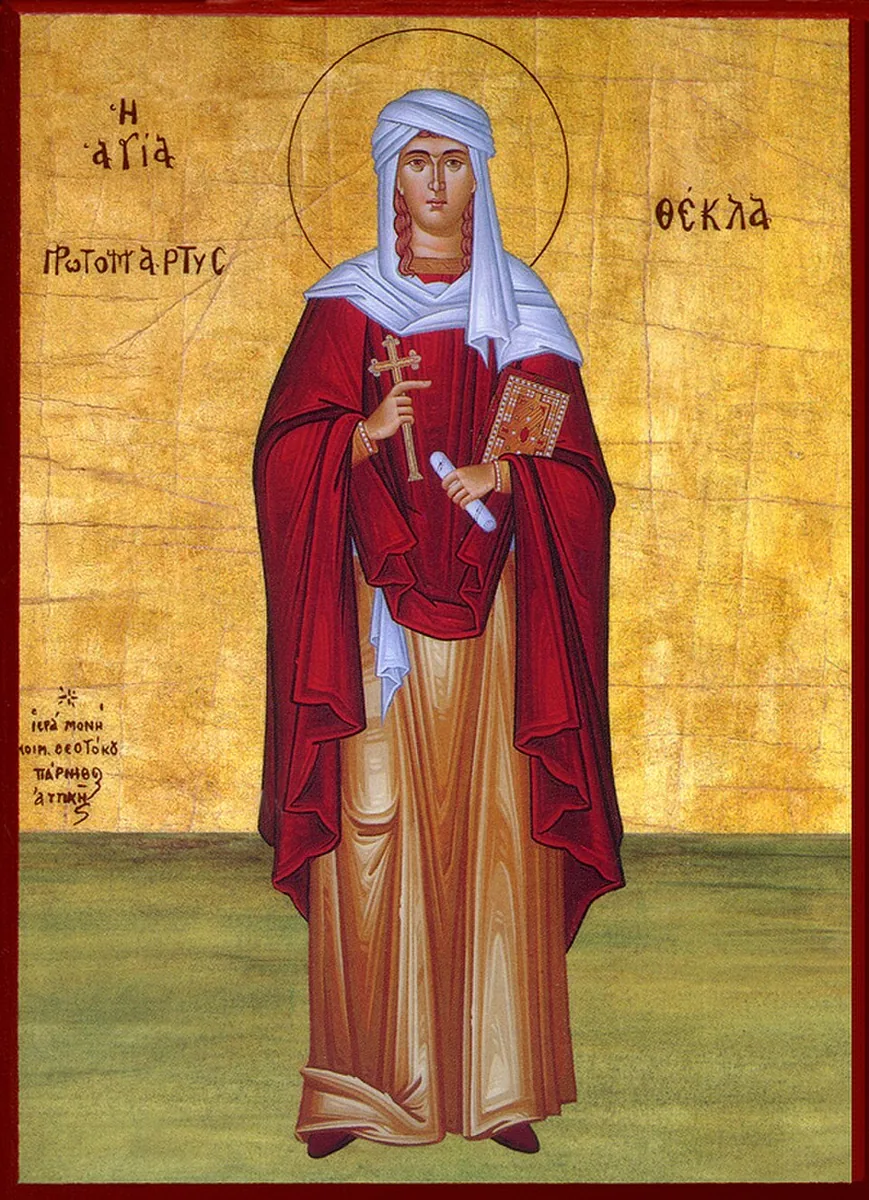
Saint Thecla is, according to tradition, a young woman of Iconium, in Asia Minor, who was converted by the preaching of Saint Paul. Her story comes to us through the Acts of Paul and Thecla, a 2nd-century narrative that the Church did not include among the books of the Bible, but which nourished the devotion of East and West for centuries. Honored as the first woman martyr, even though she survived her torments, and as "equal to the apostles" in the Eastern Churches, she is traditionally celebrated on September 23 in the West and September 24 in the East.
Who was Saint Thecla?
It is impossible to reconstruct Thecla's life with certainty. Everything told about her comes from the Acts of Paul and Thecla, a text written in Greek in the 2nd century. Around the year 200, the writer Tertullian reports that a priest in Asia who had written such an account admitted that he composed it "out of love for Paul," and was removed from office. The text therefore belongs more to pious legend than to history.
Yet her cult is very ancient and very widespread. From the 4th century, great Fathers of the Church such as Saint Ambrose and Saint Gregory of Nazianzus held her up as an example, and a great shrine rose over her presumed tomb at Seleucia in Isauria.
The girl at the window
The Acts tell that Paul, arriving at Iconium, stayed with a Christian named Onesiphorus and preached there on chastity and the resurrection. In the house next door, a young woman engaged to a man of standing, Thamyris, listened to him for three days and three nights, sitting at her window, unable to tear herself away. Her worried mother and fiancé had Paul arrested. Thecla bribed the guards to join him in prison and sit at his feet.
Paul was driven out of the city. Thecla, who now refused marriage, was condemned to the stake, at her own mother's request. But just as the fire was lit, a violent storm of rain and hail put it out, and the young woman was able to escape and find the apostle again.
Antioch: the beasts of the arena
In Antioch, a powerful man named Alexander fell for Thecla and tried to seize her. She rejected him in public. Accused, she was condemned to the beasts. A noblewoman, Tryphaena, took her under her protection while she awaited her punishment.
In the arena, a lioness lay down at her feet and defended her against the other animals. Seeing a pool full of seals, Thecla threw herself into it, baptizing herself in the name of Jesus Christ. The beasts did not touch her, and the governor finally set her free.
In antiquity this story, with its wondrous episodes, was read as praise of consecrated virginity and of the courage of Christian women. It also gave Thecla her attributes in art.
Seleucia and the spread of her cult
According to the Acts, Thecla saw Paul again at Myra, and he sent her to proclaim the Word. She returned to Iconium, then settled near Seleucia in Isauria, on the south coast of present-day Turkey, where she taught and died in peace.
Her presumed tomb became one of the great pilgrimages of the Christian East. People came there seeking healing, and communities of monks and consecrated virgins settled nearby. Saint Gregory of Nazianzus made a retreat there around 375.
In the West, her name entered some of the oldest prayers of the Church: the commendation of the soul of the dying asked God to deliver the soul of the believer as he had delivered Thecla from her torments. Milan, Tarragona and Este dedicated their cathedral or ancient basilica to her. Her memorial was removed from the General Roman Calendar in 1969 because of the legendary character of her Acts, but her cult continues in many Churches.

Why is Saint Thecla the patron saint of Tarragona?
Tarragona, in Catalonia, received a relic of the saint in 1321. Since then its cathedral has been dedicated to her, and the city keeps her feast with great solemnity every September. More widely, Thecla is a model for disciples who listen to the Gospel and for the women who proclaimed it. She is invoked for young people discerning their vocation, for those threatened because of their faith, and for the dying.
Beyond the legend, Thecla embodies a faith that listens, chooses and holds firm. She lets herself be seized by the Word of God, dares a choice of life against the expectations of those around her, and goes through trials without denying Christ.
Symbols and how to recognize Saint Thecla in art
- The lioness: lying at her feet, a reminder of the arena at Antioch.
- The pyre or flames: the stake at Iconium, put out by the storm.
- The book: the Word she listened to and later proclaimed.
- The martyr's palm: she is honored as the first woman martyr.
- Beside Saint Paul: sometimes listening to him from a window, as in the fresco at Ephesus.
To pray with her, read the prayer to Saint Thecla, or follow the novena to Saint Thecla from September 14 to 22, to finish it on the eve of her feast.
Where to pray to Saint Thecla
- Ayatekla, near Silifke (Turkey): the grotto and ruins of the great shrine of Saint Thecla.
- Maaloula (Syria): the Monastery of Mar Taqla, clinging to the cliff, where a local tradition places her retreat.
- Tarragona (Spain): the Cathedral of Saint Thecla, which keeps a relic of the saint.
- Milan: the remains of the ancient Basilica of Saint Thecla, beneath the Piazza del Duomo.
- Este (Italy): the Cathedral of Saint Thecla and its great painting by Tiepolo.
Discover also
- Saint Paul, the apostle whose preaching converted her according to the Acts.
- Saint Methodius of Olympus, who made her a heroine of his Symposium.
- Saint Agnes, another young virgin martyr honored since antiquity.
- Saint Margaret of Antioch, a virgin martyr of Asia Minor whose legend is close to hers.
- Saint Timothy, another disciple of Paul, from the same region of Lycaonia.