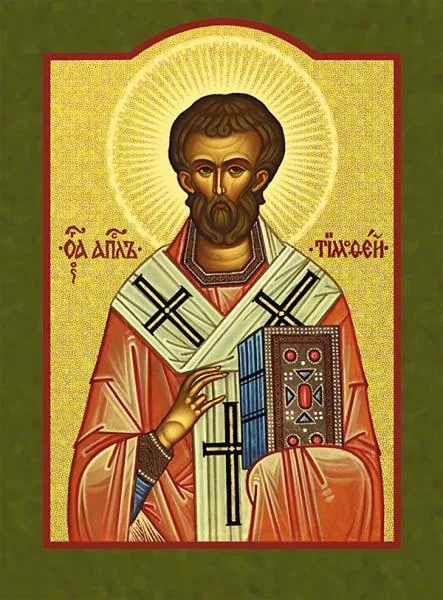
Saint Timothy was the closest disciple of Saint Paul. Born at Lystra, in Asia Minor, to a Jewish mother who had become a Christian and a Greek father, he accompanied the apostle for some fifteen years, carried his messages to the communities and co-signed several of his letters. Two letters of the New Testament are addressed to him. Tradition holds that he was the first bishop of Ephesus. He is celebrated on January 26 together with Saint Titus, the day after the feast of the Conversion of Saint Paul.
Who was Saint Timothy?
Timothy, whose Greek name means "one who honors God," grew up in Lystra, a small town in Lycaonia, in what is now central Turkey. The Book of Acts specifies that he was the son of a Jewish woman who was a believer and of a Greek father (Acts 16:1). The Second Letter to Timothy names his grandmother Lois and his mother Eunice, and praises the sincere faith they passed on to him, as well as his knowledge of the Scriptures from childhood (2 Timothy 1:5; 3:15).
He probably became a Christian during the first visit of Paul and Barnabas to Lystra, around 46-48. When Paul came back to the region a few years later, the brothers of Lystra and Iconium spoke well of the young man, and the apostle decided to take him along.
The companion of Saint Paul
Before taking him along, Paul had Timothy circumcised, because of the Jews of the region who knew his father was Greek (Acts 16:3). The young man then shared the apostle's long journeys on foot, his dangers and his foundations: Macedonia, Philippi, Thessalonica, Beroea, then Athens and Corinth. Later we find him with Paul in Ephesus, and then on the journey that took the apostle toward Jerusalem.
Paul entrusted him with delicate missions. He sent him to Thessalonica to strengthen persecuted Christians (1 Thessalonians 3:2), to Corinth to remind a divided community of the apostle's way of life (1 Corinthians 4:17), and to Philippi for news. To the Philippians, Paul wrote that he had no one else who shared his concerns so sincerely, and that Timothy had served with him "as a child serves his father" (Philippians 2:20-22). His name appears beside Paul's at the head of the Second Letter to the Corinthians, the letters to the Philippians, the Colossians and Philemon, and both letters to the Thessalonians.
The letters to Timothy
Two letters of the New Testament are addressed to Timothy. Together with the Letter to Titus, they form the "Pastoral Letters," devoted to the leadership of Christian communities. Many scholars think they were written after Paul's death by one of his disciples, faithful to his teaching; others hold them to be the work of the apostle himself. In any case, they paint an endearing portrait of Timothy: a leader who was still young, perhaps shy and in fragile health, whom Paul encouraged with affection.
They contain famous words of advice: "Let no one despise your youth" (1 Timothy 4:12), and the call to "rekindle the gift of God" received through the laying on of hands, for God did not give "a spirit of fear, but of power, of love and of self-control" (2 Timothy 1:6-7). The second letter, presented as Paul's testament from captivity, ends with an urgent appeal to come and join him.
Bishop of Ephesus and martyr
The first letter states that Paul left Timothy in Ephesus to combat false teachings and organize the community (1 Timothy 1:3). The historian Eusebius of Caesarea, in the 4th century, reports that he was the first bishop of that great city. A later account, the Acts of Timothy, tells that he was killed by pagans for protesting against the excesses of a religious festival; this is a tradition, not an established fact. In 356, his relics were carried to Constantinople, to the Church of the Holy Apostles, alongside those of Saint Andrew and Saint Luke.
Why is Saint Timothy a patron for young people and families?
The Church has not attached any official patronage to Saint Timothy, but his life speaks clearly. He is the saint of quiet faithfulness: he founded no great Churches under his own name, but he served, handed on and accompanied. His faith came first from his mother and grandmother, which makes him a natural intercessor for families who pass on the faith. A young leader supported by an elder, he is a model for young people who take on commitments, for priests and bishops, and for all who receive a task that seems too great for them. Popular devotion also invokes him for stomach ailments, because of Paul's advice about his frequent illnesses (1 Timothy 5:23). His feast, joined to that of Saint Titus, honors the co-workers without whom Paul's work would not have lasted.
To pray with him, read the prayer to Saint Timothy, or follow the novena to Saint Timothy, from January 17 to 25: it ends on the feast of the Conversion of Saint Paul, the eve of his feast.
Symbols and how to recognize Saint Timothy in art
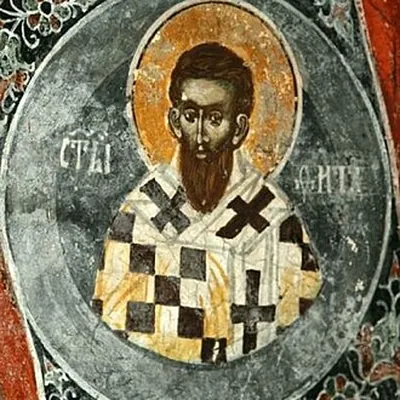
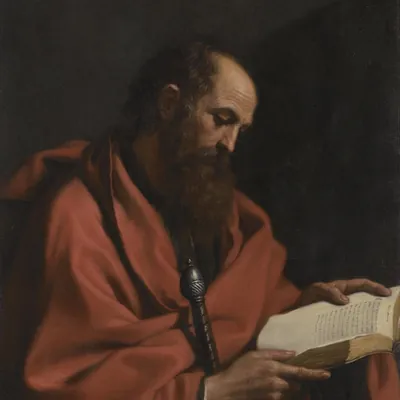
Timothy is usually shown as a young man or as a bishop, sometimes holding a book or a scroll, a reminder of the letters addressed to him and of the Scriptures he knew from childhood. He often appears at the side of Saint Paul, who is recognizable by his sword and his beard. In Eastern icons, he wears the vestments of a bishop.

Where to pray to Saint Timothy
- Termoli (Italy): the cathedral, whose crypt holds relics attributed to Saint Timothy.
- Ephesus (Turkey): the ancient site, near Selçuk, where he led the Church according to tradition.
- Lystra (Turkey): the site of his hometown, near Konya, of which only a mound remains.
- Churches dedicated to him, often together with Saint Titus, in many countries.
Discover also
- Saint Paul, his teacher and his "father in the faith."
- Saint Titus, another co-worker of Paul, celebrated on the same day.
- Saint Silas, who traveled with them through Macedonia and Greece.
- Saint Barnabas, who evangelized Lystra with Paul.
- Saint Onesimus, another disciple of Paul, named in the Letter to Philemon co-signed by Timothy.