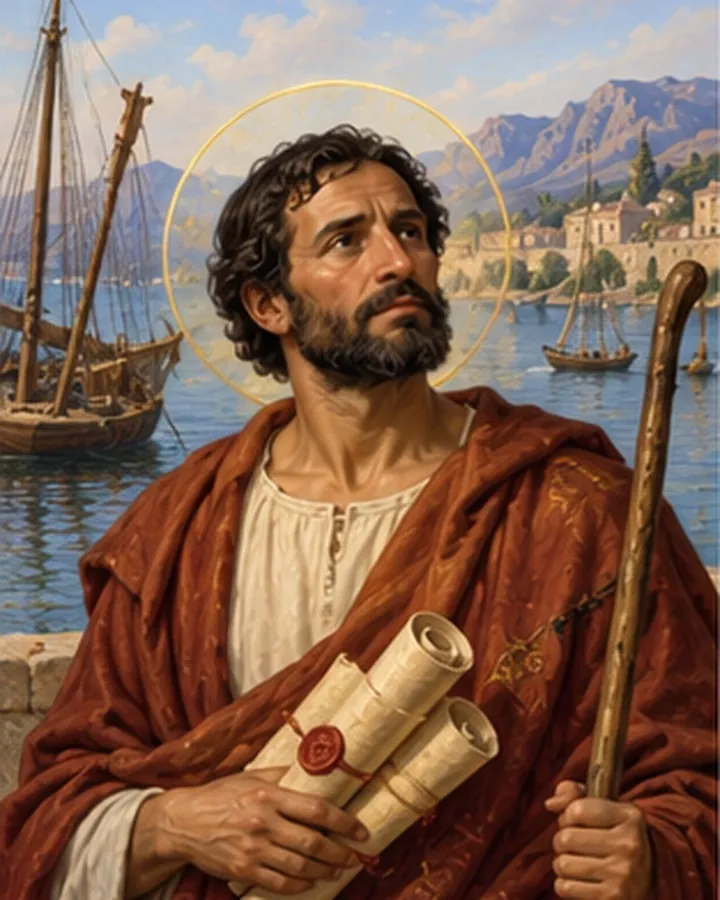
Saint Tychicus was a Christian from the Roman province of Asia, probably from Ephesus, and one of the most faithful companions of the apostle Paul. Paul entrusted him several times with carrying his letters and news to the communities: in a sense, he was the mail carrier of the first Churches. Named five times in the New Testament, he is venerated as a saint and remembered on April 29.
Who was Saint Tychicus?
Tychicus first appears in the Acts of the Apostles (20:4). Around the year 57, when Paul left Greece to go up to Jerusalem, he traveled with a small group of delegates from the Churches, among them "Tychicus and Trophimus" from Asia. These men were probably carrying the collection gathered by the communities for the poor of Jerusalem. Tychicus and Trophimus went ahead and waited for the apostle at Troas.
This was no small responsibility. The collection for Jerusalem was one of Paul's great projects, a sign of communion between the Churches born among the Gentiles and the mother Church of Jerusalem. To be chosen as a delegate for it, Tychicus had to be a man the communities of Asia trusted, both with money and with their good name.
His name is Greek and comes from the word for "fortune" or "chance," a common name at the time. Nothing in it suggests importance. Yet this ordinary man became a link between the apostle and whole Churches.
We meet him again later at the side of Paul in captivity. The Letters to the Colossians and to the Ephesians present him as the man who will carry these texts to their readers and fill in, by word of mouth, the news about the apostle.
The bearer of Paul's letters
In the ancient world there was no postal service for private individuals. A letter traveled in the luggage of a trusted person, who often read it aloud to those it was addressed to, explained it and answered their questions. The role of Tychicus was therefore much more than simple delivery.
Paul says so plainly to the Colossians: "All the things that concern me, Tychicus, our dearest brother, and faithful minister, and fellow servant in the Lord, will make known to you: whom I have sent to you for this same purpose, that he may know the things that concern you, and comfort your hearts" (Colossians 4:7-8, Douay-Rheims). Almost the same words close the Letter to the Ephesians (6:21-22), which many scholars see as a circular letter meant for several Churches of Asia.
For the Letter to the Colossians, Tychicus traveled with Onesimus, the runaway slave whom Paul was sending back to his master Philemon. One can imagine how delicate this mission was: accompanying a man returning to the one he had left, with a letter from Paul asking that he be welcomed as a brother.
A trusted man to the end
Paul kept relying on him. In the Letter to Titus, he plans to send "Artemas or Tychicus" to Crete so that Titus can come and join him (Titus 3:12). In the Second Letter to Timothy, written in the last period of the apostle's life, he notes simply: "Tychicus I have sent to Ephesus" (2 Timothy 4:12). To the very end, Tychicus remained the one Paul could send where he could not go himself.
What tradition says
The rest of his life is little known. Several cities claimed him as their bishop: Colophon, Chalcedon and Neapolis. Some martyrologies present him as a deacon, and the Roman Martyrology commemorates him at Paphos, on the island of Cyprus. A tradition also counts him among the seventy disciples sent out by Jesus. These traditions are late and cannot be verified, but they show the attachment of the Eastern Churches to this companion of Paul.

Is Saint Tychicus the patron saint of anything?
No official patronage is traditionally attached to Saint Tychicus. Yet he is easily seen as the saint of faithful go-betweens: those who pass on, connect and explain without putting themselves forward. Mail carriers, messengers, translators, journalists, parish secretaries, catechists and all who carry someone else's word can find in him a friend. Paul calls him "dearest brother" and "faithful minister." His holiness is a reminder that the Gospel spread thanks to trustworthy men and women who took to the road to carry a message that was not their own and to comfort distant communities.
Symbols and how to recognize Saint Tychicus in art
Images of Tychicus are rare. In Byzantine art, such as the Menologion of Basil II, he appears standing among other disciples of Paul, as a bearded man in the robes of a bishop or deacon. When he is shown alone, a letter or scroll is the most fitting sign of his mission, sometimes with a traveler's staff.
Where to pray to Saint Tychicus
- Ephesus, in present-day Turkey: the ancient city that was probably his hometown, a major pilgrimage site linked to Saint Paul and Saint John.
- Paphos, in Cyprus: the place where the Roman Martyrology commemorates him.
He can be prayed to anywhere, especially on April 29 or while reading the closing lines of Colossians and Ephesians. See the prayer to Saint Tychicus and the novena to Saint Tychicus.
Discover also
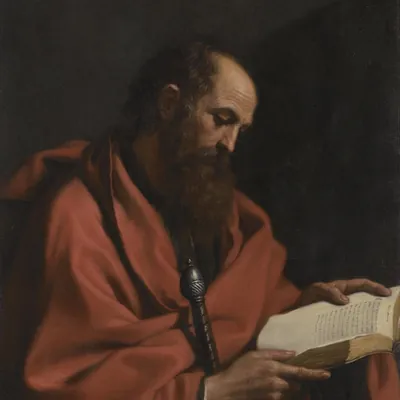
- Saint Paul, whose letters he carried.
- Saint Onesimus, his traveling companion to Colossae.
- Saint Epaphras, founder of the Church of Colossae.
- Saint Timothy, to whom Paul announced that he was sending Tychicus to Ephesus.
- Saint Epaphroditus, another messenger between Paul and the Churches.