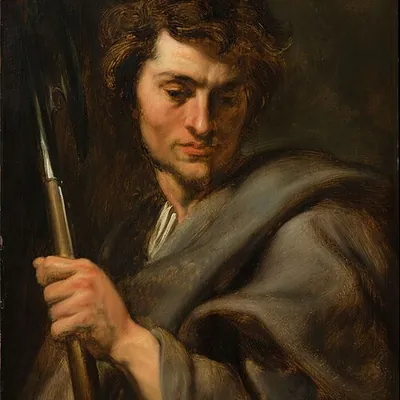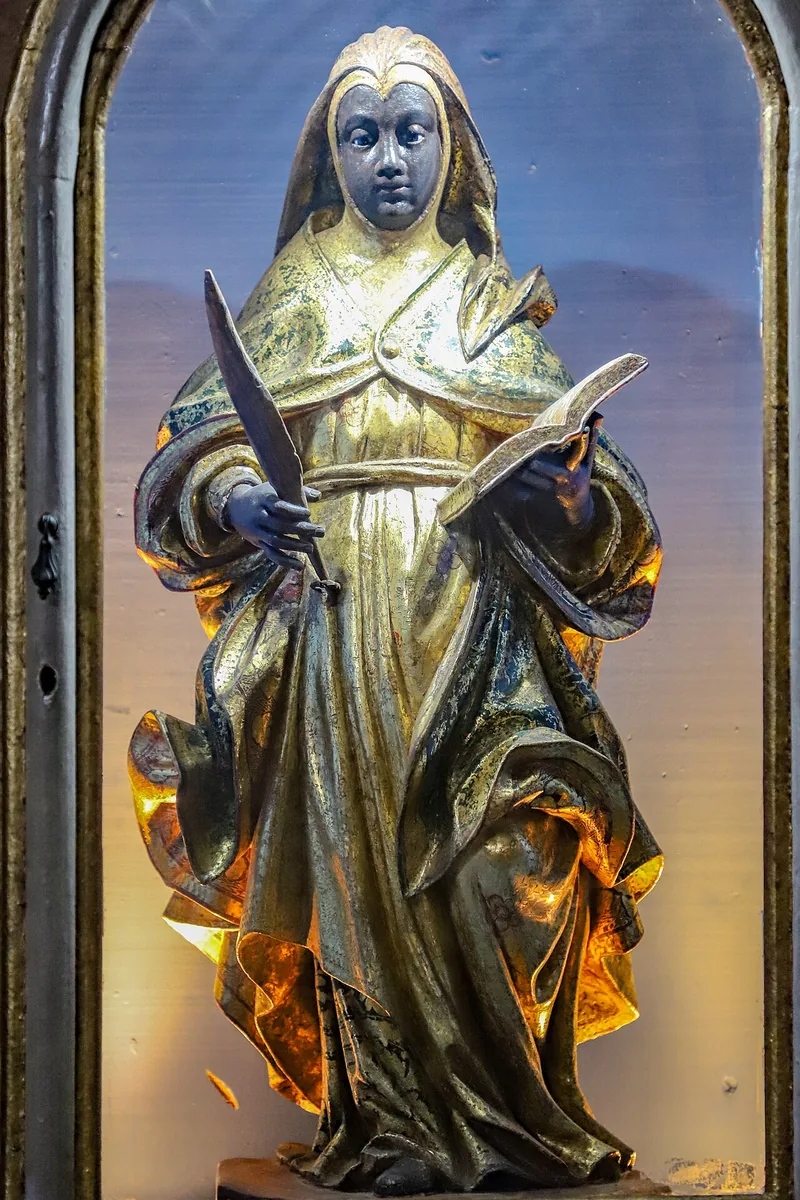
Saint Ephigenia (also Iphigenia), known as Ephigenia of Ethiopia, was a virgin of the 1st century who, according to tradition, was baptized by the apostle Saint Matthew during his mission in Ethiopia and consecrated herself to God. She is known mainly through The Golden Legend of Jacobus de Voragine. Her feast day is September 21, the same day as Saint Matthew, and she is greatly venerated in Brazil and Latin America.
Who was Saint Ephigenia?
All that we know of Ephigenia comes from legendary accounts, connected with the tradition of the apostle Matthew's mission in Africa. The best known is that of The Golden Legend, written in the 13th century by the Dominican Jacobus de Voragine. So it must be said clearly: her story belongs to pious tradition, not to documented history. The Church nevertheless entered her in the Roman Martyrology, which presents her soberly: "In Ethiopia, Saint Iphigenia, virgin, who was baptized and consecrated to God by the blessed apostle Matthew, ended her holy life in peace." Above all, her cult has become very important in the Portuguese and Spanish speaking world, where she is honored as one of the great Black saints.

The account of The Golden Legend
According to The Golden Legend, Ephigenia was the daughter of Egippus, king of Ethiopia (or Nubia). Saint Matthew, who had come to preach in that country, converted the king, the queen, their son and their daughter. He founded a Church and entrusted to Ephigenia, who had consecrated herself to Christ, the leadership of a community of more than two hundred virgins.
When Egippus died, his brother Hirtacus took the throne and wanted to marry the young woman. He asked the apostle to persuade her. The following Sunday, Matthew preached before the king and explained that Ephigenia, being consecrated, already belonged to the eternal King and could not be given to another. Enraged, Hirtacus had the apostle stabbed while he was celebrating, then tried to set fire to the house of the virgins. The account says that the flames turned back against the palace. The king, struck by illness, came to a tragic end, and Ephigenia's brother succeeded him, helping the Churches to spread throughout the kingdom.
A saint venerated in the Afro-American world
From the early modern period, Saint Ephigenia was honored in Spain, in Portugal and above all in their colonies in America, alongside other African saints. Brotherhoods of Black people, free or enslaved, chose her as their patron and built churches in her honor. In Brazil, the church of Santa Efigênia in Ouro Preto, in Minas Gerais, is a famous witness to this, and the popular festival of the Congado there associates Our Lady of the Rosary with the saint. She is often depicted as a nun, holding a small house or church in flames, in memory of the burning of her convent; for this reason popular piety invokes her against fire and for the protection of homes.

What can we learn from Saint Ephigenia?
Beyond the legendary details, the figure of Ephigenia says two things. First, the freedom of a woman who chose to give herself to Christ and stood firm before power. Second, the universality of the Church: from the beginning, tradition wished to recognize an African saint among the first fruits of the apostles' preaching. Those who suffered slavery found in her a sister and a protector. We can pray to her for consecrated women, for the Christians of Africa and for all who struggle for their dignity.
Where to pray to Saint Ephigenia
- Ouro Preto (Minas Gerais, Brazil): the church of Santa Efigênia, a major center of her cult.
- São Paulo (Brazil): the church of Santa Ifigênia, in the city center.
- In any church, on September 21, in union with the feast of Saint Matthew.
Discover also
- Saint Matthew, the apostle who, according to tradition, baptized her.
- Saint Philip the Deacon, who baptized the Ethiopian eunuch according to the Acts of the Apostles.
- Saint Benedict the Moor, another saint greatly venerated by Black brotherhoods.
- Saint Martin de Porres, saint of Peru, son of a mother of African descent.