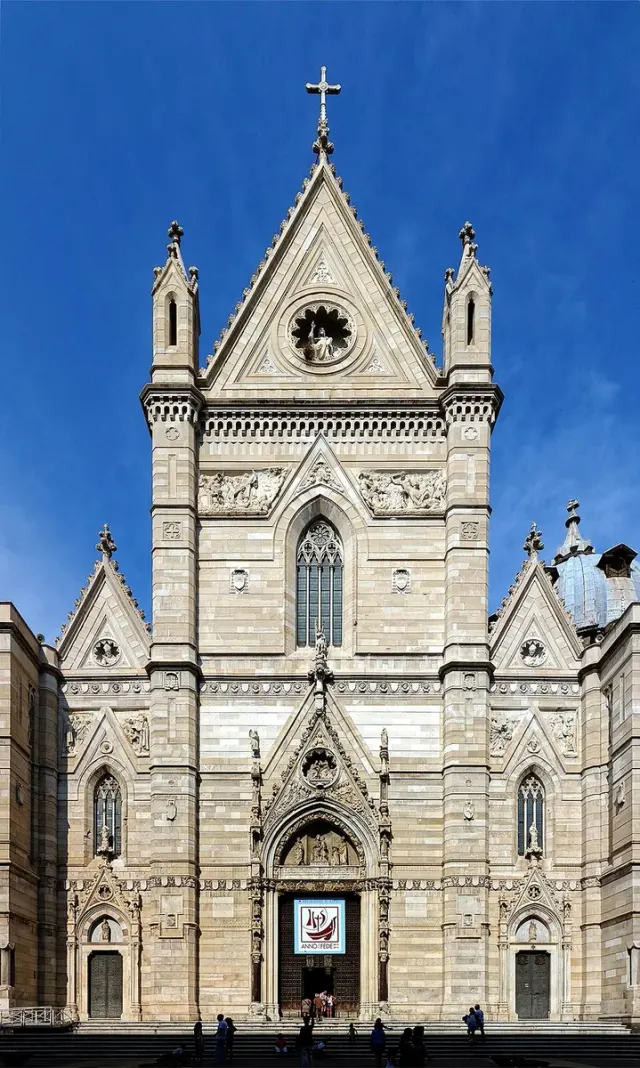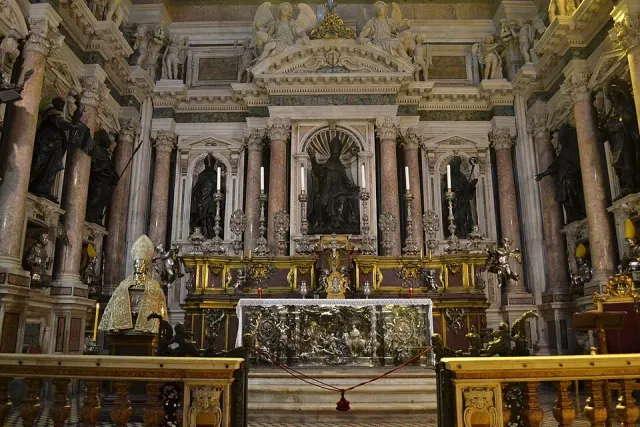
Saint Januarius, San Gennaro in Italian, was a Bishop of Benevento who died a martyr near Pozzuoli, on the Bay of Naples, during the Great Persecution of Diocletian, around 305. The patron saint of Naples, he is one of the most popular saints of southern Italy. His fame also rests on a phenomenon observed since the fourteenth century: the liquefaction of the blood kept in glass vials in Naples Cathedral. He is celebrated on September 19.
Who was Saint Januarius?
Little is known for certain about the life of Januarius. The accounts of his martyrdom, called "Acts," were written several centuries after the events and mix ancient memories with legendary elements. What is certain is the antiquity of his cult: from the fifth century his remains were venerated in Naples, and the catacombs that bear his name preserve one of the oldest known portraits of the saint, painted in fresco.
According to tradition, Januarius was Bishop of Benevento, a town in inland Campania, at the beginning of the fourth century. Local traditions disagree about his birthplace: both Naples and Benevento claim him. He is associated with a group of martyrs from the region, including the deacon Sossius of Misenum, the deacon Festus and the lector Desiderius, as well as Proculus, a deacon of Pozzuoli, and two laymen, Eutyches and Acutius.
The martyrdom at Pozzuoli
The traditional account says that Januarius learned of the arrest of Sossius, deacon of Misenum, and went to visit him in prison with his companions. Arrested in turn, they were brought before the governor of Campania. Condemned to be thrown to wild beasts in the amphitheater of Pozzuoli, they were reportedly spared by the animals. They were finally beheaded near the Solfatara, the volcanic crater that overlooks the town.
The legendary element is clear in these details, which are found in other martyrdom accounts too. But the heart of the testimony is solid: a bishop and several clerics of Campania gave their lives for Christ in the time of Diocletian, and the memory of their death was kept by the neighboring Churches. Today a small sanctuary at the Solfatara keeps the stone on which, according to tradition, Januarius was beheaded.

The long journey of the relics
The story of the relics of Januarius is eventful. In the fifth century, the Bishop of Naples had them moved to the catacombs of Capodimonte, which became a place of pilgrimage and took the saint's name. In 831, Prince Sico of Benevento, at war with Naples, seized them and carried them off to his capital. In the twelfth century they were placed in the Abbey of Montevergine, in the mountains near Avellino, where they were forgotten and later rediscovered.
In 1497, Cardinal Oliviero Carafa obtained their return to Naples. Under the choir of the cathedral he built a Renaissance crypt, the Succorpo, where the saint's bones still rest.
The blood of Saint Januarius
In the Chapel of the Treasure of Naples Cathedral, two glass vials are kept containing a dark substance venerated as the martyr's blood. Several times a year, especially on the Saturday before the first Sunday of May, on September 19 and on December 16, the archbishop shows the reliquary to the faithful. Sometimes the solid substance becomes liquid: the crowd greets it with joy, and Neapolitans see a failure to liquefy as a bad omen.
The Church has never defined this phenomenon as a miracle in the strict sense, and it has been studied by scientists without a definitive explanation. The Church allows it to be venerated as a sign that invites prayer and remembrance of the martyrs. For Neapolitans, "San Gennaro" is above all a close protector, invoked in epidemics and during eruptions of Vesuvius.

Why is Saint Januarius the patron saint of Naples?
Since the fifth century, Naples has kept and venerated his remains, and for centuries the city has turned to him in its hardest hours: plague, war, the eruptions of Vesuvius. In 1527, during an epidemic, the city vowed to build him a chapel, and the great procession of 1631 sealed his role as protector against the volcano. The bond is so strong that the whole city follows the news of the liquefaction of his blood.
Neapolitan emigrants carried this devotion across the world. In New York, the Feast of San Gennaro in Little Italy has been held every September for generations, with a procession and a great street festival.
More deeply, Saint Januarius is a pastor who did not run away: according to tradition, he was arrested while visiting a brother in prison. His example reminds us that faithfulness to Christ includes solidarity with those who suffer for their faith. To pray with him, read the prayer to Saint Januarius, or follow the novena to Saint Januarius, from September 10 to 18, the eve of his feast.
Symbols and how to recognize Saint Januarius in art
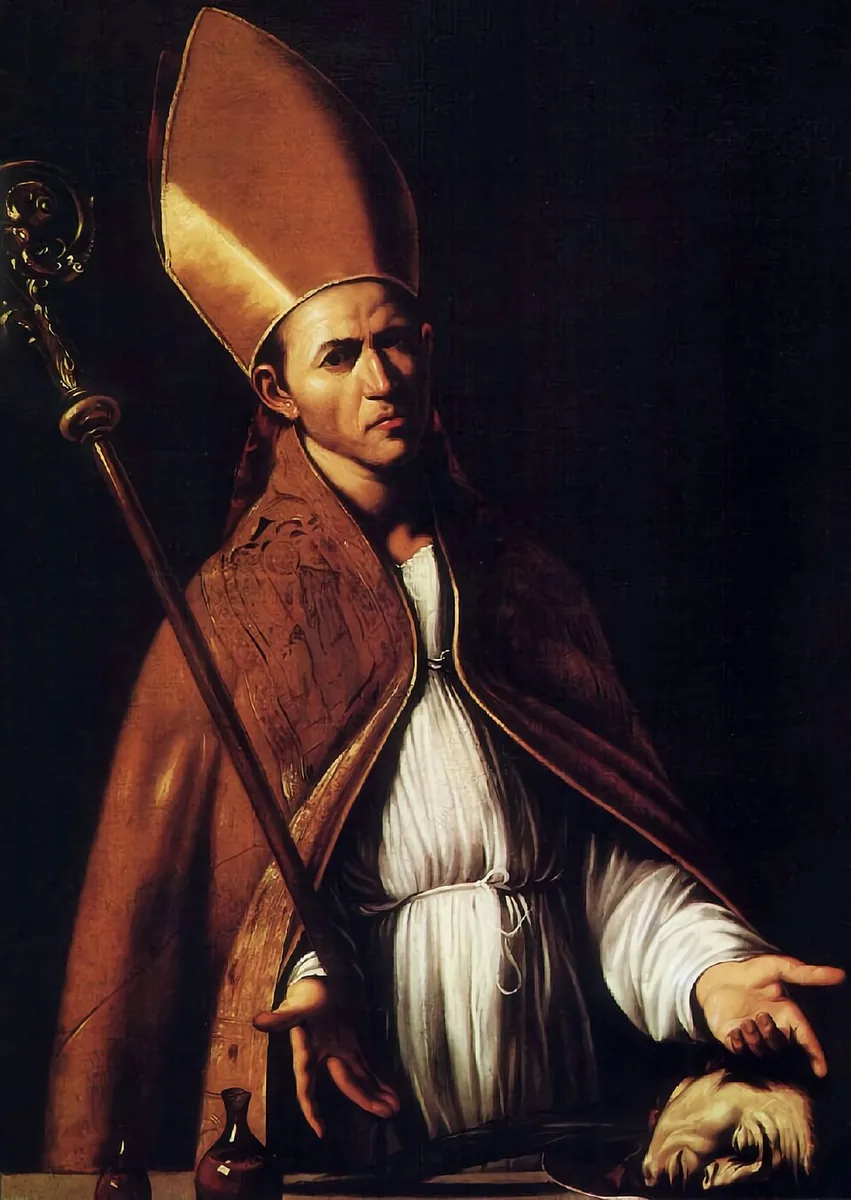
- Bishop's vestments: miter, crosier and red vestments of a martyr.
- Two vials of blood: often shown on a book he holds, recalling the relic of Naples.
- Vesuvius: in many paintings he stretches out his hand to stop the eruption over the city.
- The furnace: according to one tradition he came out of a fiery furnace unharmed, a scene painted by José de Ribera in the Chapel of the Treasure.
Where to pray to Saint Januarius
- Naples: the cathedral and the Chapel of the Treasure of San Gennaro, with the crypt of his relics.
- Naples: the Catacombs of San Gennaro, at Capodimonte, his first burial place.
- Pozzuoli: the Sanctuary of San Gennaro alla Solfatara, on the traditional site of his martyrdom.
- Benevento: the cathedral of the city where he was bishop.
- New York: the Church of the Most Precious Blood in Little Italy, center of the annual San Gennaro festival.
Discover also
- Saint Vincent of Saragossa, a deacon martyred in the same persecution of Diocletian.
- Saint Sebastian, a Roman martyr also invoked against epidemics.
- Saint Lucy of Syracuse, a martyr of southern Italy in the time of Diocletian.
- Saint Alphonsus Liguori, a Neapolitan, Doctor of the Church and another great saint of Naples.
- Saint Rosalia, patron saint of Palermo, invoked against the plague.