Saint Alphonsus Maria de Liguori (1696-1787) was a Neapolitan priest and bishop and the founder of the Redemptorists, the Congregation of the Most Holy Redeemer. A brilliant lawyer who became a missionary to the poorest countryside of the Kingdom of Naples, he left an immense body of writing, from moral theology to some of the most popular devotional books ever written. Canonized in 1839, declared a Doctor of the Church in 1871 and named patron of confessors and moral theologians, he is celebrated on August 1, the day of his death.
Who was Saint Alphonsus Liguori?
Alphonsus was born on September 27, 1696, at Marianella, just outside Naples, into a noble family. His father, Giuseppe de Liguori, was an officer of the royal galleys, an authoritarian man with great ambitions for his eldest son. His mother, Anna Caterina Cavalieri, a woman of deep faith, taught him to pray, to say the rosary and to love the Virgin Mary. From the age of seven, the boy was guided by a priest of the Oratory, the congregation founded by Saint Philip Neri.
Highly gifted, Alphonsus received a complete education: ancient and modern languages, mathematics and philosophy, but also painting and music. He entered the University of Naples at thirteen and earned his doctorate in law at seventeen, on January 21, 1713, with a dispensation for his age.
The lawyer who lost his case
As a young lawyer, Alphonsus set himself a demanding code of conduct in a Neapolitan justice system that was often corrupt. He also led the social life of a young nobleman, while visiting the sick in hospital with a confraternity. During Holy Week 1722, a retreat shook him deeply, and he decided to become a priest.
The following year, in 1723, he argued one of the most important cases in Naples and lost it. Humiliated, he shut himself in his room for several days and gave up the law. Despite his father's anger, he took clerical dress on October 23, 1723.
Ordained a priest on December 21, 1726, he chose to devote himself to the poorest people of Naples, the lazzari. He preached in simple language, without rhetorical flourishes, and gathered thousands of the faithful into a fellowship of prayer and catechesis, the "Evening Chapels." He also accompanied men condemned to death, and later advised priests to speak to them above all of the mercy of God.

Founder of the Redemptorists
In 1730, exhausted, Alphonsus went to rest in the mountains of Scala, above Amalfi. There he met shepherds and peasants completely without priests. With the support of Bishop Tommaso Falcoia and of the nun Maria Celeste Crostarosa, he founded on November 9, 1732, a congregation of missionaries devoted to the most abandoned people of the countryside. The beginnings were hard: in 1733 almost all his companions left him. He held on, and the rule was approved by Benedict XIV in 1749.
For more than twenty-five years Alphonsus traveled through the villages of the Kingdom of Naples. His method was original: after each mission, the missionaries returned a few months later to "renew" the mission and strengthen what had been sown. Today the Redemptorists serve throughout the world, including in the United States, Ireland, Great Britain, the Philippines and India.
The writer and Doctor of the Church
Alphonsus wrote a great deal, often while ill and at night. His Moral Theology, written between 1748 and 1785, seeks a balanced path between rigorism, which drives sinners to despair, and laxism, which deceives them. That is why Pope Pius XII proclaimed him in 1950 the "heavenly patron of all confessors and moralists."
He also wrote devotional works that spread very widely, such as The Glories of Mary (1750), the Visits to the Blessed Sacrament and a prayer of spiritual communion still recited all over the world. His meditations on the Stations of the Cross are still prayed in many English-speaking parishes during Lent. A musician, he also composed popular hymns, including the Italian Christmas carol Tu scendi dalle stelle.

A reluctant bishop, tested to the end
In 1762, at sixty-six, he had to accept, out of obedience to the pope, the bishopric of Sant'Agata de' Goti, a small, poor and neglected diocese. For thirteen years he reformed the clergy and the seminary, fed the poor during the famine of 1764 and preached tirelessly. An illness in 1768-1769 left him paralyzed, his head bent onto his chest, as his portraits show. He was allowed to resign in 1775.
His last years were the most painful. In 1780, misled by those close to him, he signed a document, the Regolamento, that distorted the rule of his congregation in order to gain the approval of the King of Naples. Pope Pius VI then separated him from the houses in the Papal States. For more than seven years Alphonsus lived as an outcast from the work he had founded, and went through a long inner night. He died peacefully on August 1, 1787, as the noon Angelus was ringing. The unity of the congregation was restored in 1793.
Why is Saint Alphonsus the patron saint of confessors?
Alphonsus wanted to show the poorest, those no one went looking for, a God who is close and merciful. A demanding moral theologian, he was also a gentle pastor toward sinners, and his teaching shaped generations of confessors. Catholics pray to him for priests and confessors, for those trying to make a good decision in conscience, and to learn to pray: "He who prays is saved," he used to repeat. His final years, marked by apparent failure and humiliation, show a holiness that does not depend on success.
Symbols and how to recognize Saint Alphonsus in art
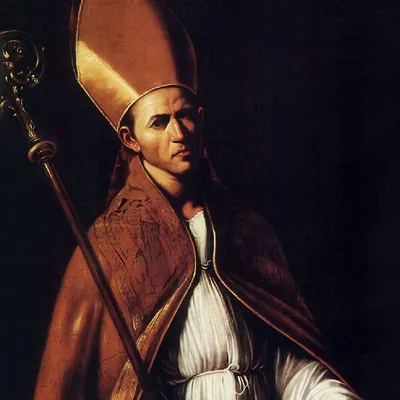
Alphonsus is usually shown as an old bishop with his head bowed, as illness left him, sometimes holding a crucifix, a book or a rosary, often in prayer before the Virgin Mary or the Blessed Sacrament.
Where to pray to Saint Alphonsus Liguori
- Pagani (Campania, Italy): his tomb in the Basilica of Saint Alphonsus and the cell where he spent his last years.
- Naples: the city of his youth and early priesthood, of which he is one of the patron saints.
- Scala (Amalfi Coast): the place where the Redemptorists were founded in 1732.
- Rome: the Church of Sant'Alfonso all'Esquilino, dedicated to him.
To pray with him, use the prayer to Saint Alphonsus Liguori and the novena to Saint Alphonsus Liguori, prayed from July 23 to 31.
Discover also
- Saint Philip Neri, founder of the Oratory, where Alphonsus was formed as a child.
- Saint Clement Mary Hofbauer, the Redemptorist who brought the congregation north of the Alps.
- Saint John Neumann, Redemptorist and Bishop of Philadelphia.
- Saint Gerard Majella, Redemptorist lay brother and patron of mothers.
- Saint Francis de Sales, another Doctor of the Church and master of pastoral gentleness.