Saint Lucy was a young Christian of Syracuse, in Sicily, who died a martyr around 304, during the great persecution of Emperor Diocletian. Her name, which evokes light (lux in Latin), and her feast in the heart of winter have made her one of the most popular saints in Europe, from Sicily to Sweden. Named in the oldest Eucharistic Prayer of the Roman Church and invoked for the eyes, she is celebrated on December 13.
Who was Saint Lucy?
Of Lucy's life, history holds with certainty only the essentials: a Christian woman of Syracuse gave her life for Christ at the beginning of the 4th century, and her memory was honored very early in her city. A Greek funerary inscription discovered in the late 19th century in the catacombs of Syracuse, that of a certain Euskia who died "on the feast of my lady Lucy," shows that her feast was already celebrated around the year 400. By the 6th century her name appeared in the Canon of the Roman Mass, alongside Agatha, Agnes and Cecilia.
The detailed account of her life comes from a Passion written later, probably in the 5th or 6th century, whose episodes belong partly to tradition and legend. They are presented here as such: they tell us less about the facts than about what the first Christians admired in her.
The story of her Passion
According to the Passion, Lucy was engaged by her mother, Eutychia, to a young pagan. But she had already resolved to consecrate her virginity to Christ. Her mother had suffered for years from hemorrhages, and Lucy persuaded her to go with her to Catania, to the tomb of Saint Agatha, martyred half a century earlier. While they prayed, Agatha appeared to Lucy in a dream, announced her mother's healing and foretold that Lucy would be the glory of Syracuse as Agatha was the glory of Catania.
Back home, her healed mother agreed to let her daughter give her dowry to the poor. The rejected suitor denounced her as a Christian to the governor Paschasius. Lucy refused to sacrifice to the gods. The account relates that they tried to drag her by force to a brothel, but no team of oxen could move her, and then that the fire lit around her did not consume her. She finally died from a sword thrust to the throat, after receiving, it is said, Holy Communion.

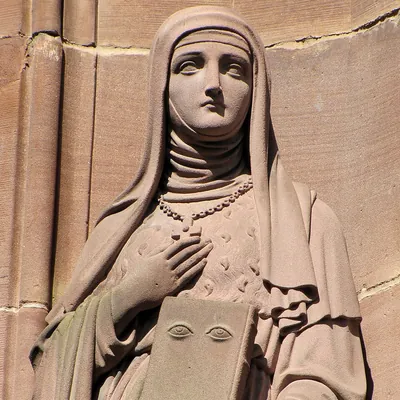
Why is Saint Lucy shown with eyes on a plate?
The oldest images show Lucy, like other virgin martyrs, with a palm and a lamp. From the late Middle Ages, painters gave her a new attribute: two eyes resting on a dish or plate, as in the portrait by Zurbarán. This image does not come from the ancient Passion. It is explained first by her name, linked to light, and by popular devotion, which called on her for diseases of the eyes. A late legend, created afterward to explain the attribute, says she tore out her own eyes to discourage a suitor; it has no ancient basis.
For Christians, these eyes speak above all of the light of faith, which allows us to see beyond appearances. Dante, who was deeply attached to Saint Lucy, made her in the Divine Comedy a messenger of the Virgin Mary, sent to rescue the poet lost in the dark wood.

A saint of light in the heart of winter
Before the calendar reform of 1582, December 13 fell very close to the winter solstice, the longest night of the year. An old English rhyme remembers it: "Lucy light, Lucy light, shortest day and longest night." This coincidence made Lucy the saint who announces the return of light, in the middle of Advent.
In Sweden and the other Nordic countries, on the morning of December 13, a girl dressed in white with a crown of candles on her head leads processions of songs and saffron buns. Several regions of northern Italy, such as Bergamo, Brescia and Verona, tell children that Lucy brings them gifts during the night of December 12. In Syracuse, her silver statue is carried in procession from the cathedral to the place of her martyrdom.
Why is Saint Lucy the patron saint of the blind?
Lucy is the patron of the blind and of people with eye diseases because of her name, which means light, and because of the long popular devotion that turned to her for sight, later expressed in art by the eyes on a plate. Her protection is not only for the body: she is also invoked by those who seek the inner light of faith.
Lucy is a martyr of faithfulness: young, rich and promised in an advantageous marriage, she chose to give her goods to the poor and her life to Christ. Her example speaks to those who must hold firm in their convictions, and her light to those going through a night, physical or spiritual. She is invoked for diseases of the eyes, for the blind and visually impaired, and for keeping a pure gaze.
To pray with her, use the prayer to Saint Lucy, or follow the novena to Saint Lucy, beginning on December 4 and ending on December 12, the eve of her feast.
Symbols and how to recognize Saint Lucy in art
- Two eyes on a plate or dish, her most famous attribute since the late Middle Ages.
- A lamp or candle, sign of the light her name evokes.
- The martyr's palm.
- A sword or a wound at the throat, recalling her death.
- A crown of candles, in the Scandinavian tradition.
Where to pray to Saint Lucy
- Syracuse (Sicily): the Basilica of Santa Lucia al Sepolcro, built on the place of her martyrdom and burial, above the catacombs.
- Syracuse: the cathedral, which keeps the silver statue carried in procession on December 13.
- Venice: the Church of San Geremia, near the Santa Lucia railway station, which holds her body.
- Catania: the Cathedral of Saint Agatha, recalling the pilgrimage of Lucy and her mother.

Discover also
- Saint Agnes, the young Roman martyr named with her in the Canon of the Mass.
- Saint Cecilia, another virgin martyr honored in the same prayer.
- Saint Eulalia of Mérida, martyred in Spain during the same persecution of Diocletian.
- Saint Barbara, a martyr whose feast on December 4, like Lucy's, brightens the season of Advent.
- Saint Margaret of Antioch, a virgin martyr of the early centuries much loved in the Middle Ages.