Saint Blaise was a bishop of Sebaste, in historic Armenia, who died a martyr in the early 4th century. The stories of his life, written long after his death, are woven with legend: according to tradition, he had been a physician, lived as a hermit among wild animals and saved a boy who was choking on a fishbone. That is why Catholics invoke him against diseases of the throat, and why on February 3, his feast day, many parishes offer the Blessing of Throats with two crossed candles.
Who was Saint Blaise?
Blaise (Blasius in Latin, Vlaho in Croatian, Biagio in Italian) was Bishop of Sebaste, a city in eastern Anatolia that corresponds to present-day Sivas, in Turkey. He died a martyr around 316, under Emperor Licinius, according to the date given by tradition. Very little is known about him for certain: his existence and martyrdom are accepted, but the "Acts" that tell his life were written several centuries later and are largely pious legend.
That did not stop his veneration from spreading widely, in both East and West. In the Middle Ages he became one of the most popular saints in Europe and was counted among the Fourteen Holy Helpers, the saints invoked in the needs of everyday life, especially in times of sickness.
The life of Saint Blaise according to tradition
A physician who became a bishop
According to tradition, Blaise first practiced medicine in Sebaste. He was then chosen as bishop of the city. When persecution broke out, he withdrew to a cave in the mountains, from where he continued to guide his flock. The story says that wild animals came to him, and that he cared for those that were wounded or sick. Hunters sent to capture animals for the arena found him surrounded by beasts and reported him to the governor.
The boy and the fishbone
On the way to prison, the legend continues, a mother threw herself at his feet: her only son was choking on a fishbone stuck in his throat. Blaise laid his hands on the child and prayed, and the boy was saved. This story is the origin of the devotion to Saint Blaise for ailments of the throat.
The poor woman, the wolf and the candles
Another episode tells that a wolf had carried off a pig, the only possession of a poor woman. At Blaise's prayer, the wolf gave the animal back. In gratitude, the woman later brought him food in prison, and candles to light his dark cell. The candles of the Saint Blaise blessing recall her gesture.
The martyrdom
Refusing to deny his faith and offer sacrifice to the pagan gods, Blaise was tortured. According to tradition, his flesh was torn with iron combs like those used to card wool. He was finally beheaded. That is why he became the patron of wool combers and wool workers.
The Blessing of Throats
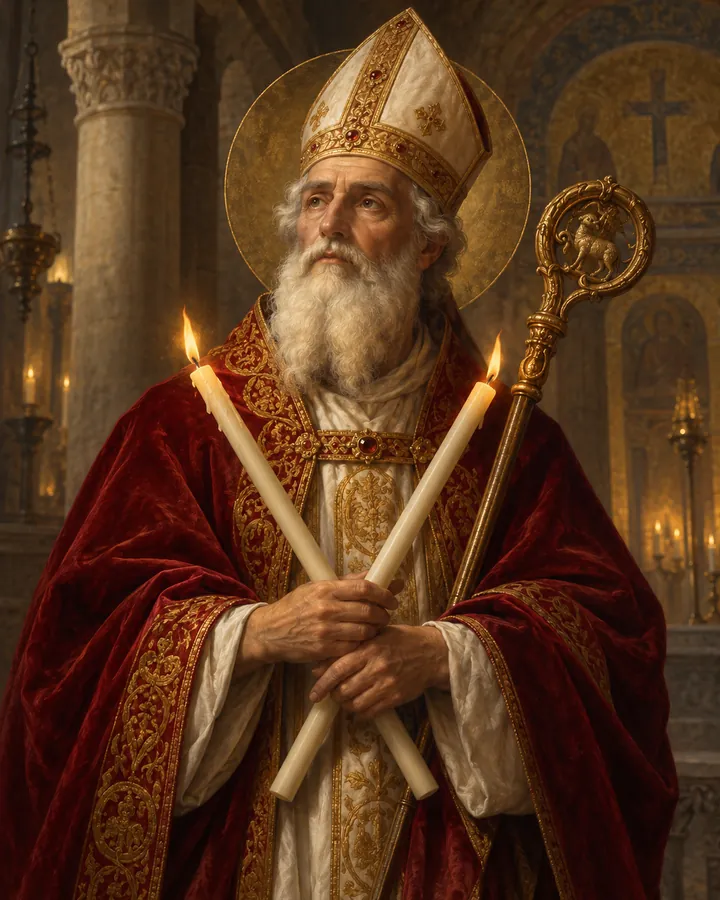
Every February 3, many Catholic parishes, in the United States, the Philippines, Ireland and elsewhere, offer the Blessing of Saint Blaise. The priest or deacon holds two crossed candles, often blessed the day before on Candlemas, the Feast of the Presentation of the Lord, against the throat of each person and says: "Through the intercession of Saint Blaise, bishop and martyr, may God deliver you from every disease of the throat and from every other illness. In the name of the Father, and of the Son, and of the Holy Spirit." This blessing is not a magic gesture: it is a prayer of the Church for health of body and soul, entrusted to the intercession of a saint.
Why is Saint Blaise the patron saint of throat ailments?
Because of the boy saved from choking, Saint Blaise has been invoked for centuries against diseases of the throat: sore throats, coughs, difficulty swallowing. Ear, nose and throat doctors often regard him as their protector. The iron combs of his martyrdom made him the patron of wool combers, weavers and wool merchants. In England, wool towns once held festive processions in honor of "Bishop Blaize." His bond with animals made him a patron of veterinarians and of animals. He is also the patron saint of the city of Dubrovnik, in Croatia.
Symbols and how to recognize Saint Blaise in art
Saint Blaise is shown as a bishop, with miter and crosier. His symbols are two crossed candles and an iron wool comb, sometimes a child whose throat he is healing, or a wolf or a pig recalling the legend of the poor woman. In Dubrovnik he often holds in his hand a model of the city he protects.

Where to pray to Saint Blaise
The great shrine of Saint Blaise is the Church of Saint Blaise in Dubrovnik, Croatia, in the heart of the old town, of which he has been patron since the Middle Ages. The cathedral treasury of Dubrovnik keeps reliquaries venerated as those of his head, throat and hands, carried in procession every February 3. In Germany, the abbey of Sankt Blasien in the Black Forest bears his name. Wherever you live, your own parish church on February 3 is the simplest place to receive his blessing.
How to pray to Saint Blaise
Catholics pray to Saint Blaise for healing of the throat and of respiratory illnesses, for sick children and for good health. You can pray the prayer to Saint Blaise or follow the novena to Saint Blaise, from January 25 to February 2, so that it ends on the eve of his feast.
Discover also
- Saint Barbara, another of the Fourteen Holy Helpers.
- Saint Christopher, Holy Helper and patron of travelers.
- Saint Margaret of Antioch, Holy Helper invoked by expectant mothers.
- Saint Giles, Holy Helper and hermit, also linked with animals.
- Saint Sebastian, martyr of the Roman persecutions, invoked against illness.