Saint George was a Christian soldier martyred at the beginning of the fourth century, most likely at Lydda in Palestine, during the persecution of Diocletian. Very little is known about his life, but his cult, attested very early, spread throughout the East and then the West. The Middle Ages made him the knight who slays the dragon, patron saint of England, Georgia, Catalonia and knights, and later of the Scouts. His feast day is April 23.
Who was Saint George?
The oldest accounts present George as an officer in the Roman army, from Cappadocia (in present-day Turkey) on his father's side and from Lydda on his mother's. When Diocletian launched the great persecution of 303, he refused to sacrifice to the gods and openly professed his faith. He was tortured and beheaded. His tomb at Lydda (today Lod, in Israel) quickly became a place of pilgrimage.
The "Acts" of his martyrdom, written later, piled up improbable tortures and wonders. As early as 494, a decree attributed to Pope Gelasius placed George among the saints "whose names are justly revered among men, but whose deeds are known only to God." The Church affirms the reality of his martyrdom and his cult, without vouching for the details of the stories.
The legend of the dragon
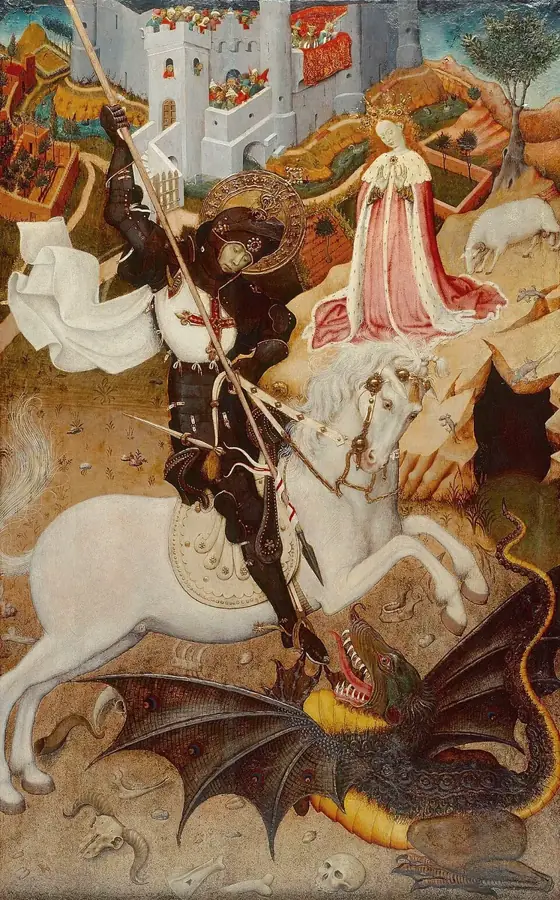
The fight with the dragon only appears around the eleventh century, and it was the Golden Legend of Jacobus de Voragine, in the thirteenth century, that gave it its classic form. Near the city of Silene in Libya, a dragon terrorizes the people, who hand over victims drawn by lot each day. The lot falls on the king's daughter. George, riding by, makes the sign of the cross, wounds the beast with his lance and leads it into the city, held on a leash made from the princess's girdle. He kills it only after the whole city has accepted baptism.
The story is an image: the dragon stands for evil and paganism, the princess for the Church or the soul set free. This image made Saint George famous in art, from Paolo Uccello to Raphael, and turned him into the model of the Christian knight.

A saint honored from East to West
In the East, George is one of the most popular saints: Greek, Russian, Georgian, Armenian, Coptic and Ethiopian Christians call him "great martyr" and "bearer of victory." Georgia counts hundreds of churches dedicated to him. The Crusaders brought his cult back to Europe, where he became the saint of knights.
England adopted him as patron in the fourteenth century, and his red cross on a white field still forms the English flag. In Catalonia, Sant Jordi on April 23 is a great popular feast: people give a rose and a book, a custom behind World Book Day. Portugal, Aragon, Malta, Lithuania and the city of Moscow also count him among their protectors. In the twentieth century, Baden-Powell gave him to the Scouts as their patron, and they celebrate Saint George's Day every year.

Why do Catholics pray to Saint George?
Behind the legend lies a fact: a soldier preferred to die rather than deny Christ. Saint George is the saint of courage in faith and of the fight against evil, beginning within oneself. People pray to him for strength in trials, for soldiers, police officers and all who protect others, for Scouts and young people, and traditionally against skin diseases and for good harvests, since his name means "farmer" in Greek.
Where to pray to Saint George
- Rome: the Basilica of San Giorgio al Velabro, which has kept a relic of his head since the eighth century.
- Lod (Israel): the Church of Saint George, served by the Greek Orthodox Church, holds his traditional tomb in its crypt.
- Venice: the Scuola di San Giorgio degli Schiavoni, with Carpaccio's cycle of paintings on Saint George.
- Barcelona: the Sant Jordi chapel of the Palau de la Generalitat, open to the public on April 23.
To pray with him, read the prayer to Saint George or follow the novena to Saint George, from April 14 to 22.
Discover also
- Saint Michael the Archangel, the other great dragon slayer of Christian art.
- Saint Sebastian, a Roman soldier and martyr, also much loved by painters.
- Saint Maurice, leader of the Theban Legion, another patron saint of soldiers.
- Saint Martin of Tours, a soldier who became a bishop.