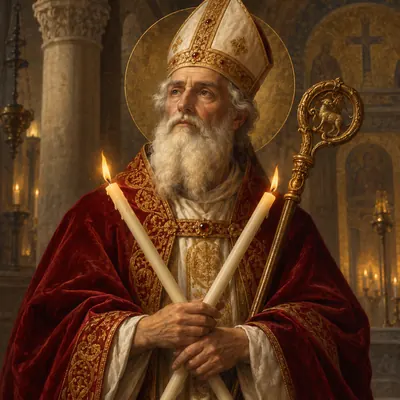
Saint Nicholas was a bishop of Myra, in Lycia (in present-day Turkey), in the 4th century. Very little is known about his life for certain, but his reputation for kindness and generosity has crossed centuries and continents. He is one of the most loved saints in the world, in the Catholic West as well as in the Orthodox East. Patron saint of children, sailors and many cities, he is celebrated on December 6, and the figure of Santa Claus descends from him by a long and winding road.
Who was Saint Nicholas?
According to tradition, Nicholas was born in Patara, a port of Lycia on the southern coast of Asia Minor, toward the end of the 3rd century. He became bishop of the nearby city of Myra and died on a December 6, around the middle of the 4th century. The oldest accounts of his life were written several centuries after his death. They mix memories, legends, and confusion with another Nicholas, abbot of Sion in Lycia in the 6th century.
Historians therefore hold on to one solid fact: by the 6th century, a bishop of Myra named Nicholas was venerated throughout the Christian East, and Emperor Justinian built a church in his honor in Constantinople. The rest belongs to tradition, but a tradition so rich that it shaped popular piety across all of Europe and, later, the whole world.
The three daughters without a dowry
The oldest and best known story of Nicholas is that of the three daughters. According to tradition, a ruined man in his town could no longer provide dowries for his three daughters and was considering handing them over to prostitution. Nicholas, who had inherited wealth from his family, heard of it. At night, he threw a purse full of gold through the window, then a second, then a third. The father finally caught him in the act and wanted to thank him, but Nicholas asked him to keep the secret.
This story sums up the whole figure of Nicholas: a concrete, discreet charity that does not seek to be seen. It is the origin of the three golden balls, or three purses, that Saint Nicholas holds in icons and paintings.
Defender of the innocent
Another ancient account, known as the "story of the generals," tells how Nicholas obtained the release of three officers unjustly sentenced to death by Emperor Constantine, by appearing to the emperor in a dream. A related story shows him stopping the arm of the executioner who was about to behead three innocent men in Myra. These stories made him the protector of the falsely accused and of prisoners.
Tradition also says that he calmed a storm to save sailors in distress and that he obtained grain for his city during a famine. Seafarers all around the Mediterranean took him as their patron, and many harbors and sailors' churches bear his name.
The legend of the three children
In France, Belgium and the Rhineland, the most famous story is that of the three little children. According to a medieval Western legend, three lost children asked a butcher for shelter; he killed them and put them in a salting tub. Saint Nicholas, passing by, discovered the crime and brought the children back to life. This legend is absent from the Greek sources. It may have grown from a misunderstood image: the three officers or the three daughters, painted small to show that they were under his protection, would have been taken for children. It made Nicholas the patron saint of children and schoolboys, and gave rise to the custom of gifts on December 6.
The relics move to Bari
For centuries, the tomb of Nicholas in Myra drew pilgrims. In the 11th century, the region fell to the Seljuk Turks. In 1087, sailors from Bari, in southern Italy, landed at Myra, opened the tomb and carried the saint's bones back to their city, where they arrived on May 9. A great Romanesque basilica was built to receive them.
Since then, Bari has been the world center of devotion to Saint Nicholas and a meeting place between Catholics and Orthodox. Every year a clear liquid collected from the tomb, called the "manna" of Saint Nicholas, is given to the faithful. May 9, the feast of the translation of his relics, is widely celebrated in Bari and in the Eastern Churches.
From Saint Nicholas to Santa Claus
In the Netherlands, the feast of Sinterklaas on December 6 remained very much alive after the Reformation. Dutch settlers brought it to New Amsterdam, later New York, and in the 19th century the figure gradually became Santa Claus, the jolly gift-bringer of Christmas Eve. Santa Claus is therefore a distant descendant of the bishop of Myra. In the Netherlands, Belgium, eastern France, Germany, Austria and Switzerland, Saint Nicholas still wears his miter, carries his crozier and visits children on December 6. Many Catholic families in the United States and elsewhere have revived the custom of leaving shoes out on the evening of December 5.

Why is Saint Nicholas the patron saint of children?
The stories of his secret generosity and the legend of the three children restored to life made him, from the Middle Ages, the patron saint of children and schoolchildren. He is also the patron of sailors and boatmen, prisoners, unmarried young women, merchants and pawnbrokers (whose three golden balls recall his three purses). Several countries and regions claim him too: Russia, Greece and Lorraine in France, as well as the cities of Bari and Amsterdam.
Symbols and how to recognize Saint Nicholas in art
Saint Nicholas is shown as a bishop: with a miter and crozier in Western art, or with the omophorion, a long stole embroidered with crosses, in Eastern icons, where he usually has a short white beard and a high forehead. His attributes are three golden balls or three purses, a book, an anchor or a ship, and, in Western art, a tub with three children standing in it.
Where to pray to Saint Nicholas
The great shrine is the Basilica of Saint Nicholas in Bari, Italy, where his body rests in the crypt. In France, the Basilica of Saint-Nicolas-de-Port, near Nancy, keeps a relic brought from Bari and holds a large candlelight procession every year in early December. In Demre, Turkey, the old Church of Saint Nicholas of Myra, where his tomb stood before 1087, can still be visited. Countless parishes in the English-speaking world are dedicated to him, often in port towns.
Praying to Saint Nicholas
Catholics pray to Saint Nicholas for children, for families in need, for sailors and travelers, and to learn to give without being seen. Read the prayer to Saint Nicholas and pray the novena to Saint Nicholas, beginning on November 27.
Discover also
Saint Nicholas was a contemporary of Saint Spyridon, another wonder-working bishop of the 4th century, and of Saint Martin of Tours, the other great saint of hands-on charity. Discover also Saint Ambrose of Milan, a bishop of the same century, and Saint Nicholas of Tolentino, who bears his name.