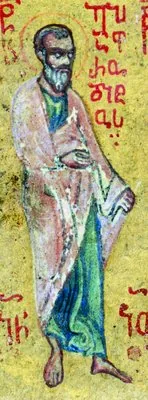
Saint Epaphroditus was a Christian of Philippi, in Macedonia, whom the apostle Paul calls in his Letter to the Philippians "my brother and fellow laborer and fellow soldier." Sent by his community to bring help to Paul in prison, he fell gravely ill in the apostle's service. Tradition makes him the first bishop of Philippi, and an Italian tradition links him to Terracina. He is celebrated on March 22 in the Catholic Church.
Who was Saint Epaphroditus?
Everything we know for certain about Epaphroditus fits into a few verses of the Letter to the Philippians (2:25-30 and 4:18). His name, of Greek origin, is derived from that of the goddess Aphrodite and was common at the time; it suggests that he came from a pagan family that had converted. He belonged to the community of Philippi, the first Church founded by Paul in Europe, around the year 50, with which the apostle had particularly warm ties.
He has sometimes been identified with Epaphras, the founder of the Church of Colossae, whose name is a shortened form of Epaphroditus. Scholars do not accept this hypothesis: the two men belonged to different communities, one in Macedonia, the other in Asia Minor.
Philippi, a Church dear to Paul
The Acts of the Apostles (chapter 16) tell how Paul, traveling with Silas, came to Philippi, a Roman colony in Macedonia. There Lydia, a seller of purple cloth, was baptized with her household, and a small community took shape around her home. Paul and Silas were beaten and imprisoned in the city before being released. The Philippians never forgot the apostle: in his letter Paul recalls that they alone supported him from the beginning, sending help more than once (Philippians 4:15-16). The gift carried by Epaphroditus belongs to this long story of generosity.
The messenger who fell ill
Paul wrote his Letter to the Philippians from prison, perhaps in Ephesus or in Rome. Through Epaphroditus, the Christians of Philippi had sent him what he needed to live. Paul thanks them with a liturgical image: their gift is "an odour of sweetness, an acceptable sacrifice, pleasing to God" (Philippians 4:18, Douay-Rheims).
But the messenger had fallen ill, "nigh unto death." Paul writes that God had mercy on him, "and not only on him, but on me also, lest I should have sorrow upon sorrow" (Philippians 2:27). This passage shows a very human apostle, worried for a friend. It also reveals the sensitivity of Epaphroditus himself, more troubled by the anxiety of his own people, who had heard of his illness, than by his own condition.
Paul decided to send him back to Philippi, no doubt with the letter, and asked that he be warmly received: "Receive him therefore with all joy in the Lord; and treat with honour such as he is. Because for the work of Christ he came to the point of death" (Philippians 2:29-30).
A brother, a co-worker, a fellow soldier
The three titles Paul gives him say a great deal. Brother: he shares the same faith and the same family in Christ. Fellow laborer: he takes part in the work of the Gospel. Fellow soldier: he shares its struggles and its risks. Paul also calls him the "apostle," that is, the envoy, of the Philippians, sent to minister to his needs (Philippians 2:25).
What tradition says
Later traditions count Epaphroditus among the Seventy disciples sent out by Jesus (Luke 10). They make him the first bishop of Philippi, and the old Roman Martyrology also presented him as bishop of Terracina, in Italy. Nothing in the New Testament confirms these details, which mainly express the veneration of the Churches for this companion of Paul.

What is Saint Epaphroditus invoked for?
Epaphroditus has no official patronage, but his story makes him a natural intercessor for certain people. He is the saint of discreet and risky service. He founded no Church and wrote no letter: he formed the link between a community and an imprisoned apostle, to the point of nearly losing his life. He reminds us of the value of those who bring help to others, such as volunteers, aid workers, and those who visit prisoners. He is close to the sick who worry more about their loved ones than about themselves, and to all who live friendship in the service of the Gospel.
To pray with him, see the prayer to Saint Epaphroditus and the novena to Saint Epaphroditus.
Symbols and how to recognize Saint Epaphroditus in art
Images of Epaphroditus are rare. In medieval manuscripts and icons he appears as one of the companions of Paul, sometimes dressed as a bishop in keeping with the tradition that made him the first bishop of Philippi. A letter or a scroll can recall the Letter to the Philippians that he probably carried home.

Where to pray to Saint Epaphroditus
- Philippi, Greece: the archaeological site of the city, with the ruins of its early Christian basilicas, where the community of Epaphroditus lived.
- Terracina, Italy: the town that an Italian tradition associates with him, with its cathedral.
The simplest way to meet him is to read the Letter to the Philippians, especially chapter 2, verses 25 to 30, and chapter 4, verse 18. His feast on March 22 is a good day to read the whole letter slowly, from beginning to end.
Discover also
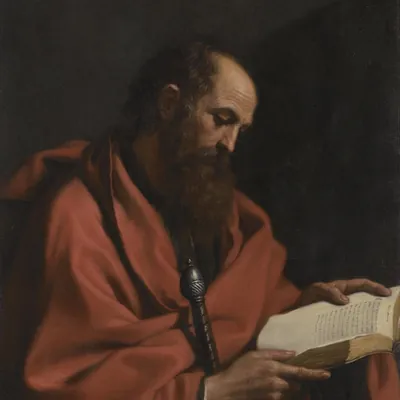
- Saint Paul, the apostle he served during his captivity.
- Saint Epaphras, with whom he has sometimes been confused.
- Saint Timothy, whom Paul announces to the Philippians in the same passage.
- Saint Silas, Paul's companion at the founding of the Church of Philippi.
- Saint Tychicus, another of Paul's messengers to the communities.