Saint Epaphras was a first-century Christian from Colossae, in Asia Minor, and a close co-worker of Saint Paul. He brought the Gospel to his hometown and to the neighboring cities of Laodicea and Hierapolis. Paul mentions him three times in his letters and paints a very short but unusually warm portrait of him: a man who is "always striving" in prayer for the communities entrusted to him. His feast day is July 19.
Who was Saint Epaphras?
Everything we know for certain about Epaphras fits into a few verses of the New Testament. In the Letter to the Colossians, Paul reminds the Christians of Colossae that they learned the Gospel from Epaphras, "our beloved fellow servant," whom he calls "a faithful servant of Christ on your behalf" (Colossians 1:7). At the end of the same letter, Paul passes on his greetings and stresses that he is "one of you" (Colossians 4:12). Finally, in the short Letter to Philemon, Paul calls him "my fellow prisoner in Christ Jesus" (Philemon 23). The Bible quotations on this page follow the World English Bible, a public domain translation.
From these verses, we can gather that Epaphras was a native of Colossae who became a Christian, probably during Paul's long stay in Ephesus, and that he went back home to found a Christian community in the Lycus valley, where Colossae, Laodicea and Hierapolis stood. Later, he joined Paul, who was then a prisoner, and shared his captivity, at least for a time.
A founder of the Church in the Lycus valley
Epaphras is one of the rare early Christians we can name as the founder of a local Church. Paul himself had apparently never visited Colossae: the Christians there knew him only by reputation. It was Epaphras, one of their own, who first announced Christ to them. Paul also testifies that Epaphras "has great zeal for you, and for those in Laodicea, and those in Hierapolis" (Colossians 4:13). His mission therefore reached the whole valley.
He also acted as a link between his community and the apostle. According to the Letter to the Colossians, it was Epaphras who told Paul about the love of the Colossians (Colossians 1:8). The letter itself, with its great hymn to Christ "the image of the invisible God," was written in response to the news he brought.
A man of prayer for his community
The most beautiful passage about Epaphras is a sentence of Paul to the Colossians: he is "always striving for you in his prayers, that you may stand perfect and complete in all the will of God" (Colossians 4:12).
Far from his city, Epaphras did not stop serving: he prayed. The Greek word Paul uses calls to mind the effort of an athlete in a contest. Intercession, in this light, is real apostolic work, not a pious extra. Epaphras teaches that one can keep building up a community even when one can no longer be physically present to it.
What tradition says
Beyond the New Testament, the information becomes uncertain. An ancient tradition counts him among the seventy-two disciples sent out on mission by Jesus in the Gospel of Luke. It also makes him the first bishop of Colossae, appointed by Paul, and says he was martyred there. None of this can be verified.
The Roman tradition adds that in the eighth century, during the iconoclast crisis in the Byzantine Empire, Greek monks carried his relics to Rome, where they were placed in the Basilica of Saint Mary Major.
Why is Saint Epaphras a patron saint?
Epaphras has no official patronage. But his short biography makes him a natural intercessor for some vocations: catechists who pass on the faith in their own neighborhood, leaders of small communities, missionaries who return to their home country, and all those who pray quietly for others. He is also a friend for anyone who serves a community from a distance, through illness, exile or old age, and can only give it the gift of prayer.
What can we learn from his holiness?
Epaphras is a reminder that the early Church was not built only by the great apostles. It owes a great deal to lesser-known disciples who brought the Gospel home and carried their communities in prayer. His holiness is humble and hidden, yet Paul gives him one of the finest tributes in his letters.
He can be prayed to for catechists, community leaders and all who intercede in secret for others. His example also invites every Christian to ask a simple question: whom has God entrusted to my prayer, and do I carry them faithfully?
Symbols and how to recognize Saint Epaphras in art
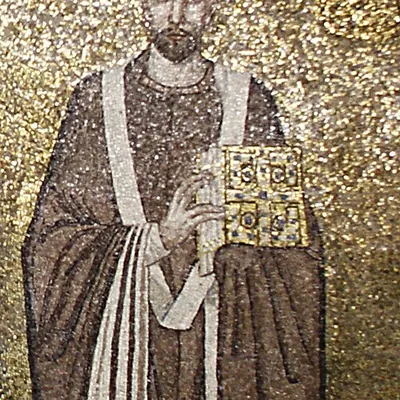
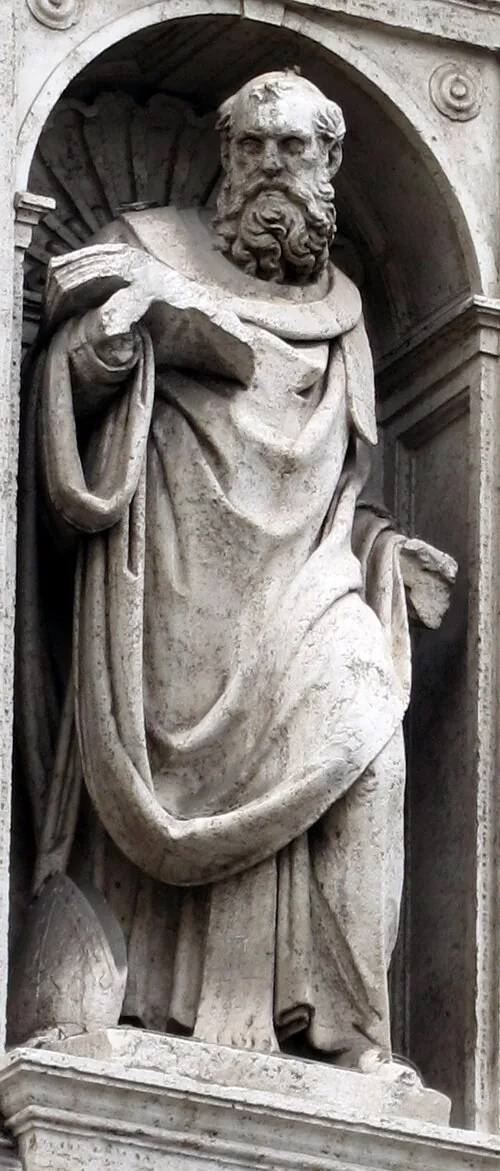
Images of Epaphras are rare. The best known is the statue carved by Stefano Maderno for the outside of the Pauline Chapel at the Basilica of Saint Mary Major in Rome. It shows him as a bearded man draped in ancient robes, in the style of the apostles and early disciples. Without the inscription or the setting, nothing in particular distinguishes him from other figures of the apostolic age.
Where to pray to Saint Epaphras
- Rome: the Basilica of Saint Mary Major, where tradition places his relics, with his statue on the facade of the Pauline Chapel.
- Colossae (Turkey): the archaeological site of the ancient city, still little excavated, near Honaz.

Discover also
- Saint Paul, his companion in mission and in captivity.
- Saint Onesimus, the slave from Colossae at the heart of the Letter to Philemon, where Epaphras sends his greetings.
- Saint Epaphroditus, another co-worker of Paul with a similar name, sometimes confused with him.
- Saint Timothy, co-sender of the Letter to the Colossians.
- Saint Tychicus, who carried the Letter to the Colossians to its readers.