Saint: definition
In the broad sense, a saint is anyone who lives in God's friendship and shares his life in heaven. In the strict sense, a saint is a deceased Christian whom the Church has recognized through canonization and proposes to all the faithful as a model and an intercessor.
God alone is holy
In the Bible, the Holy One is first of all God himself: "Holy, holy, holy is the Lord of hosts," sings the prophet Isaiah. To be holy is to be set apart for God and made like him. Saint Paul calls all the baptized in the communities he writes to "the saints," because they belong to Christ.
That is why the Church speaks of a universal call to holiness: every Christian is invited to become a saint, in family life, at work, in illness or in old age. The feast of All Saints honors the immense crowd of these unknown saints.
Canonized saints
Among them, the Church designates some with particular certainty, after a long inquiry, so that they may serve as models. It enters them in the calendar on a date called their feast day, often the day of their death, which it considers their birth into heaven. On Saintspedia you will find their lives, their prayers and the saint of the day.
Saints are not adored: God alone is adored. They are venerated, that is, honored and asked to pray for us, as one asks for the prayer of a friend. This is the meaning of the communion of saints.
Saint, St., and the French usage
In English, the word is capitalized before a name and often abbreviated: Saint Martin, St. Rita. French writes it in lowercase before a name (saint Martin, sainte Rita), but with a capital and a hyphen when it designates a place or a feast: la Saint-Martin, Saint-Malo.
Saints to know
-
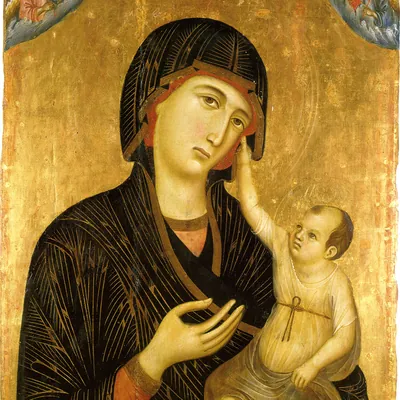 August 15
The Blessed Virgin Mary
mother of Jesus and Mother of God, honored by the Church as the first of the saints
The greatest of the saints, whom the Church calls Queen of All Saints.
-
 August 28
Saint Augustine of Hippo
bishop of Hippo, Father and Doctor of the Church, author of the Confessions
Converted after a turbulent youth, he shows that holiness is a journey.
-
 October 1
Saint Thérèse of Lisieux
Carmelite of Lisieux known as the Little Flower, Doctor of the Church and patron saint of missions, teacher of the Little Way of trust
She opened to everyone a "little way" of holiness made of trust and small gestures.
Frequently asked questions
How many saints are there?
The Roman Martyrology lists more than 6,500, and thousands of others are honored locally. But for the Church, the saints in heaven are countless.
Do you have to perform miracles to be a saint?
No. A miracle is a proof required for canonization, not a condition of holiness itself.
Can a saint have sinned?
Yes. Many saints, such as Saint Augustine or Saint Paul, had a heavy past. Holiness is a conversion, not an absence of faults.
Related terms
Holiness and Veneration of the Saints: other terms
- Guardian Angel
- Apparition
- Archangel
- Attributes of the Saints
- Halo
- Beatification
- Blessed
- Confessor
- Incorrupt Body
- Veneration of the Saints
- Doctor of the Church
- Hagiography
- Martyr
- Martyrology
- Miracle
- Mysticism
- Patronage
- Fathers of the Church
- Postulator
- Canonization process
- Servant of God
- Stigmata
- Wonderworker
- Venerable
- Heroic virtue