Stigmata: definition
The stigmata are wounds that appeared on the bodies of certain saints, on the hands, feet or side, in the image of the wounds of the crucified Christ. The first known case is that of Saint Francis of Assisi in 1224.
Origin of the word
The Greek stigma means a mark, like the one branded on a slave. Saint Paul writes to the Galatians: "I bear the marks of Jesus on my body." Since the Middle Ages, the word has referred to the wounds of the Passion reproduced on the body of a believer, often during intense prayer.
This is not a devotion anyone would seek out: the stigmatics experienced them as suffering and humiliation, and often tried to hide them.
The great stigmatics
In September 1224, on Mount La Verna in Tuscany, Saint Francis of Assisi received the stigmata after a vision of the crucified Christ in the form of a seraph. He bore them until his death, two years later. The event, reported by his companions, deeply marked Christendom.
Saint Catherine of Siena received stigmata in 1375 that remained invisible, at her request, but whose pain she felt. In the 20th century, Saint Padre Pio bore visible wounds for fifty years, from 1918 until his death, examined by several doctors. Saint Gemma Galgani also received them, in 1899.
The Church's view
The Church is very cautious. It has never canonized anyone because he or she had the stigmata: it is virtues and miracles that count. Padre Pio was in fact subjected to investigations and restrictions for years. The stigmata can be a sign of union with the suffering Christ, but they do not by themselves prove holiness and belong to the realm of mystical life.
Saints to know
-
 October 4
Saint Francis of Assisi
founder of the Friars Minor, poet of the Canticle of the Creatures, patron saint of Italy and of ecology
The first known stigmatic, in 1224 on Mount La Verna.
-
 September 23
Saint Pio of Pietrelcina (Padre Pio)
Italian Capuchin priest, confessor and stigmatic of San Giovanni Rotondo
He bore visible stigmata for half a century.
-
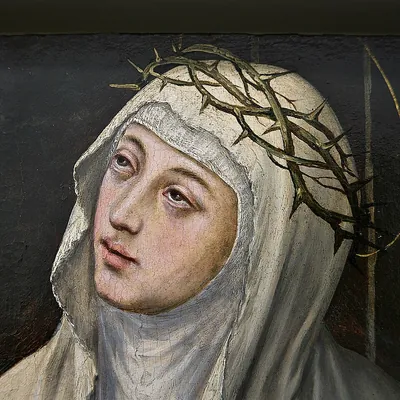 April 29
Saint Catherine of Siena
Dominican tertiary and mystic from Siena, Doctor of the Church, patron saint of Italy and co-patron of Europe
Her stigmata, received in 1375, remained invisible.
-
 April 11
Saint Gemma Galgani
young lay mystic of Lucca, united to the Passion of Christ, who died at twenty-five
A young mystic from Lucca, who received the stigmata in 1899.
Frequently asked questions
How many saints have had the stigmata?
Several dozen stigmatics are recognized as saints or blesseds, but the exact list is debated, as many cases are poorly documented.
Are the stigmata a miracle?
The Church does not count them among the miracles required for beatification. It considers them a mystical phenomenon to be examined with caution.
Can stigmata be seen today?
Cases are sometimes reported. The Church studies them with discernment, since they may have natural causes or be fraudulent.
Related terms
Holiness and Veneration of the Saints: other terms
- Guardian Angel
- Apparition
- Archangel
- Attributes of the Saints
- Halo
- Beatification
- Blessed
- Canonization
- Communion of Saints
- Confessor
- Incorrupt Body
- Veneration of the Saints
- Doctor of the Church
- Hagiography
- Intercession
- Martyr
- Martyrology
- Patronage
- Fathers of the Church
- Postulator
- Canonization process
- Relics
- Patron saint
- Servant of God
- Wonderworker
- Venerable
- Heroic virtue