Pope Saint Simplicius was bishop of Rome from 468 to 483. His fifteen-year pontificate coincided with the disappearance of the Western Roman Empire: in 476 the last emperor, Romulus Augustulus, was deposed and the Germanic chieftain Odoacer took control of Italy. In this collapsing world, Simplicius tried to defend the faith of the Council of Chalcedon against an East drawn toward other paths. The Catholic Church celebrates him on March 10.
Who was Saint Simplicius?
According to the Liber Pontificalis, the ancient book of the lives of the popes, Simplicius was born in Tivoli, near Rome, around 420, the son of a man named Castinus. Nothing is known of his career before his election on March 3, 468, ten days after the death of Pope Saint Hilarius.
What we know of him comes almost entirely from his letters: disciplinary decisions for the West, and an abundant correspondence, often unanswered, with the emperor and the patriarchs of the East. Historians point out that no source links him directly to the great military and political events of his time. He was not a political actor in the fall of the Empire; he was a pastor who kept watch over the faith while the world around him changed.
Defending Chalcedon without being heard
In 451 the Council of Chalcedon declared that Christ is one person in two natures, divine and human. This is the faith Catholics still profess: Jesus is truly God and truly man, without confusion and without separation. Part of the East, attached to the formula of a single nature (known as Monophysitism), rejected the council's teaching.
Simplicius followed the line of Saint Leo the Great, whose Tome had shaped the council's definition. He first rejected the claim of Patriarch Acacius of Constantinople to equal Rome in honor. He then wrote to the usurper Basiliscus, who was placing Monophysite bishops in the great sees and had condemned Leo's Tome.
The return of Emperor Zeno settled nothing. With Acacius, he sought a compromise that would satisfy both sides. Simplicius protested against the appointment of Peter Mongus in Alexandria and supported a candidate faithful to Chalcedon, John Talaia, but his letters had no effect.
Shortly before his death, the Henoticon prepared the break between Rome and Constantinople known as the Acacian Schism, which his successor Saint Felix III would have to face.
These debates may seem distant, but they touched the heart of the faith. If Christ were not fully human, he would not have truly shared our life and our death; if he were not fully God, he could not save us. By holding to Chalcedon, Simplicius was defending the very Christ whom Christians meet in the Gospel and in the Eucharist.

Governing the Church in the West
In Italy, Simplicius called bishops back to their duties. He withdrew from the bishop of Altinum the right to ordain, asked the bishops of Picenum not to keep more than a quarter of the Church's revenues for themselves, and threatened the bishop of Ravenna, who had imposed a bishop on Modena against his will.
For Spain, he was the first pope to appoint a vicar of the Roman see, Zeno of Seville.
In Rome itself, he ordained many priests and organized the service of the three great basilicas outside the walls for baptisms and funerals, so that the faithful would always find a priest there.
The churches of his pontificate
It was under Simplicius that the church of Santo Stefano Rotondo was built on the Caelian Hill, dedicated to Saint Stephen, the first martyr. It is one of the oldest circular Christian buildings in Rome.
For the first time, a civil building, the basilica of Junius Bassus on the Esquiline Hill, was turned into a church, dedicated to Saint Andrew. The Liber Pontificalis also credits him with the church of Santa Bibiana.
Why is Saint Simplicius remembered today?
No particular patronage is attached to Saint Simplicius. He did not obtain what he wanted: the East did not listen to him, and the West was breaking apart before his eyes. His life is a reminder that faithfulness is not measured by success.
For fifteen years he kept writing, recalling the common faith and serving his diocese amid the ruins of an empire. Many Christians today, in parishes that are shrinking or in societies where faith seems to fade, can recognize themselves in this patient pope who kept going without seeing the results.
Symbols and how to recognize Saint Simplicius in art
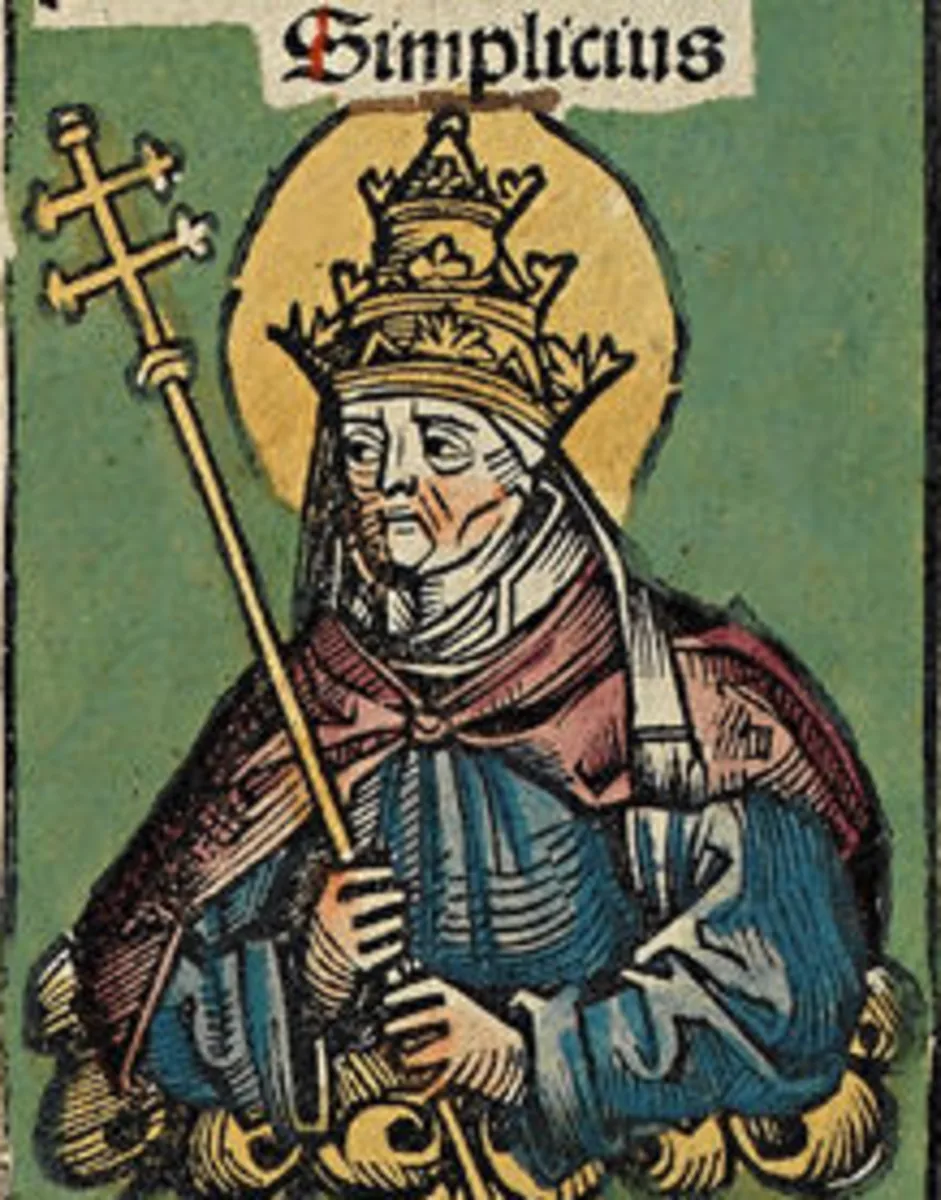
- The papal tiara, as in the woodcut of the Nuremberg Chronicle (1493).
- Papal vestments and a book or letter, recalling the correspondence through which he is known.
- The mosaic medallion in the series of papal portraits at Saint Paul Outside the Walls, where the popes appear in order.
Where to pray to Saint Simplicius
In Rome, Saint Peter's Basilica is where he was buried, near Leo the Great, in the old basilica. The church of Santo Stefano Rotondo, built during his pontificate, still welcomes visitors on the Caelian Hill. In Tivoli, his hometown, you can also remember him. Wherever you are, you can pray with him using the prayer to Saint Simplicius and the novena to Saint Simplicius.
Discover also
- Saint Hilarius, his predecessor.
- Saint Felix III, his successor, who lived through the break with Constantinople.
- Saint Leo the Great, whose Tome he defended.
- Saint Gelasius I, another pope of the late 5th century.
- Saint Flavian of Constantinople, a martyr of the Christological controversies.