Saint Patrick is the apostle of Ireland. Born in Roman Britain, he was kidnapped at sixteen by Irish raiders and sold into slavery, escaped, and then freely went back, as a bishop, to bring the Gospel to the people who had enslaved him. He is one of the very few saints of his time who left personal writings, above all his Confession. He died on a March 17 in the fifth century, and that day, his feast, has become the national day of the Irish all over the world.
Who was Saint Patrick?
Patrick, Patricius in Latin, was born at the end of the fourth or the beginning of the fifth century into a Christian family of Roman Britain, present-day Great Britain. He names the place of the family estate himself, Bannavem Taburniae, but no one has been able to identify it with certainty. His father, Calpornius, was a deacon and a member of the local gentry; his grandfather, Potitus, was a priest. Patrick admits that as a young man he paid little attention to the faith.
The dates of his life are debated. Irish tradition places his arrival as a bishop in 432 and his death in 461; other historians favor a later mission and a death around 493. What is certain comes from his two authentic texts, written in Latin: the Confession, an account of his life and a long act of thanksgiving, and the Letter to the Soldiers of Coroticus, in which he denounces a British chieftain who had massacred and enslaved newly baptized Irish Christians.

A slave in Ireland
Captured along with thousands of others, as he tells it, the young Patrick was sold in Ireland and spent six years tending flocks. Tradition places his captivity on the slopes of Slemish Mountain, in what is now County Antrim, though he does not say so himself. It was in this solitude that he turned to God. He writes that he prayed up to a hundred times a day and almost as many at night, in the woods and on the mountain, in snow, frost and rain, and felt no harm from it, because the Spirit was burning within him.
One night a voice told him that a ship was waiting for him. He fled, traveled a long way to the coast and persuaded sailors to take him on board. After a hard crossing and a difficult journey, he found his family again, and they begged him never to leave them.

The call of the Irish
Back home, Patrick saw in a dream a man named Victoricus who handed him a letter headed "The Voice of the Irish." As he read it, he seemed to hear the people who lived near the Wood of Foclut, by the western sea, crying out: "We beg you, holy youth, to come and walk among us once more." He then prepared for the priesthood. Medieval tradition has him study in Gaul, with Saint Germanus of Auxerre or at the monastery of Lérins, but his own writings do not say so.
Once a bishop, he returned to Ireland. He traveled the country, baptized thousands, ordained clergy, and encouraged young men and women to consecrate their lives to God. He refused gifts from kings and wealthy people, so that no one could accuse him of seeking his own profit. He also knew danger: he says he was imprisoned and threatened with death more than once.
History and legend
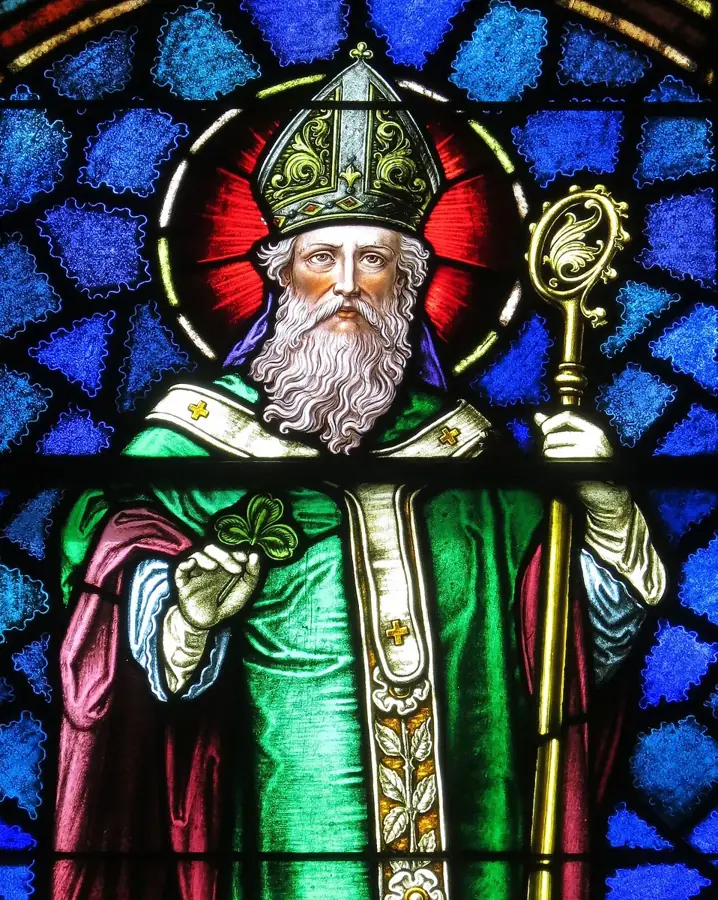
From the seventh century on, a rich body of legend grew up around Patrick. It is told that he lit the Paschal fire on the Hill of Slane in defiance of the High King at Tara, that he drove the snakes out of Ireland, or that he explained the Trinity with a shamrock leaf. None of these stories appears in his writings, and the shamrock was linked to him only later. Tradition also credits him with founding the Church of Armagh, the see of the Primate of All Ireland, and with the famous prayer known as Saint Patrick's Breastplate, which probably dates from a few centuries after him.

What can we learn from his holiness?
Saint Patrick is a witness to forgiveness and to mission. He went back freely to those who had enslaved him, to offer them what he held most precious. His Confession reveals a humble man, aware of his lack of learning, amazed at what God had done through him. He is invoked for Ireland and for the Irish scattered around the world, for missionaries, and for all who go through exile or captivity.
To pray with him, you can use the prayer of Saint Patrick's Breastplate or follow the novena to Saint Patrick from March 8 to 16, so that it ends on the eve of his feast.
Why is Saint Patrick the patron saint of Ireland?
Patrick is honored as the patron of Ireland because the Irish Church has always seen him as its founding missionary. He was not the first Christian on the island, since Palladius had been sent before him, but his long mission, his preaching across the country and the memory kept at Armagh, Downpatrick and Saul made him the father in faith of the Irish. His feast on March 17 is a solemnity in Ireland and a public holiday. Because Irish emigrants carried his memory with them, his day is also celebrated in the United States, Britain, Canada, Australia and many other countries, and great churches bear his name, such as Saint Patrick's Cathedral in New York.
Symbols and how to recognize Saint Patrick in art
- Bishop's vestments: he is usually shown with a miter and a crozier, as the bishop of the Irish.
- The shamrock: the three-leaved clover of the Trinity legend, a late but very popular emblem.
- Snakes: sometimes at his feet, recalling the legend that he drove them from Ireland.
- Green: the color of Ireland, often associated with his feast, although older images do not always use it.
Where to pray to Saint Patrick
- Downpatrick (Northern Ireland): Down Cathedral and the granite stone that marks his grave according to tradition.
- Saul (Northern Ireland): the site of his first church and, according to tradition, of his death.
- Armagh: the two Saint Patrick's Cathedrals, Catholic and Anglican, at the see of the Primate of All Ireland.
- Croagh Patrick (County Mayo): the mountain climbed by pilgrims, especially on the last Sunday of July.
- Lough Derg (County Donegal): the island of "Saint Patrick's Purgatory," a penitential pilgrimage.
Discover also
- Saint Columba of Iona, the Irish monk who carried the Gospel to Scotland.
- Saint Brendan of Clonfert, the seafaring abbot of monastic Ireland.
- Saint Aidan of Lindisfarne, the monk from Iona who evangelized northern England.
- Saint Finbarr of Cork, founder of the Church of Cork.
- Saint David, apostle of Wales, across the Irish Sea.