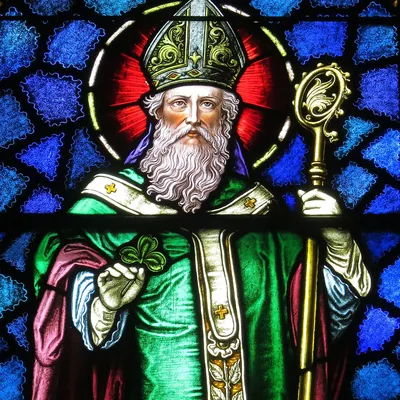
Saint Jerome is the great translator of the Bible in early Christianity. A passionate scholar and a monk with a fiery temper, he devoted most of his life to the study of Scripture and translated the Old Testament directly from Hebrew into Latin. His work forms the basis of the Vulgate, the Latin Bible used in the Western Church for more than a thousand years. He died in Bethlehem around 420, and his feast day is September 30. He is a Father and Doctor of the Church.
Who was Saint Jerome?
Eusebius Hieronymus was born around 347 in Stridon, a small town on the border between Dalmatia and Pannonia, whose exact location is still debated. His parents, Christian and well-off, sent him to Rome to study under the grammarian Donatus. There he acquired a solid classical education and a lasting love for Cicero and Virgil. It was also in Rome that he was baptized as a young man. He then traveled to Gaul, notably to Trier, and stayed in Aquileia, where he joined a circle of friends drawn to the ascetic life.
From scholar to monk
Around 373, Jerome set out for the East. In Antioch, while ill, he had a dream that he later described in a famous letter to Eustochium: dragged before the judgment seat of God, he heard himself accused of being "a Ciceronian, not a Christian." He promised never again to prefer secular books to the Scriptures. He then withdrew for a time to the desert of Chalcis, southeast of Antioch, where he led a harsh life of penance and learned Hebrew from a converted Jew. There he discovered that study itself could become a form of asceticism.

Secretary to Pope Damasus
Ordained a priest in Antioch, he went on to Constantinople, where he attended the teaching of Saint Gregory of Nazianzus. In 382 he accompanied bishops traveling to Rome for a council, and Pope Damasus kept him at his side. The pope asked him to revise the Latin translations of the Gospels, which were then numerous and often faulty.
On the Aventine Hill, Jerome also guided a group of women from the Roman aristocracy, among them Marcella, Paula and her daughter Eustochium, introducing them to the study of the Bible and to the ascetic life. His bluntness and his criticism of worldly clergy earned him solid enemies: after the death of Damasus in 384, he had to leave Rome.
Bethlehem and the Vulgate
In 386 Jerome settled in Bethlehem, near the Grotto of the Nativity. With Paula, who financed the foundations, he organized a monastery for men, a monastery for women and a guesthouse for pilgrims. For more than thirty years he worked there tirelessly.
His great work was the translation of the Old Testament into Latin from the original Hebrew, rather than from the Greek translation of the Septuagint, as had been done until then. This choice, bold for its time, drew criticism, including from his correspondent Saint Augustine. His translations, gathered with other texts, became the Vulgate, which the Council of Trent declared "authentic" in the sixteenth century.

A passionate saint
Jerome also wrote many biblical commentaries, lives of monks and more than one hundred twenty letters, lively and often biting. He threw himself into the controversies of his time, against Jovinian, against Vigilantius, against the Pelagians, and fell out with his old friend Rufinus over Origen. He never hid his anger, and tradition has never made him a model of gentleness. His holiness is that of a passionate man who put his temperament at the service of the Word of God. He died in Bethlehem at a great age, on a September 30, in 419 or 420.
Why is Saint Jerome the patron saint of translators and librarians?
Because he gave Western Christians the Bible in the language they spoke at the time, Jerome is the patron saint of translators, biblical scholars and librarians, and of students and everyone who works with books. His feast day, September 30, is also International Translation Day.
Jerome reminds us that the Bible is not a distant book but a word to be read, studied and prayed every day. His famous saying, "Ignorance of the Scriptures is ignorance of Christ," is quoted by the Second Vatican Council. His difficult character also makes him close to anyone who struggles with their temperament. In 2020, for the 1,600th anniversary of his death, Pope Francis dedicated an apostolic letter to him, Scripturae Sacrae Affectus.
Symbols and how to recognize Saint Jerome in art
Painters often show Jerome dressed as a cardinal, with a lion lying at his feet. Neither is historical: the rank of cardinal did not exist in his time, and the story of a wounded lion healed by a monk who removed a thorn from its paw comes from an ancient legend, first told of another Palestinian monk, Saint Gerasimus, and attributed to Jerome in the Middle Ages.
- A cardinal's red hat and robe.
- A lion at his side.
- Books, a quill and a desk: the scholar at work in his study.
- A stone and a skull: the penitent in the desert, striking his chest with a stone.

Where to pray to Saint Jerome
- Bethlehem: the Grottoes of Saint Jerome, beneath the Church of Saint Catherine, next to the Grotto of the Nativity.
- Rome: the Basilica of Saint Mary Major, where tradition places his relics, brought from Bethlehem in the Middle Ages.
- Rome: the Aventine Hill, where he gathered Marcella, Paula and Eustochium to study the Scriptures.
- Florence: the Church of Ognissanti, with Ghirlandaio's fresco of him at his desk.
To pray with him, you can say the prayer to Saint Jerome to love the Word of God, or follow the novena to Saint Jerome from September 22 to 30.
Discover also
- Saint Paula, his disciple and friend, who founded the Bethlehem monasteries with him.
- Saint Damasus I, the pope who entrusted him with revising the Gospels.
- Saint Augustine, his contemporary, with whom he exchanged sometimes heated letters.
- Saint Ambrose, another Latin Doctor of the Church of the same era.
- Saint Gregory of Nazianzus, whom he heard preach in Constantinople.