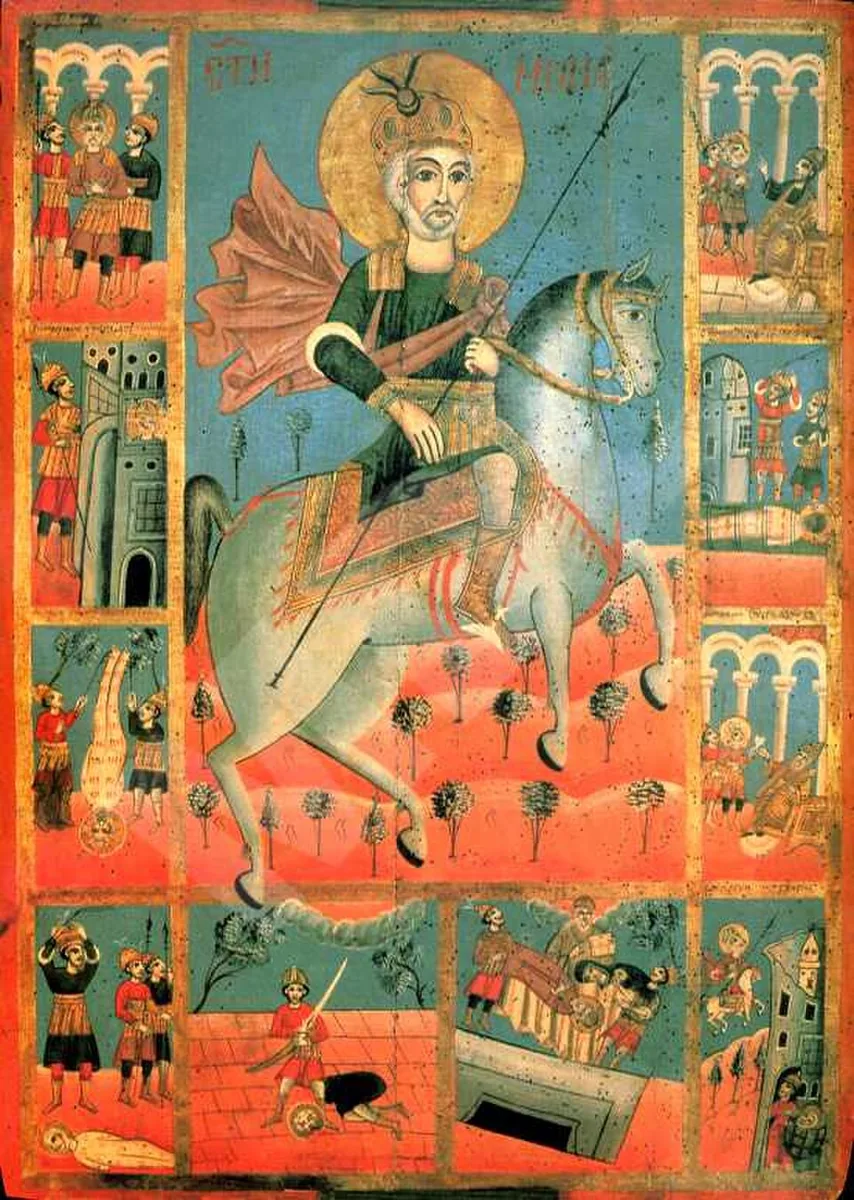
Saint Menas (Mina in Coptic and Arabic) was an Egyptian martyr of the early 4th century, a soldier in the Roman army who became a hermit and was put to death for his faith during the persecution of Diocletian. His tomb, in the desert west of Alexandria, became the greatest pilgrimage of Christian Egypt: Abu Mena. His feast day is November 11.
Who was Saint Menas?
Menas is one of the best-loved saints of the Christian East, and of Egypt in particular. He is counted among the "great martyrs", those witnesses of the faith whose cult crossed every border. Yet his story is hard to establish. We know it through many texts, written in Greek, Coptic, Latin, Syriac, Armenian, Ethiopic and even Old Nubian: a Coptic encomium of the 7th or 8th century, the Synaxarium, and collections of miracles. These sources agree neither on the year of his death nor on the place of his martyrdom. Some historians have even wondered whether there were two martyrs of the same name, one in Phrygia and one in Egypt. What is beyond doubt, on the other hand, is the scale of the devotion paid to his tomb from the late 4th century onward.
The soldier who chose the desert
According to the traditional account, Menas was born around 285 at Nikiou, near Memphis. His parents, Eudoxius and Euphemia, had no children. One day, on a feast of the Virgin Mary, Euphemia prayed for a long time before an icon of the Mother of God to obtain a son, and she heard a voice answer "Amen". The child was named Menas, a name tradition links to that word. Historians point out instead that the name is very old in Egypt, but the story speaks clearly of a mother's trust.
His father, who held an office in the administration of the province, died when Menas was fourteen. A year later the young man joined the army, where he received a high rank thanks to his family's reputation. After three years he left the uniform, because he wanted to belong to Christ alone, and went to live in the desert.
Witness and martyrdom
After five years of solitude, according to tradition, Menas saw in a vision angels crowning the martyrs. A voice promised him three crowns: for his virginity, for his life of asceticism and for his martyrdom. He then left his solitude and declared before the magistrate that he was a Christian. He refused to deny his faith despite torture and was beheaded. The accounts place his death in Phrygia or in Alexandria, and give it different dates: we must admit that we do not know for certain where or when he died.
Christians gathered his body and loaded it onto a camel to bring it back to Egypt. Once in the desert beyond Lake Mareotis, the animal refused to go any further, and the other beasts did the same. The faithful saw it as a sign: this was where Menas wished to rest. They buried him on the spot.
Abu Mena, the saint's city
The memory of the tomb is said to have been lost, until a shepherd discovered that his sick sheep were healed by rolling in the earth and water of the place. Healings multiplied, and a church was built over the tomb. Excavations have shown that the first foundation dates from the late 4th century. The shrine was then enlarged several times, until it became a true holy city, with its basilicas, its baptistery and its great hostels for pilgrims.
Visitors went home with small clay flasks filled with blessed water or oil, stamped with the image of the saint praying between two camels. A very large number of them have been found all around the Mediterranean: they bear witness to the immense reach of his cult. The shrine was ruined in the 7th century. In the 20th century, the Coptic Church founded a new monastery dedicated to Saint Mina near the ruins, which once again draws many faithful.

Devotion and art
Saint Menas is honored by the Catholic Church, by the Orthodox Churches and by the Coptic Church, which celebrates him on 15 Hathor in its calendar. In the Latin calendar his memorial falls on November 11, the same day as Saint Martin. He is invoked by people who are falsely accused and, traditionally, by traveling merchants. In Crete, the city of Heraklion took him as its patron: it is said that in 1826 a mysterious horseman prevented a massacre of Christians there, and the faithful recognized the saint in him. Since then, Cretan art has often shown him as an officer on horseback.
The oldest image remains that of the orant, arms raised, between two kneeling camels. He should not be confused with Abbot Mena, a later monk shown beside Christ on a famous Coptic icon kept at the Louvre.
What can we learn from Saint Menas?
Menas gave up a promising career to seek God in silence, then found the courage to speak of his faith in public, at the cost of his life. His story, handed down in accounts that do not always agree, carries a simple message: whoever belongs to Christ has nothing to fear. For centuries, crowds of the sick and the poor came to his tomb seeking healing. You can pray to him for those who suffer, for people unjustly accused, and for the courage to bear witness.
To pray with him, see the prayer to Saint Menas and the novena to Saint Menas.
Where to pray to Saint Menas
- Abu Mena (Egypt), about 45 kilometers southwest of Alexandria: the ruins of the holy city and the Coptic monastery of Saint Mina.
- Heraklion (Crete): the cathedral of Agios Minas, placed under his patronage.
- The Louvre (Paris): several pilgrim flasks bearing his image.
Discover also
- Saint George, another soldier martyred in the persecution of Diocletian, also venerated as a "great martyr".
- Saint Theodore Stratelates, a Roman officer and martyr, honored in the East among the soldier saints.
- Saint Anthony the Great, the father of the hermits of Egypt.
- Saint Martin of Tours, a soldier who became a monk, celebrated on the same day.