Saint Theodore Stratelates, whose surname means "the general," is a soldier saint deeply venerated in the Christian East, where he is honored as a "great martyr." According to his Passion, written in the ninth century, he was an army commander from Euchaita, in Asia Minor, put to death at Heraclea Pontica under Emperor Licinius around 319. Many historians think he is a legendary double of Saint Theodore the Recruit (Theodore Tyro). The Roman Martyrology lists him on February 7, and the Byzantine Churches celebrate him on February 8 and June 8.
Who was Saint Theodore Stratelates?
Early Christianity loved its soldier saints: Maurice, Demetrius, George, Procopius, Sergius and Bacchus. Among them, Theodore holds a special place.
A first Theodore, called the Recruit (Tyro, the conscript), is well attested from the fourth century. Saint Gregory of Nyssa preached a sermon in his praise, and his shrine at Euchaita, in the north of Asia Minor, drew pilgrims. The second Theodore, the Stratelates, appears in the texts only in the ninth century.
Since the Bollandist scholar Hippolyte Delehaye, many specialists have held that both were originally one and the same martyr, whose legend split in two: the simple recruit would have become, in another tradition, a brilliant general. Other scholars show that the two figures were already distinguished in the seventh or eighth century. The question remains open. What is certain is the devotion that surrounds Theodore Stratelates in the Churches of the East, Eastern Catholic and Orthodox alike.
The story of his Passion
The dragon of Euchaita
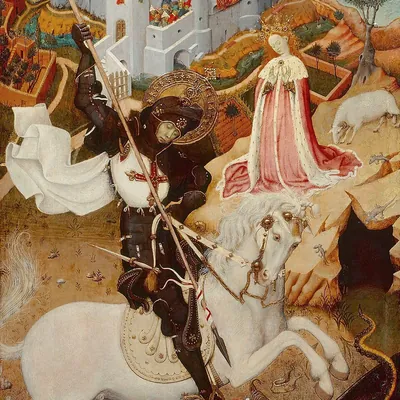
According to the Passion, Theodore became famous by delivering the region of Euchaita from a dragon that terrorized it. Like the better-known story of Saint George, this episode expresses in an image the victory of faith over evil.
The general who broke the idols
Appointed to command the troops of Heraclea Pontica, on the Black Sea, he served under Emperor Licinius, who was persecuting Christians. Theodore arranged for the gold and silver statues of the city's gods to be gathered at his house. He smashed them, then gave the pieces to the poor.
Cross and sword
Arrested, he was tortured and then crucified. The account, attributed to his servant Abgar, says that in the morning the soldiers found him still alive. Refusing to flee martyrdom, Theodore gave himself up again, asked Abgar to bury him on the family estate at Euchaita, and offered his neck to the executioner, who beheaded him. The Passion places his death on a Saturday in the first week of Lent.
This detail is telling. In the Byzantine calendar, the first Saturday of Lent is already dedicated to Theodore the Recruit. The overlap is one of the reasons scholars see the two Theodores as closely intertwined, if not as a single martyr remembered in two ways.
This account, written several centuries after the events it describes, follows the pattern of the epic Passions of the Byzantine period. It should be read as a meditation in images on the courage of the martyr rather than as a chronicle.
Why is Saint Theodore Stratelates the patron saint of soldiers?
As a general who, according to tradition, remained faithful to Christ while holding high military command, Theodore naturally became a protector of soldiers. Byzantine armies and the peoples of Eastern Europe invoked the soldier saints in time of war, and Theodore was among the most popular. Today, Christians pray to him for members of the armed forces and their families, and for all who carry authority and responsibility for others.
Symbols and how to recognize Saint Theodore Stratelates in art
Theodore Stratelates is one of the most frequently depicted saints in Byzantine, Georgian and Slavic art. Look for these signs:
- Armor, spear and shield: he is shown as a warrior in Roman military dress.
- On horseback, striking a serpent: a reminder of the dragon of Euchaita.
- Beside another Theodore: he is sometimes painted next to Theodore the Recruit, the two soldier saints side by side.
- The cross: some icons show him holding a cross, the sign of his martyrdom.
A fresco from 1096 in the church of Iprari, in Georgia, is one of his oldest dated images, and the painter Manuel Panselinos depicted him on Mount Athos.
What can we learn from Saint Theodore Stratelates?
Behind the legend, the message is clear: a man entrusted with great power refuses to serve idols and puts what he has at the service of the poor. Breaking the precious statues to give their value to the poor says that God, and the little ones, come before riches.
We can pray to him for soldiers and their families, for those who exercise authority, and for unity between the Christians of East and West, who venerate him together.
Where to pray to Saint Theodore Stratelates
- Byzantine-rite churches: Greek Catholic and Orthodox communities, which celebrate him on February 8 and June 8.
- Georgia: the churches of Svaneti, where he was painted as early as the eleventh century.
- Mount Athos: the monasteries that keep frescoes and icons of him.
In English-speaking countries, Ukrainian, Ruthenian and Melkite Catholic parishes, as well as Orthodox churches, keep his feast in their calendars.
Discover also
- Saint Acacius of Byzantium, a centurion martyred in the Great Persecution.
- Saint Demetrius of Thessaloniki, another great soldier saint of the East.
- Saints Sergius and Bacchus, officers martyred and venerated in Syria.
- The Forty Martyrs of Sebaste, soldiers also killed under Licinius.
- Saint Mercurius of Caesarea, another soldier martyr much venerated in the East.