Saint Godehard (also known as Gotthard or Gothard) was a Bavarian Benedictine monk, born around 960 near the abbey of Niederaltaich, who reformed several great monasteries before becoming bishop of Hildesheim, in Saxony, from 1022 until his death on May 5, 1038. Canonized in 1131, he gave his name to the famous Gotthard Pass in the Swiss Alps. His feast day is May 5.
Who was Saint Godehard?
Godehard lived in the time of the Ottonian emperors, when bishops and abbots were among the great figures of the Holy Roman Empire. His life is well documented: his disciple Wolfhere wrote two successive biographies of his master. They describe a rigorous monk, a demanding reformer and a building bishop, close to Emperor Saint Henry II but concerned above all with the Christian life of his people. Legends soon gathered around this portrait, a sign of the veneration he inspired. His cult spread from Scandinavia to Italy, and his name remains attached to one of the best-known passes of the Alps.
The monk of Niederaltaich
Godehard grew up in the shadow of the Benedictine abbey of Niederaltaich, on the Danube. There he studied, took his vows and became provost in 984, that is, the person responsible for the material life of the community. In 996 he became its abbot, with the support of Duke Henry of Bavaria, who would later be Emperor Saint Henry II. Godehard was a convinced supporter of the monastic renewal inspired by Cluny: a return to strict observance of the Rule of Saint Benedict, carefully celebrated liturgical prayer, and a poor and regular common life.
The reformer of abbeys
His reputation led to his being called to head other monasteries: Tegernsee in 1001-1002, Hersfeld from 1005 to 1012, Kremsmünster from 1007 to 1012. Everywhere he restored discipline. Reform did not come without resistance: at Hersfeld, some fifty monks preferred to leave the abbey rather than accept his demands. Godehard held firm, convinced that a monastery bears fruit only if it is faithful to its rule. From 1012 onward, he devoted himself again mainly to Niederaltaich.
The bishop of Hildesheim
On the death of Saint Bernward, bishop of Hildesheim, Emperor Henry II chose Godehard to succeed him. He was consecrated on December 2, 1022. The monk who had become bishop continued the work of his predecessors: he had some thirty churches built in his diocese, completed the abbey church of Saint Michael in Hildesheim and rebuilt the westwork of the cathedral. But his biographers stress above all his visits and synods, through which he sought to make the faith more alive in the parishes. His monk's rigor and his quiet frankness struck his contemporaries. He died on May 5, 1038, at the monastery of Saint Maurice, which he had founded near Hildesheim.
Devotion and art
The chronicler Hermann of Reichenau already mentions his veneration in the 11th century. In 1131, Pope Innocent II canonized him. From 1133, a great Romanesque church dedicated to him began to be built in Hildesheim: today's Basilica of Saint Godehard. Relics were sent to many monasteries, especially in Swabia. A chapel was dedicated to him at the top of the Alpine pass that would take his name, consecrated according to some sources around 1230 by the archbishop of Milan. His cult then spread into northern Italy. Godehard is also the patron of the town of Gotha, in Thuringia, which shows him on its coat of arms.
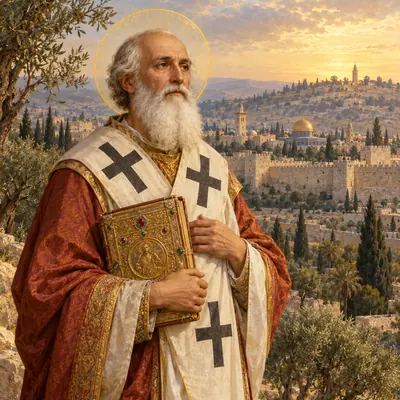
He is shown as a bishop, with miter and crozier, and sometimes with burning coals in a fold of his cloak. This image refers to a legend: as an altar boy, he is said to have carried embers for the censer in his garment without burning himself or the cloth.

What can we learn from Saint Godehard?
Godehard united two vocations: that of the monk who seeks God in faithfulness to a rule, and that of the bishop who builds, visits and teaches. He knew how to be demanding without ceasing to be a pastor. His name, given to a pass in the Alps, also links him to the travelers who cross it. We can pray to him for religious communities, for bishops, for travelers and for all who must carry out a reform with patience and firmness.
Where to pray to Saint Godehard
- Basilica of Saint Godehard, Hildesheim (Lower Saxony, Germany): the great Romanesque church built in his honor after his canonization.
- Hildesheim Cathedral: the cathedral of his diocese, whose westwork he rebuilt, and which keeps a medieval reliquary bearing his name.
- Niederaltaich Abbey (Bavaria): the monastery where he was a pupil, a monk and abbot.
- Gotthard Pass (Switzerland): the Alpine pass that bears his name.
Discover also
- Saint Henry II, the emperor who supported him and made him bishop of Hildesheim.
- Saint Benedict of Nursia, whose rule he wanted faithfully observed.
- Saint Ulrich of Augsburg, another great bishop of the Empire, canonized before him.
- Saint Wolfgang of Regensburg, bishop and monastic reformer in Bavaria in the same period.