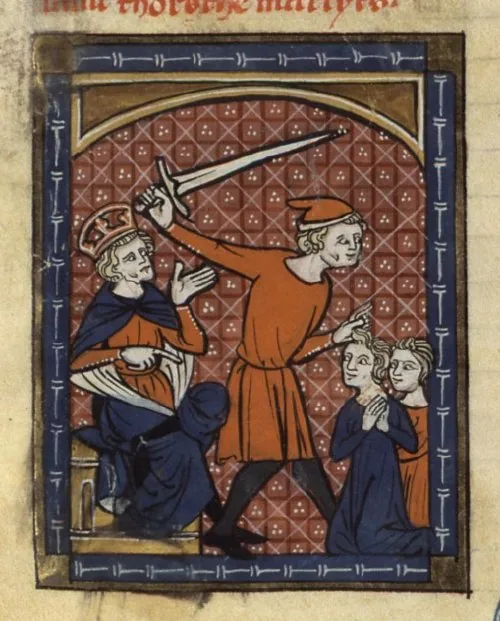
Saint Gorgonius is a martyr of the early 4th century, buried in Rome in the cemetery "At the Two Laurels," on the Via Labicana. In 766 Saint Chrodegang, bishop of Metz, brought his relics to Lorraine, to the abbey of Gorze, and from there his cult spread throughout France. His feast day is September 9.
Who was Saint Gorgonius?
Gorgonius (in French Gorgon) is one of those martyrs of the early centuries whose name and tomb we know, but very little of their life. Tradition identifies him with an officer of the court of Emperor Diocletian who, having become a Christian, refused to deny his faith together with his companion Dorotheus and was put to death during the Great Persecution, around 303-304. Historians, however, distinguish the Gorgonius of Nicomedia, mentioned by the historian Eusebius of Caesarea, from the Gorgonius of Rome, honored on the Via Labicana. Today the Roman Martyrology commemorates on September 9 the Roman martyr buried "At the Two Laurels." For the faithful of Lorraine, he is simply Saint Gorgon, the martyr whose relics made Gorze famous.
A martyr of the Great Persecution
At the beginning of the 4th century, Emperor Diocletian launched the most violent of all the persecutions against Christians. According to Eusebius of Caesarea, who lived through it, there were Christians serving even in the imperial palace of Nicomedia. Among them, Dorotheus and Gorgonius, high officers of the emperor's household, were ordered to sacrifice to the gods. They refused, and were tortured and then put to death.
In Rome, a martyr named Gorgonius was venerated in the cemetery "At the Two Laurels," on the Via Labicana, the same place where Saints Marcellinus and Peter rested. Tradition brought the two figures together. Historians remain cautious: they may be two different martyrs. What is certain is that from ancient times the Christian community of Rome honored a martyr of this name and kept his tomb.
The relics of Gorze
In the 8th century, Saint Chrodegang, bishop of Metz and a great reformer of the Frankish Church, founded the abbey of Gorze, near Metz. To give his monastery a protector, he obtained relics of Saint Gorgonius in Rome and brought them back to Lorraine in 766. Gorze became one of the great monasteries of medieval Europe, with Saint Gorgonius as its patron.
At the end of the 10th century, the monks of Gorze wrote a Panegyric and a book of Miracles in his honor, including a miracle that took place at Varangéville, in Lorraine. Relics were later entrusted to the abbey of Saint-Arnould in Metz and to the abbey of Cluny. Through the great Cluniac network, devotion to Saint Gorgonius reached many regions of France.

Devotion and art
Saint Gorgonius is celebrated on September 9. Several French towns bear his name, and many churches are dedicated to him, for example in Metz, Moyeuvre-Grande, Varangéville, Woël, Pouillon, Véron, Plovan and Moustoir-Remungol. Saint-Gorgon chapels still welcome pilgrimages in September, as at Anor, in the Nord department, or at Saint-Martin-de-Boscherville, near Rouen, where the feast of Saint Gorgon was revived in 2001. Popular devotion calls on him against nervous diseases and rheumatism.
He is often shown as a Roman soldier or officer, with the palm of martyrdom. The museum of Épinal keeps a painting from the early 17th century by the Lorraine painter Claude Bassot, showing Saint Gorgonius and Saint Barbara with a donor. The church of Vienne-en-Bessin, in Calvados, has a painting and a stained glass window of his martyrdom.
What can we learn from Saint Gorgonius?
About Saint Gorgonius we know one thing above all: he preferred Christ to his career and to his life. Whether or not he served at the emperor's court, he was faithful to the end. His story also shows how the faith of the martyrs of Rome nourished, centuries later, the faith of the monks and villages of Lorraine and France. You can pray to him to stay faithful to Christ in your workplace, for persecuted Christians, and for the sick who suffer in their bodies.
To pray with him, see the prayer to Saint Gorgonius and the novena to Saint Gorgonius.
Where to pray to Saint Gorgonius
- Gorze (Moselle, France): the village of the former abbey where Saint Chrodegang placed his relics.
- Varangéville (Meurthe-et-Moselle): the church of Saint-Gorgon.
- Metz (Moselle): the church of Saint-Gorgon.
- Anor (Nord): the Saint-Gorgon chapel and its September pilgrimage.
- Saint-Martin-de-Boscherville (Seine-Maritime): the Saint-Gorgon chapel.
Discover also
- Saint Sebastian, another Roman officer martyred for Christ.
- Saint Arnulf of Metz, bishop of Metz, whose abbey received part of his relics.
- Saints Sergius and Bacchus, other officer martyrs from the East.
- Saint Barbara, painted at his side by Claude Bassot.