Saint Barbara is a virgin martyr of the early Christian centuries, venerated in both East and West. Her story, handed down through legendary accounts written long after her death, tells that her father shut her up in a tower, then beheaded her himself, before being struck by lightning. From this story grew an immense devotion: Saint Barbara is the patron saint of firefighters, miners and artillerymen. She is celebrated on December 4.
Who was Saint Barbara?
It must be said from the outset: we know almost nothing certain about Saint Barbara. The oldest accounts of her passion date at best from the seventh century, and they agree neither on the place nor on the date of her martyrdom. Some place it at Nicomedia, in Asia Minor, others at Heliopolis, in Egypt or Syria, under the emperor Maximian or during a third-century persecution. Her cult, on the other hand, is ancient and widespread: she has been invoked since the early Middle Ages in Constantinople, and then throughout the West.
This is why, in the reform of the liturgical calendar in 1969, the Catholic Church removed her feast from the General Roman Calendar for lack of sufficient historical data. This was not a condemnation: Saint Barbara remains in the Roman Martyrology on December 4, and her feast is still celebrated in many places and by the Eastern Churches, which call her "the Great Martyr."

The legend of the tower
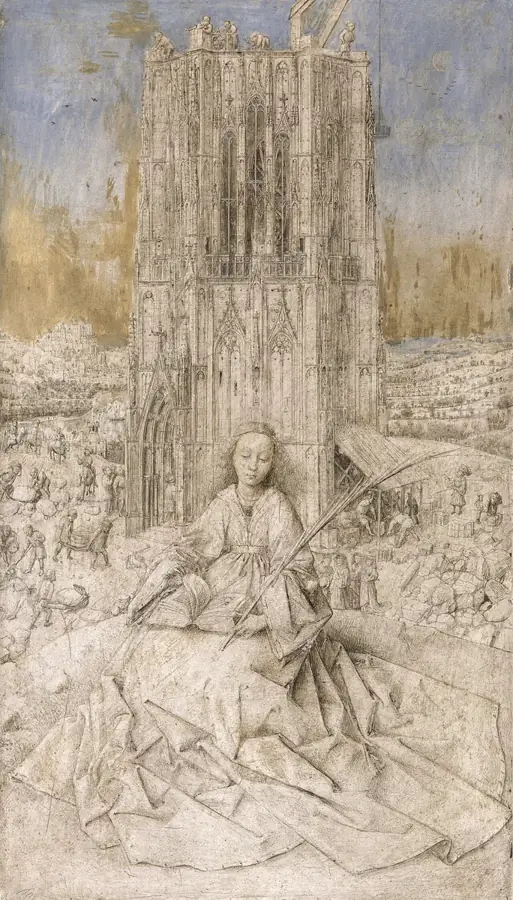
According to the traditional account, Barbara was the daughter of a rich pagan named Dioscorus. To shield her from prying eyes and suitors, her father made her live in a tower. While Dioscorus was away, she discovered the Christian faith and asked for baptism. She then had a third window opened in the tower, in honor of the Trinity, and traced a cross on the wall. The tower, present in almost all her images, became her emblem.
On his return, her father realized that his daughter was a Christian. In a rage, he wanted to kill her. Barbara fled, but was handed over to the governor, who had her tortured. The legend multiplies torments and miraculous healings, in the manner of martyrdom accounts of that period. She refused to deny her faith. Her own father beheaded her; at once, he was struck by lightning.
Why is Saint Barbara the patron saint of firefighters, miners and artillerymen?
That last episode explains most of her patronages. Since lightning avenged her death, she is invoked against storms and sudden death. With the arrival of gunpowder, she became the patron of all who handle fire and explosives: artillerymen, fireworks makers, then miners, quarry workers and firefighters.
In the mines of northern France, Belgium and Germany, Saint Barbara's Day on December 4 was a holiday when Mass was celebrated before a shared meal. To this day, firefighting units and artillery regiments celebrate her every year; in the United States, the field artillery honors her through the Order of Saint Barbara.
On sailing ships, the powder magazine was often placed under her protection, and in French it was even called the sainte-barbe. She is also invoked for a good death: tradition says that before her execution she asked God that those who called on her would not die without receiving the sacraments.

A much-loved saint
Few saints have been depicted so often. Flemish painters show her as an elegant young woman absorbed in a book, with her tower under construction in the background. With Saint Margaret of Antioch and Saint Catherine of Alexandria, she forms the trio of the most popular virgin martyrs of the Middle Ages.
In Provence, "Saint Barbara's wheat," sown on December 4 in small dishes, announces Christmas: if it grows well, they say, the year will be good. In the Americas, her name lives on in places such as Santa Barbara in California.
Symbols and how to recognize Saint Barbara in art
- The tower, often with three windows, recalling the Holy Trinity.
- The palm of martyrdom, held in her hand.
- A crown, sign of the victory of the martyrs.
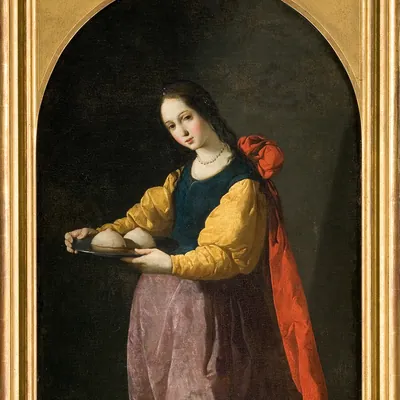
- A chalice and a host, sign of the Communion she obtains for the dying.
- A book, especially in Flemish paintings, where she is shown reading.
- A cannon or lightning, in later images linked to her patronages.

What does her holiness teach us?
Even if her story is largely legendary, Saint Barbara bears witness to the memory the Church keeps of the anonymous martyrs of the early centuries, often women, who chose to die rather than deny Christ. Her legend speaks of a faith stronger than fear, and of a trust that stays with us to the very last moment. Catholics pray to her for those who risk their lives in their work and for a peaceful death, reconciled with God.
To pray with her, use the prayer to Saint Barbara for those who face danger, or follow the novena to Saint Barbara, from November 25 to December 3, the eve of her feast.
Where to pray to Saint Barbara
- Le Faouët (Brittany, France): the Chapel of Sainte-Barbe, clinging to the rock above the Ellé valley.
- Kyiv (Ukraine): Saint Volodymyr's Cathedral, which keeps relics attributed to her.
- Kutná Hora (Czech Republic): the great Gothic Church of Saint Barbara, built by the town's silver miners.
- The mining regions of northern France and Lorraine, where many churches and chapels are dedicated to her.
Discover also
- Saint Margaret of Antioch, another virgin martyr among the Holy Helpers.
- Saint Christopher, also invoked in danger and counted among the Holy Helpers.
- Saint Erasmus, a martyr invoked by sailors.
- Saint Agnes, a young Roman martyr.
- Saint Juliana of Nicomedia, a martyr of the same city according to tradition.