Saint Peter Claver was a 17th-century Jesuit priest from Catalonia who spent nearly forty years in Cartagena de Indias, in present-day Colombia, serving the enslaved Africans brought ashore in that great slave-trading port. He met them as they came off the ships, fed them, nursed them and announced the Gospel to them. He died in 1654, was canonized in 1888, and is the patron saint of Colombia and of missions among Black peoples. His feast day is September 9.
Who was Saint Peter Claver?
Pere Claver was born in 1580 in Verdú, a village in Catalonia, into a family of Christian farmers. He lost his mother at thirteen. Drawn early to the clerical state, he received the tonsure at fifteen, then went to study in Barcelona with the support of an uncle who was a canon. There he met the Jesuits, and on August 7, 1602, he entered the novitiate of the Society of Jesus in Tarragona.
Sent to study philosophy in Palma de Mallorca, he became friends with the porter of the college, an elderly and very humble Jesuit brother, Alphonsus Rodríguez, who would be canonized on the same day as him. The old brother often spoke to him about the missions of the New World and the immense need for apostles there. The young Peter asked to be sent.
Cartagena, a slave-trading port
At the beginning of the 17th century, Cartagena de Indias was one of the main ports of arrival for enslaved Africans in Spanish America. Every year about a dozen slave ships unloaded captives who had been crammed for weeks in holds without air or light. Many arrived sick, starving and terrified. Some missionaries who protested against this treatment were persecuted or expelled.
Since 1605, a Jesuit, Father Alonso de Sandoval, had been caring for these men and women and studying their peoples and languages. Peter Claver became his disciple and continued his work. On the day of his final vows in 1622, he added to the Latin formula of his profession a phrase that sums up his life: Petrus Claver, Aethiopum semper servus, "Peter Claver, slave of the Africans forever."
Forty years in the service of the enslaved
As soon as a ship was announced, Peter Claver went to the port with food, water, medicine and fruit. He went down into the holds, washed and nursed the sick, and embraced the dying. He returned day after day to the warehouses where the captives waited to be sold. Using pictures, he taught them the great truths of the faith, and he baptized those who asked for it. His biographers credit him with hundreds of thousands of baptisms; the figure belongs to tradition, but it shows the scale of his work.
To make himself understood, he depended on interpreters who spoke the captives' languages. The sources show that these interpreters, some of whose names have come down to us, were themselves enslaved people belonging to the Jesuit college. This reality is a reminder that Peter Claver lived inside a system he did not abolish, and from which his Church and his order also profited. Yet within that world he refused to treat the enslaved as merchandise: he looked on them as brothers and sisters, children of God with full dignity.
His dedication did not stop at the port. He visited hospitals, lepers and prisoners, and accompanied condemned men to their execution. For himself he kept almost nothing.

The last years
In 1650 an epidemic struck Cartagena. Peter Claver fell ill; he survived, but remained paralyzed and could no longer work. He spent his last four years in the infirmary of the college, often forgotten and sometimes poorly cared for. He died on September 8, 1654. His death caused great emotion in the city, and his tomb quickly became a place of prayer. His body now rests under the high altar of the church that bears his name.
Why is Saint Peter Claver the patron saint of Colombia and of missions among Black peoples?
Peter Claver spent his whole priestly life in Colombia, and Leo XIII, who greatly admired him, proclaimed him patron of missions among Black peoples in 1896. The pope is reported to have said that no life, after that of Christ, had moved him so much. In 1985, Colombia made September 9 its National Human Rights Day in his honor.
In the United States, his name is carried by the Knights of Peter Claver, a Catholic fraternal order founded in 1909 in Mobile, Alabama, by and for African American Catholics. More broadly, he is prayed to for victims of human trafficking and exploitation, for migrants, and for all whose dignity is trampled.
He did not give great speeches: he fed, washed, nursed, listened and consoled, for forty years, in the same place. To pray with him, read the prayer to Saint Peter Claver and follow the novena to Saint Peter Claver from August 31 to September 8.
Symbols and how to recognize Saint Peter Claver in art
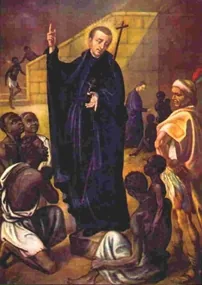
Peter Claver is shown in the black cassock of a Jesuit, often holding a cross. He is usually depicted bending over enslaved Africans to help them, giving them water, nursing them or baptizing them. Some images show him at the port of Cartagena beside a ship, or with a staff and a bag of provisions for the captives.
Where to pray to Saint Peter Claver
- Cartagena de Indias (Colombia): the Sanctuary of San Pedro Claver, in the walled old city, where his body rests under the high altar. In the former Jesuit convent you can see the cell where he lived and the room where he died. Pope John Paul II prayed there in 1986.
- Verdú (Catalonia, Spain): his birthplace, now a museum.
- Tarragona and Palma de Mallorca (Spain): the places of his Jesuit formation.
- Brazzaville (Republic of the Congo): the Church of Saint Peter Claver, built in 1963.
Discover also
- Saint John Berchmans, a young Jesuit canonized on the same day.
- Saint Ignatius of Loyola and Saint Francis Xavier, founder and great missionary of the Society of Jesus.
- Saint Martin de Porres, a mixed-race Dominican brother of Lima, his contemporary.
- Saint Peter of Saint Joseph de Betancur, apostle of the poor in Guatemala in the same century.
- Saint Josephine Bakhita, a former slave who became a religious sister.