Saint Omer, known in Latin as Audomar, was a monk of Luxeuil who became bishop of Thérouanne, in northern France, in the seventh century. Born in the Cotentin, in Normandy, he evangelized the land of the Morini, today the Pas-de-Calais and French Flanders. With his companions, he founded a church and a monastery on the river Aa, around which grew the town that bears his name, Saint-Omer. He died blind around 667, is invoked for diseases of the eyes and is celebrated on September 9.
Who was Saint Omer?
What we know of Omer comes from several successive Lives. The first, now lost, was written at the beginning of the ninth century from oral tradition. A few documents also survive, such as a privilege he granted in 662 to the monastery of Sithiu. The main outline of his life is therefore known, but the details call for caution.
According to tradition, he was born around 600 at Orval, near Coutances, to parents named Friulf and Domitta. He grew up in a region where Saxons had settled and learned their language and customs. This proved a great asset for his future mission in the North, where the coasts were also populated by Saxons.
A monk of Luxeuil
When his mother died, Omer's father decided to enter religious life, and his son followed him to the monastery of Luxeuil, in the Vosges. Luxeuil had been founded at the end of the sixth century by the Irish monk Saint Columbanus. It was then the great school of holiness of the Frankish kingdom: many bishops and founders were trained there, and its monks spread throughout northern Gaul. Omer received a demanding formation, centered on prayer, penance and mission.
Bishop of the Morini
Around 637, during the reign of King Dagobert I, Omer was called to become bishop of Thérouanne, the city of the Morini. The region had been evangelized in the fourth century, but the invasions had brought much of it back to paganism, and the coasts had become Saxon.
Omer traveled throughout his diocese. He preached, celebrated the great feasts among his people, had crosses set up and churches built. His knowledge of the Saxon language helped him make himself understood.
The gift of Sithiu
Near the mouth of the Aa, he was welcomed by a wealthy landowner, Adroald, whom he converted. In 651, Adroald gave him several estates, including the island of Sithiu. There Omer founded a church dedicated to the Virgin Mary, which later became a collegiate church and then the cathedral of Notre-Dame de Saint-Omer.
The companions of Sithiu
To help him, Omer called three monks trained in the tradition of Columbanus: Mommolinus, Bertin and Bertrand. Mommolinus became the first abbot of Sithiu before leaving for Noyon, where he would succeed Saint Eligius as bishop. Bertin succeeded him and founded, east of Notre-Dame, a church dedicated to Saint Peter, which became the great abbey of Saint-Bertin.
Around these two sanctuaries a town gradually grew up. In the Middle Ages it took the name of its founder: Saint-Omer.
The blind bishop
At the end of his life, Omer lost his sight. He died around 667 at Wavrans-sur-l'Aa and, as he had wished, Bertin had his body carried to the church of Notre-Dame at Sithiu. In the ninth century, an attempt was made to carry his relics off to Saint-Quentin, but Bishop Folquin of Thérouanne foiled it and brought them back to Saint-Omer.
Why is Saint Omer the patron saint of eyes and of the town of Saint-Omer?
The town of Saint-Omer owes him its very existence: it grew up around the church and monastery he founded at Sithiu, and it took his name. He is naturally its patron.
His blindness at the end of his life most likely explains why he is invoked for diseases of the eyes. People pray to him before eye surgery, for failing sight and for the blind and visually impaired. At Orval, in the Manche, his traditional birthplace, he is also invoked for intestinal troubles.
More broadly, Omer is one of those monk-bishops who rebuilt the Christian faith in northern Gaul after the invasions. A patient missionary, he knew how to surround himself with companions and trust them, so that his work outlived him and gave birth to a town. He can be prayed to for missionaries and for all who work as a team in the service of the Gospel.
Symbols and how to recognize Saint Omer in art
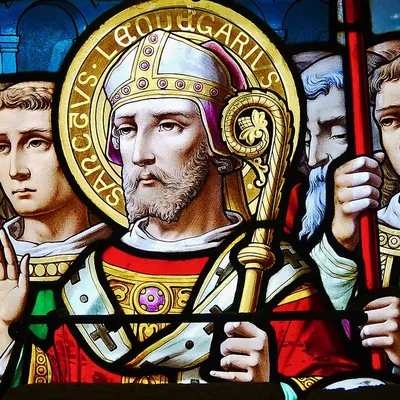
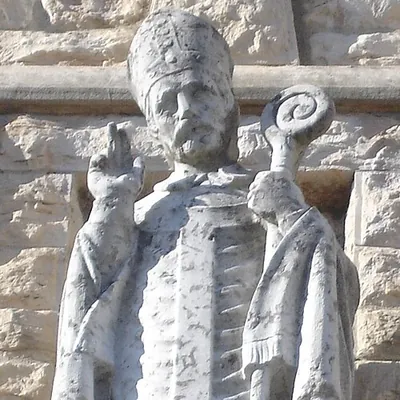
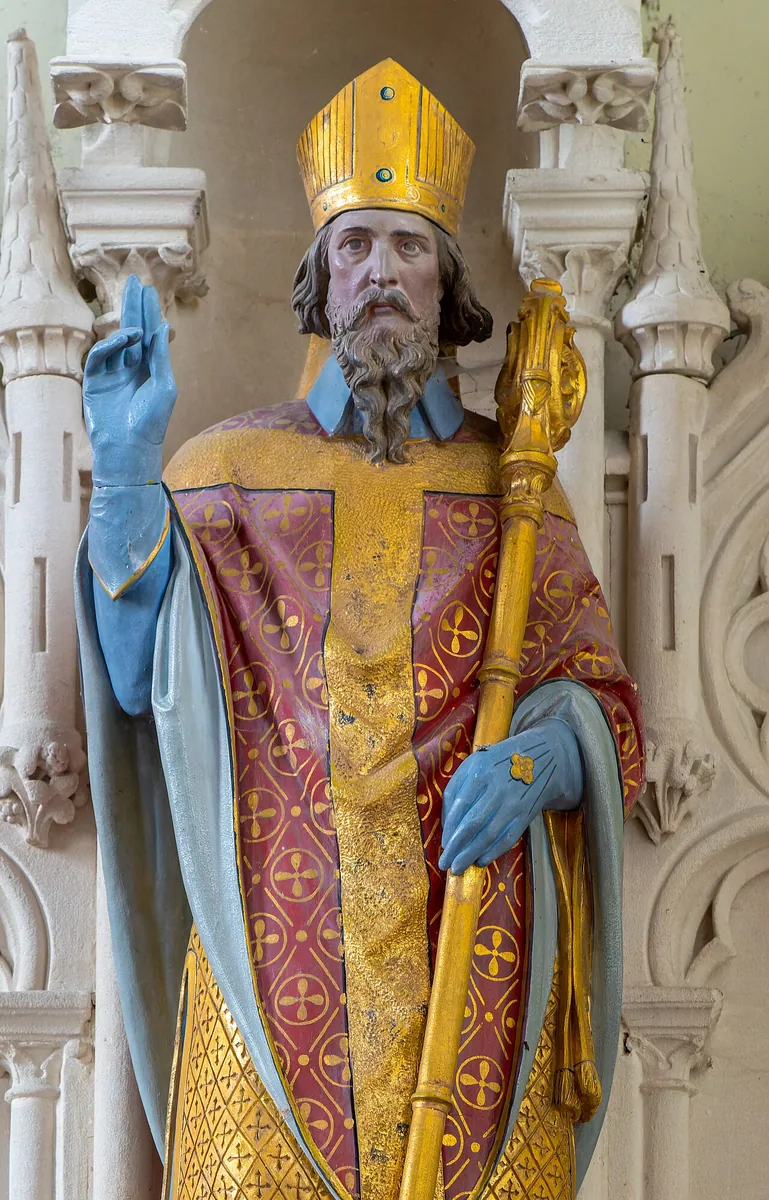
Saint Omer is shown as a bishop, with miter and crosier. Statues of him are found in many churches of the Pas-de-Calais and French Flanders, such as the gilded wooden statue in the church of Houchin. An eleventh-century illuminated Life of Saint Omer, kept in Saint-Omer, depicts scenes of his life, including his arrival at Luxeuil with his father.
Where to pray to Saint Omer
- Saint-Omer (Pas-de-Calais): the cathedral of Notre-Dame, heir to the church he founded and where he was buried.
- Saint-Omer: the ruins of the abbey of Saint-Bertin.
- French Flanders: the many churches dedicated to Saint Omer, such as those of Brouckerque, Ledringhem and Rexpoëde.
- Orval (Manche): his native village according to tradition.
To pray with him, use the prayer to Saint Omer or the novena to Saint Omer.
Discover also
- Saint Columbanus, founder of Luxeuil.
- Saint Eligius of Noyon, bishop and missionary of northern Gaul in the same period.
- Saint Amand, another great missionary of Flanders in the seventh century.
- Saint Ouen of Rouen, a contemporary close to the court of Dagobert.
- Saint Hugh of Rouen, another bishop of northern France.