Saint Chad, in Old English Ceadda, was an Anglo-Saxon monk and bishop of the seventh century, trained at Lindisfarne. First made bishop of the Northumbrians, he humbly stepped aside when his appointment was judged irregular, and then became the first bishop of the Mercians to have his seat at Lichfield. Saint Bede the Venerable praises his gentleness and holiness. He probably died on March 2, 672, and his feast day is March 2.
Who was Saint Chad?
Chad came from Northumbria, the Anglo-Saxon kingdom in the north of England. He belonged to a remarkable family of brothers: with them, including Saint Cedd, he was one of the fruits of the mission that came from Ireland and Scotland with Saint Aidan, founder of the monastery of Lindisfarne. Chad studied there, then spent time in Ireland, a land of many monasteries, before joining his brother Cedd, abbot of Lastingham.
Almost everything we know about him comes from the Ecclesiastical History of the English People by Saint Bede the Venerable, written a few decades after his death. Bede, who received his information from monks who had known Chad, paints the portrait of a humble, studious pastor wholly given to his mission.
A bishop who accepted being set aside
In 664 Chad succeeded his brother as head of the monastery of Lastingham. That same year, King Oswiu of Northumbria had him appointed bishop of his kingdom. Yet the see had been intended for Saint Wilfrid, who had gone to Gaul to receive episcopal ordination and was delayed in returning. This created a double appointment, and Chad's own consecration was considered questionable.
In 669 the new archbishop of Canterbury, Saint Theodore of Tarsus, sent from Rome to reorganize the Church in England, declared Chad's appointment irregular. According to Bede, Chad answered without bitterness: if his ordination had not been done properly, he would gladly step down, for he had never thought himself worthy of the office and had accepted it only out of obedience. Moved by this humility, Theodore himself completed his ordination according to the rules and, soon afterward, named him bishop of the Mercians.
Bishop of Lichfield
Chad settled at Lichfield, at the heart of the kingdom of Mercia, in the Midlands of England. Faithful to the ways of his Irish teachers, he was accustomed to travel through his diocese on foot to preach the Gospel. Bede tells how Theodore asked him to ride a horse for long journeys and, when Chad hesitated, the archbishop himself helped him into the saddle. Near his church, Chad set up a more secluded dwelling where he prayed and studied with a few brothers.
His time as bishop was short. According to Bede, he died of the plague after being warned of his approaching death. The account relates that a monk heard mysterious singing descending from heaven toward his dwelling, and Bede presents it as the announcement of his passing to God. He also mentions healings obtained at his tomb. These stories express the veneration that surrounded Chad from the moment of his death. He was buried at Lichfield, and his tomb soon drew pilgrims.
The cult of Saint Chad
His relics were kept in Lichfield Cathedral until the Reformation and the dissolution of the monasteries in the sixteenth century. Part of them was saved and, since the nineteenth century, they have been venerated in Saint Chad's Cathedral in Birmingham, the Catholic cathedral dedicated to him. Many churches in the English Midlands bear his name, and he remains one of the best-loved Anglo-Saxon saints in England.
Why is Saint Chad the patron saint of Mercia and Lichfield?
Chad was the first bishop of the Mercians to have his seat at Lichfield, and his tomb there made the city a center of pilgrimage for centuries. For this reason he is honored as the patron of the old kingdom of Mercia, roughly the English Midlands, and of the city and diocese of Lichfield. The Catholic Archdiocese of Birmingham, which keeps his relics, also holds him in particular honor.
What can we learn from Saint Chad?
Chad is a saint of humility within the Church. Set aside from an office he had not sought, he did not defend himself but submitted to legitimate authority, and that obedience opened the way to a new mission. He reminds us that the Church is built less by ambition than by availability. He can be invoked for bishops, for those who must accept a difficult decision and for missionaries.
Symbols and how to recognize Saint Chad in art
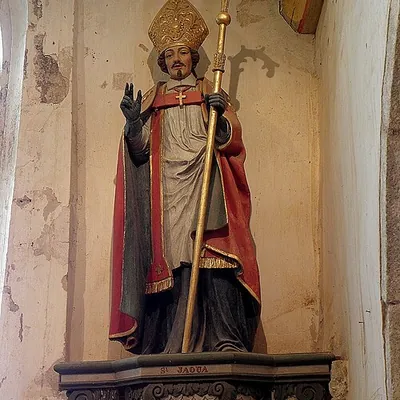
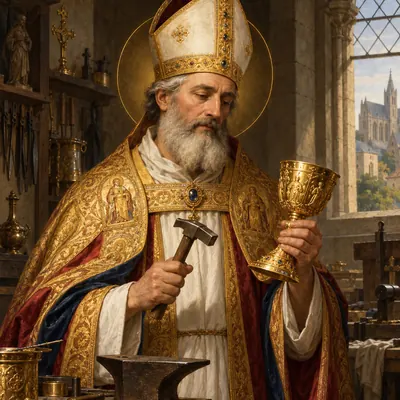
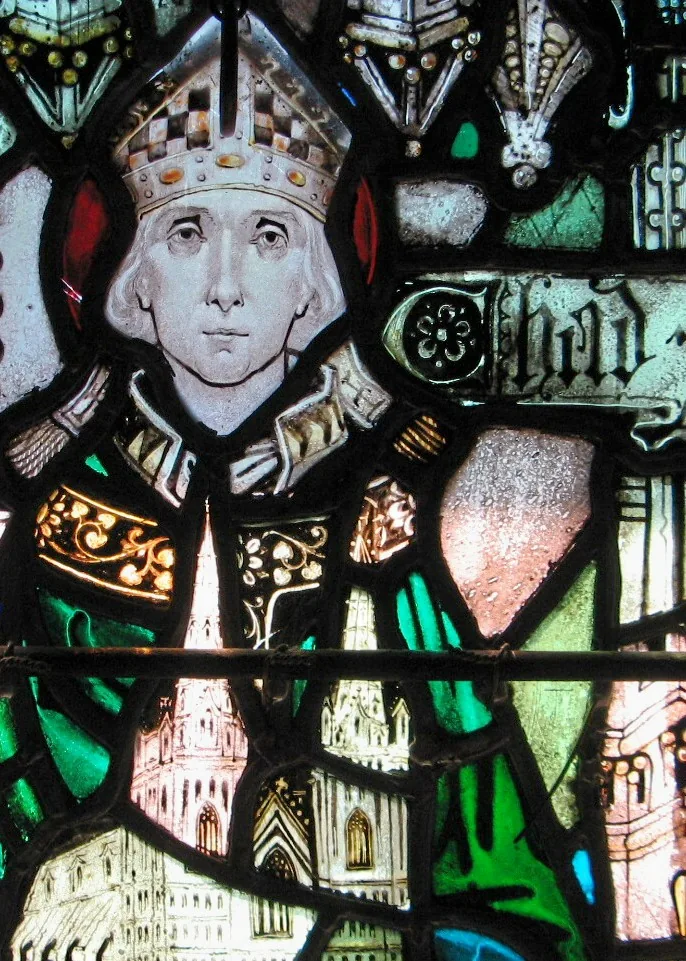
Chad is shown as a bishop, with miter and crozier, often holding a model of a church, the sign of his work as founder of the Church of Lichfield. He appears in this way in many stained glass windows in England and elsewhere.
Where to pray to Saint Chad
- Birmingham (England): Saint Chad's Catholic Cathedral, which keeps his relics.
- Lichfield (Staffordshire): the cathedral, seat of his diocese and site of his former tomb.
- Lastingham (Yorkshire): the monastery where he succeeded his brother Cedd.
- Wishaw (Warwickshire): the Church of Saint Chad.
To pray with him, Saintspedia offers a prayer to Saint Chad and a novena to Saint Chad ending on March 2.
Discover also
- Saint Cedd, his brother, abbot of Lastingham and missionary.
- Saint Aidan of Lindisfarne, whose mission formed him.
- Saint Theodore of Tarsus, the archbishop who sent him to Lichfield.
- Saint Wilfrid, the other bishop appointed to York.
- Saint Bede the Venerable, who tells his story.