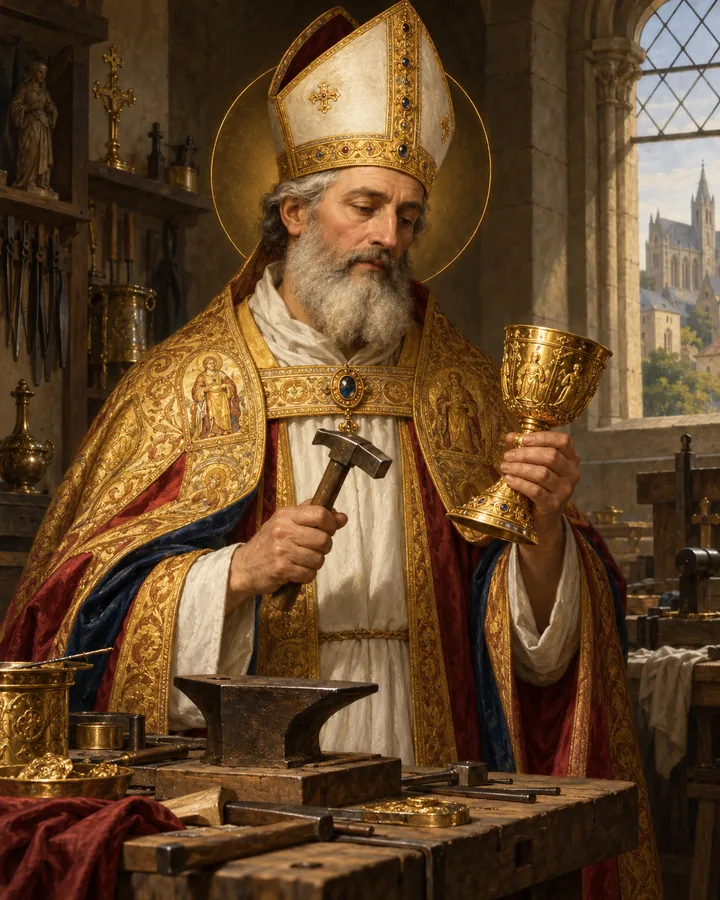
Saint Eligius, known in French as Saint Éloi, is one of the most popular saints of Merovingian France. A goldsmith of exceptional talent from the region of Limoges, he became adviser and treasurer to King Dagobert I, then, after a deep conversion, bishop of Noyon and Tournai, where he evangelized the lands of the north. Generous toward the poor, he spent his fortune buying the freedom of slaves and founding monasteries. He died on December 1, 660, his feast day, and remains the patron saint of goldsmiths, blacksmiths and all who work with metal.
Who was Saint Eligius?
Eligius was born around 588 at Chaptelat, near Limoges, into a Christian Gallo-Roman family. His father, Eucherius, noticed his skillful hands very early and apprenticed him to Abbo, a goldsmith who ran the mint of Limoges. There the young man learned to work gold, silver and precious stones, and to strike coins.
He then went to Neustria, in northern Gaul, and entered the service of Bobbo, treasurer of King Clothar II. The king was looking for a craftsman who could make him a ceremonial throne adorned with gold and jewels. According to his Life, Eligius received enough gold for one throne and made two, keeping nothing for himself. Struck by his talent and his honesty, Clothar took him into his service. His son Dagobert would make him one of his closest advisers.

Goldsmith to King Dagobert
At Dagobert's court, Eligius held a leading place. He directed the minting of coins, and several coins of the period still bear his name. He made many precious objects for the king and for churches: according to his Life, he adorned with precious metal the tombs of several venerated saints, among them Saint Denis near Paris and Saint Martin in Tours. Almost none of these works has survived, but the goldsmith's reputation has remained intact through the centuries.
The king also entrusted him with political missions: in 636 Eligius led the embassy that brought the Breton king Judicael to make peace with the Franks. With his friends Ouen, the king's referendary, and Desiderius, the future bishop of Cahors, he formed at court a group of fervent laymen, nearly all of whom became bishops. The French folk song about "good King Dagobert," composed much later, kept the memory of this wise adviser, presenting him with humor.
A layman in the service of the poor
Rich and influential, Eligius nevertheless led a life of prayer and penance. He wore a hair shirt under his fine clothes, welcomed the poor to his table and gave generously from his wealth.
His great work of charity was the ransom of captives. At a time when prisoners of war were sold as slaves, he bought back a great number of them, especially Saxons, set them free and left them the choice of returning home or staying with him.
He obtained from Dagobert an estate at Solignac, near Limoges, and in 632 founded there a monastery following the customs of Saint Columban and Saint Benedict. In Paris, he turned a house received from the king into a monastery for women, under the guidance of Saint Aurea.

Bishop of Noyon and missionary
After Dagobert's death, Eligius left the court. In 641 he was chosen for the see of Noyon and Tournai, the former diocese of Saint Medard. This vast territory stretched to the North Sea, through regions that were still largely pagan. For nearly twenty years the bishop traveled across Flanders, preaching, baptizing and founding churches and monasteries, undeterred by the hostility he sometimes met. His Life also credits him with discovering the relics of Saint Quentin.
He died at Noyon on December 1, 660. His Life, attributed to his friend Saint Ouen and reworked in the Carolingian period, tells that Queen Bathilde wanted to have his body taken to the abbey of Chelles, but it proved impossible to move: he was buried at Noyon, where his cult developed at once.
Why is Saint Eligius the patron saint of goldsmiths and blacksmiths?
As a trained goldsmith and master of the royal mint, Eligius naturally became the patron of goldsmiths, silversmiths and coin makers. Popular traditions, such as the story of a horse he is said to have shod in a miraculous way, made him the saint of blacksmiths and farriers as well, and by extension of all metalworkers.
For centuries, goldsmiths, blacksmiths, farriers, locksmiths and wheelwrights celebrated their patron on December 1, often with a Mass, a blessing of tools or horses and a shared meal. In many parts of France and Belgium, "Saint Éloi's day" is still the feast of the metal trades. In the English-speaking world, the British Army's Royal Electrical and Mechanical Engineers also honor him as their patron.
Saint Eligius shows that work done with one's hands, with skill and honesty, can become a path to holiness. A craftsman and then a man of power, he never confused wealth with worth: he placed both at the service of the poor and of captives. He is prayed to for craftsmen, metalworkers, all workers and those with economic responsibilities.
Symbols and how to recognize Saint Eligius in art
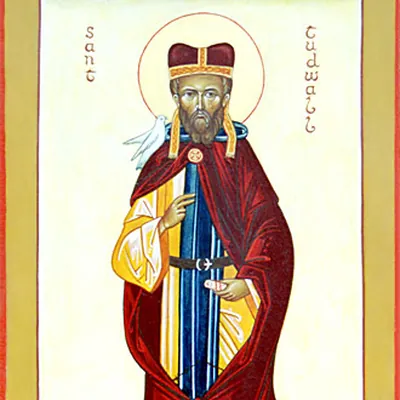
- Bishop's vestments, with miter and crosier, often combined with the tools of his trade.
- A goldsmith's hammer, an anvil or tongs, recalling his craft.
- A chalice or a precious object he is working on, in his goldsmith's workshop.
- A horse's leg or a horseshoe, from the legend of the miraculous shoeing.

To pray with him, read the prayer to Saint Eligius, or follow the novena to Saint Eligius from November 22 to 30, the eve of his feast.
Where to pray to Saint Eligius
- Noyon (Oise, France): the Cathedral of Notre-Dame, seat of his episcopate.
- Solignac (Haute-Vienne): the Romanesque abbey church, on the site of the abbey he founded in 632.
- Chaptelat (Haute-Vienne): his native village, which keeps his memory.
- Dunkirk: the Church of Saint-Éloi, a reminder of his missionary work in the north.
Discover also
- Saint Medard, his predecessor in the see of Noyon and Tournai.
- Saint Martin of Tours, whose tomb he adorned according to his Life.
- Saint Genevieve, patroness of Paris, where he lived for many years.
- Saint Clotilde, queen of the Franks, a figure of the first Merovingian dynasty.
- Saint Gregory of Tours, historian of the Merovingian kings a generation earlier.