Saint Wilfrid, or Wilfrith, was a seventh-century Anglo-Saxon bishop, one of the strongest and most debated figures of the young Church in England. Born in Northumbria around 633 and trained at Lindisfarne, Lyon and Rome, he won the day for Roman customs at the Synod of Whitby in 664, became bishop of York, founded the monasteries of Ripon and Hexham, and evangelized Sussex during one of his exiles. He died in 709 or 710. His feast day is April 24 and, in England, October 12.
Who was Saint Wilfrid?
Wilfrid was a man of contrasts. His contemporaries describe him as an ambitious prelate with a lavish lifestyle, surrounded by a large retinue and often in conflict with kings and bishops. But they also show him tireless in the service of the Church: a builder, a missionary and an educator, so attached to unity with Rome that he made the journey there three times to defend his cause. He spent much of his time as a bishop in exile, without ever giving up.
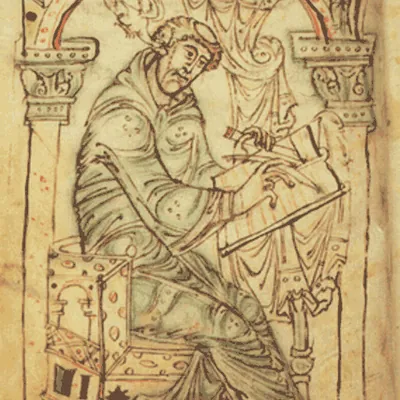
We know him from two sources. The first is his Life, written shortly after his death by Stephen, a monk of Ripon, at the request of his disciples: it is a work of praise, but very rich in detail. The second is the Ecclesiastical History of Saint Bede the Venerable, which is more reserved about him.
Lindisfarne, Lyon and Rome
At fourteen, after a quarrel with his stepmother, Wilfrid left his father's house and presented himself at the court of King Oswiu. Queen Eanflæd took him under her protection and sent him to study at the monastery of Lindisfarne, founded shortly before by Saint Aidan. There he received the formation of the Irish monks.
But Wilfrid dreamed of Rome. Around 653 he set out with Benedict Biscop: they were the first Anglo-Saxons known to make this pilgrimage. In Lyon, Bishop Annemund wanted him to marry his niece and take up an office; Wilfrid refused and continued his journey. In Rome he learned the Roman method of calculating the date of Easter and discovered the veneration of relics.
Back in Lyon, he observed the Frankish monasteries inspired by Saint Columbanus and by the Rule of Saint Benedict. He would bring back to England stonemasons, liturgical customs and a high idea of the Roman Church.
The Synod of Whitby
Returning around 658, Wilfrid received the monastery of Ripon from Prince Alhfrith, and there he imposed Roman customs and the Benedictine Rule. In 664 King Oswiu gathered a synod at Whitby, at the monastery of Abbess Hilda, to settle a question that divided his own court: the date of Easter. The monks trained at Iona followed an older calculation, different from that of Rome.
Wilfrid spoke for the Roman party and, according to Bede, his speech carried the king's decision: Northumbria aligned itself with Rome. Wilfrid became the dominant figure of the Church in the North and was chosen as bishop.
Bishop and builder
Doubting the validity of ordinations performed in England, Wilfrid had himself consecrated in Gaul, at Compiègne. His return was delayed, and on his arrival he found Saint Chad installed in his see, so he withdrew to Ripon. In 669 Archbishop Theodore of Tarsus restored him to York.
Nine years of intense activity followed. He restored the cathedral of York, founded the monastery of Hexham on land given by Queen Æthelthryth (Saint Etheldreda), created schools and brought a choirmaster from Kent to introduce Roman liturgical chant. His stone churches, built by masons from Gaul, impressed his contemporaries; the crypts of Ripon and Hexham are their surviving remains.
Exiles and mission
In 678, having fallen out with King Ecgfrith, who blamed him in particular for encouraging the queen to enter a monastery, Wilfrid was driven out. Archbishop Theodore divided his huge diocese. Wilfrid appealed to the pope. On the way, he spent the winter among the Frisians and preached the Gospel to them, opening the way for Saint Willibrord. King Dagobert II offered him the bishopric of Strasbourg, which he refused. In Rome, Pope Agatho ordered his restoration, but the king of Northumbria had him imprisoned and then expelled him again.
Wilfrid then took refuge in Sussex, the last Anglo-Saxon kingdom still pagan. For five years he preached there, and Bede reports that he won the trust of the people by teaching them to fish in the sea, after a terrible famine. He founded the monastery of Selsey, the origin of the later diocese of Chichester.
Recalled in 686, he was driven out again in 692, spent years in Mercia, and went to Rome a third time, where Pope Sergius I supported him. In 706, reconciled, he recovered Ripon and Hexham. He died at Oundle in 709 or 710 and was buried at Ripon.
Why is Saint Wilfrid the patron saint of Ripon and Middlesbrough?
Ripon was Wilfrid's first monastery and the place he chose for his burial. The town has honored him ever since, and his crypt still lies beneath its cathedral. The Catholic Diocese of Middlesbrough, in the north of England, also has him as its patron, honoring the great bishop of the Northumbrian Church in the region where he lived and worked.
Wilfrid is not an easy saint. His uncompromising character made him many enemies. But he put that energy at the service of the Church's unity with Rome, the beauty of the liturgy, education and mission, and his exiles became opportunities to proclaim the Gospel. You can pray to him for those who are unjustly pushed aside, for church builders and for those who carry a difficult temperament they wish to place at God's service.
Symbols and how to recognize Saint Wilfrid in art
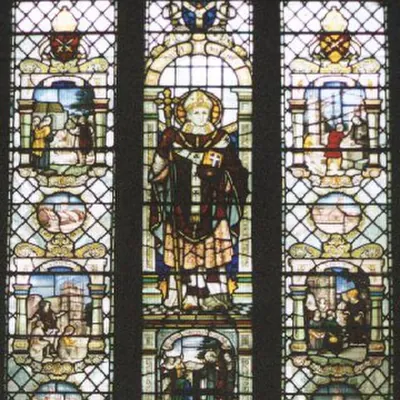
Saint Wilfrid is shown as a bishop, with miter and crosier. Stained glass windows, such as the one in Chichester Cathedral, often show him preaching or baptizing the people of Sussex. A fishing net or fish can recall Bede's story of how he taught the South Saxons to fish, and a model of a church his work as a builder at Ripon and Hexham.
Where to pray to Saint Wilfrid
- Ripon (North Yorkshire): the crypt of Saint Wilfrid, beneath the cathedral.
- Hexham (Northumberland): the Anglo-Saxon crypt of the abbey he founded.
- Chichester (West Sussex): the cathedral, heir to the see of Selsey.
- Middlesbrough: the Catholic diocese of which he is patron.
To pray with him, use the prayer to Saint Wilfrid or the novena to Saint Wilfrid.
Discover also
- Saint Benedict Biscop, his traveling companion to Rome.
- Saint Hilda of Whitby, host of the Synod of Whitby.
- Saint Chad, installed for a time in his see of York.
- Saint Theodore of Tarsus, archbishop of Canterbury.
- Saint Willibrord, a monk of Ripon who became apostle of the Frisians.