Saint Dymphna is a young martyr venerated since the Middle Ages in Geel, Belgium, in the province of Antwerp. According to tradition, she was the daughter of a 7th-century Irish king and was killed by her own father after fleeing his incestuous desire. Her story rests on a late legend, but her cult gave birth to something unique: the care of people with mental illness in the families of Geel, a practice that continues today. Patron saint of those who suffer from mental illness, anxiety and depression, she is celebrated on May 15.
Who was Saint Dymphna?
What we know for certain about Saint Dymphna can be said in a few words: in the 13th century, the relics of a young virgin martyr named Dymphna and of a priest named Gerebernus were venerated at Geel. The account of her life was written around the middle of the 13th century by a canon of Cambrai named Peter, at the request of the bishop of Cambrai, from the traditions kept on the spot.
Historians therefore regard the life of Dymphna as a legend, some of whose elements appear in other medieval stories. That takes nothing away from the reality of her very ancient cult, nor from the strength of what it produced: a tradition of care and hospitality toward people with mental illness that is still cited as an example throughout the world.

The legend of Saint Dymphna
According to the legend, Dymphna was the daughter of a pagan king of Ireland and of a Christian mother, both beautiful and devout. She was secretly baptized and consecrated her life to God. Her mother died while she was still a teenager. The grieving king looked for a new wife who resembled the one he had lost. His advisers finally pointed out that only his daughter resembled her, and the king resolved to marry her.
Horrified, Dymphna fled with her confessor, the elderly priest Gerebernus, and a few servants. They crossed the sea and settled near Geel, in Brabant, where they lived in prayer and in the service of the poor. But the king tracked them down, according to the story thanks to Irish coins the fugitives had used. His soldiers killed Gerebernus. Dymphna still refused to give in, and her father beheaded her with his own hand. She was about fifteen years old.
The relics and the first healings
According to tradition, the people of Geel buried the two martyrs where they fell. Later their bodies were found in two stone coffins. Healings of people who were "possessed" or "out of their minds," as people said then, were attributed to Dymphna's intercession. The relics of Gerebernus were taken to Germany and are venerated at Sonsbeck, in the Rhineland, while those of Dymphna remained at Geel.
Geel, the town that welcomes the mentally ill
From the Middle Ages, people with mental illness and their families came from far away to Geel to pray to Saint Dymphna. They followed a novena, nine days of prayer, in the church, and a sickroom was built against the shrine. Soon there was not enough room. The people of Geel began to take the sick into their own homes and farms for the length of their stay, and sometimes for years.
This custom, born of faith and charity, became a true system of care. In the 19th century the Belgian state supervised it, with doctors and a hospital. Today families in Geel still welcome people living with mental illness, who share their daily life and take part in the life of the town. Psychiatrists from all over the world come to study this model of community care.

Why is Saint Dymphna the patron saint of mental illness?
The healings attributed to her intercession and the welcome given to the sick in Geel made Saint Dymphna the patron saint of people with mental illness, nervous disorders, anxiety and depression, as well as of their families and caregivers. Because of her story, she is also invoked by victims of incest and family abuse, and against epilepsy. In the English-speaking world, many Catholics turn to her today for mental health, and her name is given to chapels and programs in Catholic hospitals.
Symbols and how to recognize Saint Dymphna in art
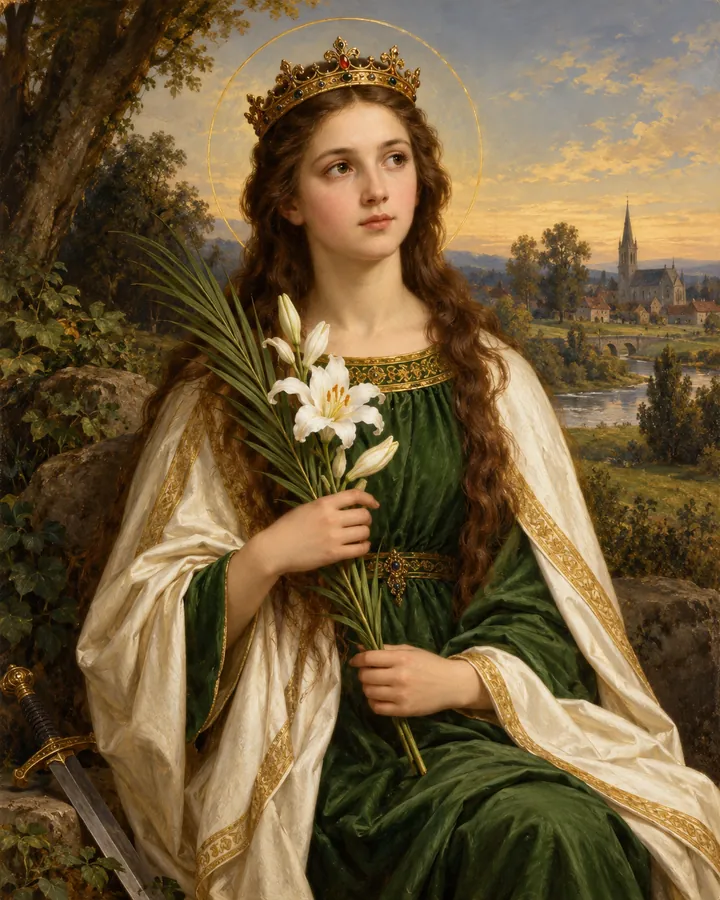
Saint Dymphna is shown as a young crowned princess, often holding a sword, the instrument of her martyrdom, and a lamp. She is sometimes depicted with a chained demon at her feet, a symbol of the afflictions from which she frees the sick. The paintings in Geel also tell of her flight with Gerebernus and her death.
Where to pray to Saint Dymphna
The heart of her cult is the Church of Saint Dymphna in Geel, Belgium, where her relics are venerated and the old sickroom can still be seen. In the United States, the National Shrine of Saint Dymphna in Massillon, Ohio, founded in 1939 near a state psychiatric hospital, receives prayer requests from all over the world.
Praying to Saint Dymphna
Catholics pray to Saint Dymphna for people living with mental illness, anxiety or depression, for their loved ones, and for caregivers. Read the prayer to Saint Dymphna and pray the novena to Saint Dymphna, beginning on May 6. Prayer does not replace medical care: it goes hand in hand with it.
Discover also
Other saints are invoked for the sick and those who care for them, like Saint John of God, patron of hospitals, who was himself once locked up as a madman, and Saint Benedict Joseph Labre. Like Dymphna, Saint Agnes was a very young martyr. For Ireland, discover also Saint Patrick.